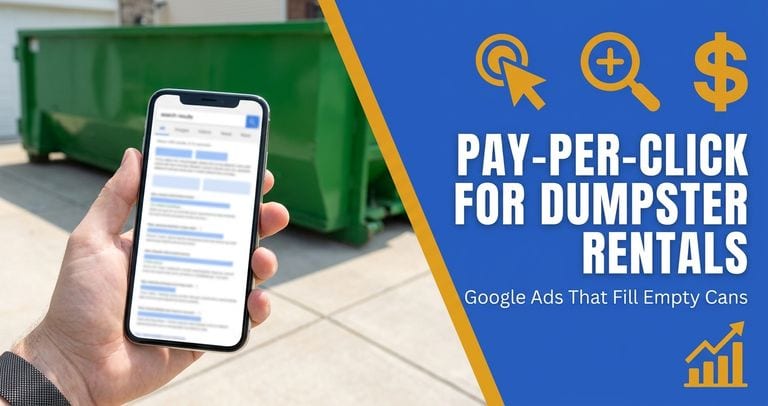
Pay-Per-Click Can Fill Empty Cans Fast, Or Burn Through A Budget Before Lunch
You already run a real dumpster rental company. You know the feeling of looking out at the yard on a Tuesday and counting cans that should be on driveways.
Pay-per-click ads on Google are the fastest way to put your number in front of people searching for a dumpster right now. Turn a campaign on in the morning and the phone can ring that afternoon.
They are also the fastest way to waste money. Clicks from people looking for a dumpster to buy, a job driving a roll-off truck or a place to dump a couch for free cost the same as clicks from people ready to rent.
This guide is written for the owner who already has trucks and cans and wants to know whether pay-per-click is worth it, and how to run it so the clicks turn into rentals. Owner to owner, with worked examples you can redo with your own numbers.
We will cover how Google's search ads work, how to pick the searches you pay for and the ones you block, how to write ads people click, where to send them, how to set a budget, how to know what is working and the mistakes that waste the most money.
How Google Search Ads Work For A Hauler
When someone searches on Google, ads show up above and below the regular results. You choose the searches you want to show up for, the area you serve and how much you are willing to pay for a click. Google runs an auction every time someone searches, and the ads that win depend on your bid and on how relevant and useful Google thinks your ad and page are.
You pay only when someone clicks, or taps your phone number in a call ad. That is the "pay-per-click" part. You can set a daily budget so you never spend more than you planned.
The big advantage for dumpster rental is timing. People search for dumpsters when they need one, often for this week. A search ad reaches them at exactly that moment, which is something few other kinds of advertising can do.
Key takeaway: Search ads put you in front of people at the moment they need a dumpster. Whether they make money depends on three things: paying only for the right searches, sending clicks to a page that makes booking easy, and tracking which clicks turn into rentals.
Choose The Searches You Pay For
The searches you bid on, called keywords, decide who sees your ads. Pick searches that show the person wants to rent a dumpster in your area soon.
Searches Worth Paying For
- "dumpster rental near me" and "dumpster rental [your town]"
- "roll off dumpster rental" and "roll off container rental"
- Size searches like "20 yard dumpster rental" or "10 yard dumpster"
- Job searches like "roofing dumpster rental", "construction dumpster rental" or "dumpster for garage cleanout"
- Urgent searches like "same day dumpster rental"
Searches To Block
Negative keywords stop your ads from showing on searches you do not want. Block these from day one and add more every week as you see what people actually searched:
- "jobs", "driver", "CDL", "hiring" (people looking for work)
- "for sale", "buy", "used" (people buying a dumpster, not renting)
- "free", "landfill hours", "dump near me" (people looking to haul their own trash)
- Brand names of big national companies, unless you have a reason to show up for them
- Towns outside your service area
Match Types In Plain English
Google lets you choose how closely a search must match your keyword. Broad settings show your ad on loosely related searches, which can waste money for a local business. Tighter settings, like phrase and exact match, keep you closer to the searches you chose. Most local haulers do better starting tight and loosening only once they see what works.
Write Ads People Want To Click
Your ad has a few lines to convince someone you are the right company. Use them on what dumpster customers care about:
- Your town. "Dumpster Rental in [Town]" tells them you are local.
- Speed. "Same-Day and Next-Day Drops" if you offer it.
- Clear pricing. "Flat Rates, Weight Included" if that is how you price.
- Proof. Your review count and star rating, if they are strong.
- The sizes you have. "10 to 40 Yard Roll-Offs".
Add your phone number as a call extension so people on phones can call straight from the ad. Add links to your size pages and your contractor page so people can jump to what they need.
Write a few versions and let Google show them. After a few weeks, keep the ones that bring calls and replace the ones that do not.
Send Clicks To A Page That Books Rentals
The ad gets the click. The page decides whether you get the rental. Sending paid clicks to a homepage that makes people hunt for sizes and prices wastes a lot of them.
The page a click lands on should match the search. Someone who searched "20 yard dumpster rental" should land on a page about your 20 yard: what fits, what is included, the price or starting price and how to book. Someone who searched "roofing dumpster" should land on a page about roofing jobs.
Every landing page needs:
- Your phone number at the top, tap-to-call on phones
- A short form: name, phone, address, size and date
- What is included and what costs extra
- Real photos of your cans and trucks, and your reviews
- Fast loading on a phone
We go through each of these in our guide to websites for dumpster rental companies. A strong page often does more for your results than any change to the ads.
Set A Budget That Matches Your Fleet
Your budget should match how many rentals you want from ads, not a number someone picked. Start from your own numbers.
A Worked Example With Round Numbers
Here is a worked example with round numbers. Use your own.
| Step | Number |
|---|---|
| Extra rentals you want from ads each month | 20 |
| Calls and forms it takes to book one rental (you book 1 in 2) | 2 |
| Calls and forms needed | 40 |
| Clicks it takes to get one call or form (1 in 8) | 8 |
| Clicks needed | 320 |
| Average cost per click | $6 |
| Monthly budget | $1,920 |
| Ad cost per booked rental | $96 |
If each rental makes you $150 after disposal and drive time, that campaign pays. If each rental only makes $80, it loses money, and you either need better pages, a higher booking rate, cheaper clicks or better prices. Click costs vary a lot by market and season, so plug in what you actually see in your account.
Turn It Up And Down With Your Yard
One of the best things about pay-per-click is that you control it daily. Raise the budget when cans are sitting idle and lower it when the fleet is out. Many haulers spend more in spring and early summer and pull back in winter.
Run Ads When You Can Answer
You can schedule ads for certain hours. If nobody answers the phone after six, consider lowering bids or turning off call ads in the evening, so you are not paying for calls that go to voicemail.
Track Clicks All The Way To Rentals
Google will tell you how many clicks you got. It cannot tell you which ones booked a rental unless you set that up.
- Count calls and forms as conversions in your ad account, so Google knows what a good click looks like.
- Use a tracked phone number on ads and landing pages so you know which calls came from ads. Call tracking also lets you listen back and hear why callers did or did not book.
- Match calls to rentals. Once a month, compare ad calls to booked rentals. That gives you the real cost per rental.
- Read the search terms report every week. It shows what people actually searched before clicking, which is where you find new negative keywords.
The Mistakes That Waste The Most Money
No Negative Keywords
Without them, you pay for job seekers, people buying used dumpsters and people looking for the landfill.
Targeting Too Wide An Area
Clicks from towns you do not serve, or serve at a loss, are wasted. Set your area to where you actually want to drop cans.
Sending Everyone To The Homepage
Make the page match the search. A size or job page books more than a general homepage.
Letting Ad Calls Go To Voicemail
Paying for a click and then missing the call is the most expensive mistake in pay-per-click. Answer live or text back fast.
Judging By Clicks Instead Of Rentals
Lots of cheap clicks that never book are worse than fewer clicks that do. Measure cost per booked rental.
Set It And Forget It
Accounts drift. Check search terms, ads and budget every week, even if only for fifteen minutes.
Other Ad Types Worth Knowing About
Search ads are the main event for dumpster rental, but a few other options come up often.
Call Ads
Call ads show a phone number and a call button instead of a link to your site. They work well for people on phones who want to talk to someone right away. They only make sense when someone is there to answer.
Google's Automated Campaigns
Google offers campaigns that spread your ads across search, maps, YouTube and other sites automatically. They can work, but they give you less control over where the money goes. For a local hauler with a limited budget, most owners do better starting with plain search ads they can see and trim, and testing automated campaigns later.
Remarketing
Remarketing shows ads to people who already visited your website, on other sites and on Facebook and Instagram. It is useful for reminding contractors and homeowners who looked but did not book. Keep it a small share of your budget.
Facebook And Instagram Ads
Social ads reach people before they search, which makes them better for building awareness with contractors and property managers than for catching someone who needs a can today. They can work, but they are a different tool than search ads.
Run It Yourself Or Hire Help?
Plenty of owners run their own Google Ads, especially with a small budget and a short list of keywords. If you do, block time every week to read the search terms, add negatives, check your calls and adjust the budget.
If you hire someone, ask how they will report results. You want calls and booked rentals, not just clicks and impressions. Make sure the ad account is in your name, so your history and data stay with you if you ever switch. And make sure they block the wrong searches from day one.
Pay-Per-Click Works Best With The Rest Of Your Marketing
Ads stop the moment you stop paying. Your Google Business Profile, your reviews and your website keep working every day. The haulers who get the most out of pay-per-click usually have the rest in place first: a profile full of real photos and recent reviews, and a website that answers questions and makes booking easy.
Think of ads as the way to fill gaps, like a slow month, a new town you just started serving or a new can size you want to push. Let your website and reviews carry the steady work.
How Home Service Direct Helps Dumpster Rental Companies
We build websites for dumpster rental companies with a page for every size, service and town, tap-to-call on every page and a short request form, so whether a customer finds you through an ad, Google Maps or a referral, the page is ready to book them. We also send a Google review request after every rental, which helps both your ads and your map listing look more trustworthy.
Calls from your own site are yours alone, with no per-lead fees. Read more about getting dumpster rental calls of your own, or see how ads fit into the bigger picture of marketing a dumpster rental company.
Frequently Asked Questions
Is pay-per-click worth it for a dumpster rental company?
It can be, because people search for dumpsters when they need one now. It pays when you block the wrong searches, send clicks to pages that make booking easy, answer every call and track cost per booked rental.
How much should I spend on Google Ads?
Work backward from how many rentals you want, your booking rate and what clicks cost in your market. Start with a budget you can afford to test for a month, then raise it on the campaigns that book rentals at a profit.
What keywords should I avoid?
Searches about jobs and drivers, buying dumpsters, free dumping and landfill hours, and towns you do not serve. Check the search terms report every week and keep adding to the list.
Should my ads go to my homepage?
Usually not. Send each ad to the page that matches what was searched, like a page for that size or that kind of job, with the phone number and request form easy to find.
How fast will ads bring in calls?
Often within days once the campaign is approved and running. Making them profitable takes a few weeks of trimming searches, testing ads and improving the landing page.
Do I still need a good website if I run ads?
Yes. The ad only gets the click. A page that answers questions and makes booking easy is what turns the click into a rental.