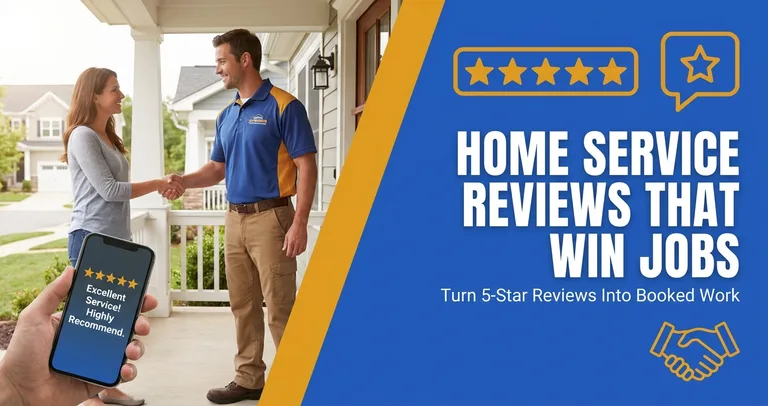
Why Home Service Reviews Drive Booked Jobs (Not Just Vanity)
You already know reviews are nice to have. What you probably have not priced out is how much money a thin review profile is costing you every month. When a homeowner is comparing three contractors for a roof, a panel upgrade, or a tree they need gone, they are not reading your About page. They are looking at two things: how many reviews you have and what the recent ones say. If the company two streets over has 240 reviews and you have 31, you lose jobs you never even got a shot at, and it never shows up on a report.
Here is the part that hits your margins. Online reviews for contractors do two jobs at once. They raise your conversion rate, so more of the people who find you actually call, and they lower your effective cost per lead, because trust does work your ad budget would otherwise have to pay for. An established company running Google Ads or Local Services Ads at real volume can watch its cost per booked job drop just by getting its review count and rating into a competitive range. Same clicks, same spend, more booked jobs, because fewer people bounce to a more-reviewed competitor.
This is owner-to-owner. We will cover why home service reviews move the needle, a repeatable system to ask at the right moment, the exact text and email to use, how to handle the bad ones, where Google fits versus everything else, and how to turn a strong review profile into more phone calls. The companies that win the review game are not the ones with the best service. They are the ones who built a system to ask, every job, without fail.
Reviews, Trust, and Maps Ranking: The Three Ways They Make You Money
It helps to separate the three distinct ways home service reviews put money in your account, because each one is a different lever.
1. Trust at the moment of decision. A homeowner about to spend $4,000 to $40,000 on their house is nervous. They have heard the contractor horror stories. A wall of recent, specific reviews is the single fastest way to calm that nerve. It is the difference between a quote request and a price-shopper who ghosts you.
2. Google Maps and Local Pack ranking. Google decides who shows up in the Map Pack, the three businesses that appear above the regular results, using relevance, distance, and prominence. Review count, rating, and how fresh and steady your reviews are all feed prominence. A company adding reviews every week signals an active, trusted business. A company with 18 reviews and nothing new in two years signals the opposite. When you climb into that top three, you get found by people who never typed your name.
3. Conversion rate on traffic you already pay for. This is the one most owners miss. Every dollar you spend on ads, your website, and your trucks drives people to a decision point. Your review profile is what they check before they pull the trigger. Improve it and you convert more of the exact same traffic. You do not need more leads to book more jobs, you need to stop leaking the ones you already have.
Put those together and you see why reviews are not a marketing nice-to-have. They are a profit lever that touches lead cost, close rate, and how often you get found for free.
How to Get More Reviews for Your Home Service Business: Build a System, Not a Habit
Here is the honest truth about why your review count is stuck. It is not that customers are unhappy. It is that asking is left up to memory, and memory loses to a busy day every time. Your tech finishes the job, the homeowner is thrilled, everyone shakes hands, and nobody asks. The fix is to make the ask a step in the job, not a thing people remember to do.
A working review system has four parts:
- A trigger. One specific moment that fires the request every time. The best trigger is the job being marked complete or the invoice being paid in your CRM or field software. No human has to remember anything.
- A channel. Text first, email as backup. Texts get opened in minutes. Email gets opened eventually, if at all. Most of your reviews will come from the text.
- A direct link. Send people straight to your Google review form, not your homepage. Every extra tap loses people. Grab your Google review link from your Business Profile and use it everywhere.
- A fallback. If they do not respond to the text in two or three days, the email goes out. That second touch alone can double your response rate.
Set a simple target. If you close 60 jobs a month and even 25 percent leave a review, that is 15 a month, 180 a year. Most of your local competitors are getting a handful a year by accident. A system at any real volume buries them inside of twelve months.
If wiring this into your software and follow-ups is not something you want to babysit, this is exactly the kind of thing we set up as part of local SEO that builds your review profile, so the asks fire automatically and the reviews land on the platforms that actually move your ranking.
The Right Moment to Ask (And the Exact Words to Use)
Timing is most of the game. Ask too early and the job is not done. Ask too late and the emotion is gone. For most home service work, the sweet spot is the same day the job is finished, ideally within a couple hours of your crew pulling out, while the relief and the fresh result are still front of mind.
Just as important is who asks. A review request that comes right after the tech says it in person converts far better than a cold automated text on its own. Train your crew to plant the seed: "If you were happy with how today went, you will get a quick text from us with a link, it would mean a lot if you left us a few words." Then the automated text shows up and finishes the job. Personal ask plus automated link beats either one alone.
Text template
"Hi [Name], thanks for trusting [Company] with your [job] today. If we earned it, a quick Google review really helps a small local crew like ours. Takes 30 seconds: [link]"
Email follow-up template
"Hi [Name], it was a pleasure handling your [job] this week. Reviews are how homeowners around [city] find us and decide who to trust, so if you have a minute, we would be grateful if you shared your experience here: [link]. Thank you, the team at [Company]."
Two rules. Keep it short, because long requests get ignored. And never offer money, a discount, or anything of value for a review. Google and the FTC both prohibit it, and it can get your reviews scrubbed or your profile flagged. You are asking for a favor, not buying a transaction.
Handling Negative Reviews Without Losing Sleep or Customers
Every established company gets bad reviews. Run enough jobs and the math guarantees it. The owners who panic and the owners who handle it calmly end up in very different places, and the difference is almost entirely in the response, not the review.
First, the counterintuitive part: a few negative reviews actually help you. A perfect 5.0 with 300 reviews reads as fake to a sharp homeowner. A 4.7 or 4.8 with a handful of ones and twos that you answered like a professional reads as real, and real wins trust. So do not chase a flawless rating, chase a real one with great responses.
When a bad one lands, work the playbook:
- Respond within 24 to 48 hours. Future customers are reading your reply far more than the complaint itself. Your response is the actual content.
- Stay calm and own your part. No defensiveness, no arguing, no dumping the customer's private details. "We are sorry this fell short of our standard" beats a paragraph explaining why they are wrong, every time.
- Take it offline. Give a name and a number and offer to make it right. "Please call me directly at [number], I want to fix this. - [Owner name]." That single line tells every future reader you are an owner who stands behind the work.
- Fix it if you can, then ask for an update. If you genuinely resolve the issue, it is fair to ask the customer to update their review. Many will.
For a review that is fake, from a competitor, or from someone who was never a customer, flag it to Google for removal. That can take a while and does not always work, so your best protection is volume. When you are adding fresh reviews every week, one bad one sinks down the page and barely dents your average. A steady stream of new reviews is the best insurance policy you can buy against a bad day.
Google vs Other Platforms: Where to Point Your Energy
You only have so much attention, so put it where the returns are. For nearly every home service company, the priority order is clear.
Google reviews come first, and it is not close. Google reviews on your Business Profile feed your Map Pack ranking, show up right next to your ads, and are the first thing most homeowners see when they search. If you do nothing else, build your Google reviews. This is where get more reviews for your home service business turns directly into more calls.
After Google, weigh the rest by your trade and your area:
- Facebook. Worth it if your local market is active there. Recommendations get shared and seen by neighbors, which is real word of mouth.
- Yelp. Matters more in some metros and trades than others. Be aware Yelp aggressively filters reviews and pushes paid ads, so do not pour your energy here unless your market rewards it.
- Angi, HomeAdvisor, BBB, and trade-specific sites. Useful as supporting trust signals, especially if you already get leads through them, but secondary to Google.
One smart move: keep a couple of strong reviews flowing to your second platform too, so you are not a ghost there if a homeowner checks. But do not split your ask. Send everyone to Google by default, and only route the occasional customer elsewhere. A spread-thin profile across six sites with eight reviews each loses to a deep Google profile with 200. Concentrate your fire.
Turning a Strong Review Profile Into More Phone Calls
Collecting reviews is half the job. The other half is putting them to work everywhere a customer makes a decision, so they pull weight instead of sitting on one page nobody visits.
- Put your rating and review count on your website above the fold. "4.9 stars, 200+ reviews" near your phone number and quote button lifts conversion on every visitor you already pay to get there.
- Pull real review quotes onto your service and city pages. Specific quotes that name the city and the job build trust and feed your local SEO at the same time.
- Use reviews in your ads. Star ratings in Google Ads and quotes in Facebook ads raise click-through and lower your cost per click. Better ad performance from the assets you already collected for nothing.
- Respond to every positive review with keywords. A reply like "Thanks for trusting us with your storm damage repair in [city]" gives Google more relevance signals tied to your service and area.
- Share standout reviews on your Google Business Profile and social. Free, ongoing proof that keeps your profile active, which Google rewards.
Done right, your reviews stop being a number you check and become a sales tool working across your site, your ads, your Map Pack listing, and your social, all at once. That is the compounding part. The review you earn today keeps closing jobs for years.
If you would rather have all of this built and run for you, the asking system, the response handling, the website and ad integration, and the local ranking it drives, that is the core of our done-for-you marketing for established home service companies. You keep running crews, we keep the reviews and the booked jobs coming.
Frequently Asked Questions
How many Google reviews does my home service business actually need?
Enough to beat the competitors you show up next to in your market, not a fixed number. Search your main service plus your city, look at who ranks in the Map Pack, and note their review counts. Your target is to pass them and keep going. In a competitive metro that often means a few hundred reviews and a steady stream of new ones. The freshness matters as much as the total, so a business adding reviews every week often outranks one with a higher count that went quiet.
Can I offer a discount or gift card for leaving a review?
No. Google's policies and FTC rules both prohibit incentivized reviews, and it can get your reviews removed or your profile penalized. You can and should ask every customer directly, make it effortless with a one-tap link, and have your crew mention it in person. That is fully allowed and it works better than a bribe anyway, because honest reviews from happy customers read as genuine.
What is the fastest way to get more reviews for my home service business?
Automate the ask so it fires on every completed job. Trigger a text the same day the work is finished, with a direct link straight to your Google review form, and have the tech mention it in person before they leave. Add an email follow-up two or three days later for anyone who did not respond. That combination, done on every job without relying on anyone's memory, will out-collect any competitor running on good intentions inside of a few months.