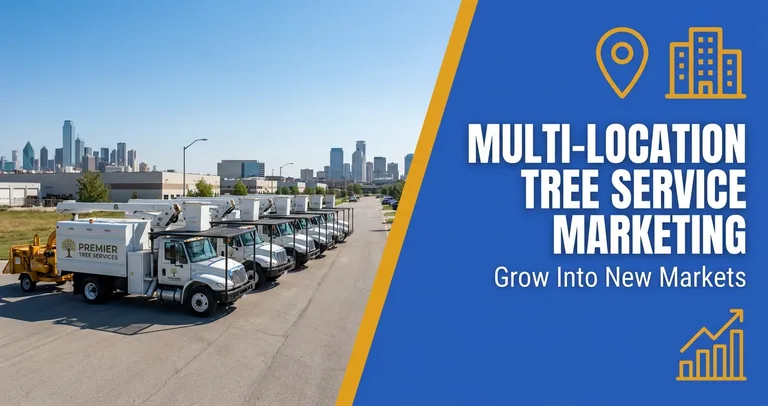
You already won your home market. Your crews stay booked, your trucks are paid off or close to it, and you have the production capacity to handle more volume than your current city can hand you. So the obvious next move is to grow into the next city over. The problem is that the marketing playbook that built your first market does not copy and paste. The contractor who treats a second or third city like a bigger version of the first one usually ends up with a fleet of vans driving 40 minutes to undersized jobs, a Google presence that ranks nowhere, and a brand that feels thinner in every market instead of stronger.
Multi-location tree service marketing is its own discipline. Google does not reward a single business that claims to serve ten cities. It rewards businesses that look genuinely local in each city they want to rank in, with a real address, real reviews from that market, and a page that proves you actually work there. Get that right and each new market compounds: more reviews, more local links, more brand searches, lower cost per booked job over time. Get it wrong and you pay full-price advertising in every market forever while ranking organically in none of them.
This is the owner-to-owner version for 2026. How to set up a separate Google Business Profile per location the right way, build city landing pages that actually rank instead of getting flagged as thin duplicates, earn citations and reviews per market, hold one brand together across a spread-out footprint, route crews so a new market is profitable and not just busy, and how to decide whether a city is even worth entering before you spend a dollar in it.
Decide Whether a New Market Is Worth Entering Before You Spend a Dollar
Most failed expansions are not marketing failures. They are math failures that marketing got blamed for. Before you build a single page or buy a single click, run the new city through the same filter you would use to bid a job: what does it cost to serve, and what will it pay.
Look at four things for any city you are considering:
- Drive time from your nearest crew staging point. Anything past 35 to 45 minutes one way starts eating your day. A crew that loses 90 minutes round-trip to a market does maybe one fewer job a day, and at a few thousand dollars of revenue per crew-day, that gap decides whether the market is profitable at all.
- Job size and tree stock. A wealthy suburb full of mature oaks and a 1985 housing tract are not the same market. Older, larger trees and higher home values mean bigger removals and bigger tickets. Drive the neighborhoods or pull them up on satellite. You are buying job size, not population.
- Competitive density and review depth. Search "tree service" plus the city and look at the map pack. If the top three businesses have 300-plus reviews each and have been collecting them for years, that is a market you can still enter but you will grind for 12 to 18 months to crack the pack. If the leaders sit at 40 to 80 reviews, the door is wide open.
- Whether you can get a real local footprint. Google ranks the map pack heavily on proximity to the searcher. If you cannot establish a legitimate address in or very near the city, your organic local ceiling is lower and you will lean harder on paid.
The honest test: would this city clear your minimum margin if you had to win every job on paid ads alone for the first year? If yes, organic upside is gravy. If the only way the math works is by assuming free organic leads on day one, you are not ready to enter it yet.
A Separate, Legitimate Google Business Profile Per Location
This is the single biggest lever in multi-location tree service marketing, and it is also where owners most often cut a corner that gets them suspended. The rule is simple: one real Google Business Profile per location, and the location has to be real.
Google's local algorithm leans hard on proximity. A searcher in the new city sees the businesses closest to them in the map pack. Your home-market profile, ten cities away, will almost never show up there no matter how strong it is. So to compete in the map pack of a new city, you need a Business Profile with a verified address in that area. That can be a small yard, a shared shop, a rented office, or in some cases a staff member's address that Google can verify, but it has to be a place you actually operate from. Virtual offices, UPS boxes, and a friend's empty house are how you get a hard suspension that takes your home profile down with it. Not worth it.
Once you have a legitimate profile per market, treat each one as its own asset:
- Set a real service-area radius on each profile that matches where that location's crews actually go, instead of one profile claiming the whole metro.
- Keep the business name identical across every profile (same brand, no keyword stuffing like "Smith Tree Service Dallas" unless that is your true legal name). Google penalizes keyword-stuffed names, and competitors will report them.
- Post, photo, and review each profile independently. Upload job photos shot in that city. Local imagery and local reviews are signals Google reads per profile.
- Use a local phone number or a tracked number that forwards to your central office so you can measure each market's call volume separately.
One last thing owners miss: profiles need to be worked, not just created. A new profile with three reviews ranks below an established competitor with 200. Plan for a ramp, and front-load review generation in the first 90 days of a new market so the profile has enough weight to start showing up.
City Landing Pages That Rank Instead of Getting Flagged as Thin Duplicates
Every market you enter needs its own page on your website, and here is where almost everyone botches it. They take their main service page, swap the city name, and publish twelve near-identical pages. Google has been able to detect and discount that pattern for years. Those pages do not rank, and at scale they can drag down the trust of your whole site.
A city page earns its ranking by being genuinely about that city. That does not mean spinning a thousand words of fluff. It means real, specific, locally true content:
- Local proof. Photos of jobs you have actually done in that city, with a caption naming the neighborhood. Reviews from customers in that market. A crew or truck shot that looks like that area.
- Tree and condition specifics for the area. The species you remove most there, the storm patterns, soil and drought issues, local ordinances on protected trees or permits. An owner in that market reads this and knows you work there. Google reads it as topical depth no template can fake.
- Service-area detail. Name the actual neighborhoods, suburbs, and ZIP areas that location covers. Embed a map. Reference nearby landmarks.
- The local profile and NAP. Tie the page to that market's Google Business Profile, with the matching name, address, and phone number visible.
The test is brutal but fair: if you covered the city name on the page, could a stranger still tell which market it is about? If the answer is no, the page is a duplicate with a different headline and it will not rank. If you want this built right across every market without burning your own production time on it, that is exactly the kind of work a tree service marketing partner handles, or you can task an in-house writer who spends real time in each market.
Citations and Reviews Have to Be Built Per Market, Not Once
Reviews and citations are the two signals that separate a profile that ranks from one that just exists, and both have to be earned market by market. Your 400 reviews in your home city do almost nothing for your ranking in a city 30 miles away, because Google evaluates each profile's review depth, velocity, and recency on its own.
On citations, the goal is consistent name, address, and phone (NAP) for each location across the directories that matter: Google, Bing, Apple Maps, the major data aggregators, and the tree and home-service directories. The trap with multiple locations is inconsistency. One profile lists a suite number, another drops it; one uses the tracked number, another the real line. Those mismatches confuse the algorithm and weaken every affected profile. Build a single source-of-truth document with the exact NAP for each location and use it every single time you create or update a listing.
On reviews, the only thing that works at multiple locations is a system that asks per market:
- Ask every customer, every job, the same day. The crew lead or office texts a review link the afternoon the job wraps, while the fresh stump is still impressing the homeowner.
- Route the request to the right profile. A job in City B must generate a City B review. Tag jobs by market in your CRM so the review link points at the correct Business Profile.
- Reply to every review, in every market. Responses are a ranking and trust signal, and they show prospective customers you are present in their city, not an out-of-town outfit.
A realistic target for a new market is a steady drip, a handful of reviews a month from real jobs, so the profile builds velocity Google can see. Reviews that arrive in a burst and then stop look manufactured. Slow and steady, market by market, is what compounds.
Managing One Brand Across Multiple Locations
The strength of a multi-location tree service is that it is one brand, not five franchises that happen to share a logo. The marketing job is to look identical to a customer regardless of which city they are in, while looking genuinely local to Google in each one. Those two goals fight each other if you are not deliberate.
Keep these consistent everywhere:
- Name, logo, truck wraps, crew uniforms, and phone-answering script. A customer who saw your truck in City A and gets a quote in City B should feel like the same company. That consistency is what lets reviews, referrals, and brand searches in one market spill into the next.
- One website, with location pages under it, not a separate site per city. Separate sites split your authority and double your maintenance. A single strong domain with well-built city pages and location-specific Business Profiles is the structure that wins.
- One standard for quality and response time. Online reputation is brand-wide. A market where calls go unanswered or jobs go sideways will produce reviews that follow your name everywhere.
What gets localized is the proof and the presence: the photos, the reviews, the Business Profile, the service-area language, the local phone number. The pattern to remember is national-feeling brand, locally-proven presence. Customers trust the brand because it looks established and consistent; Google ranks you in each city because everything underneath looks authentically local.
Routing Crews and Leads So a New Market Is Profitable, Not Just Busy
Marketing that generates calls in a market your crews cannot serve profitably is not a win, it is a new way to lose money. The marketing and the operations have to be planned together, because in tree work the economics live and die on windshield time and crew utilization.
A few principles that keep a multi-market footprint profitable:
- Cluster, do not scatter. Enter cities that border markets you already serve, so a crew can chain jobs across two or three adjacent areas in a day instead of driving back to base between each. A tight cluster of three contiguous suburbs beats three scattered cities every time.
- Stage crews where the work is. If a market matures enough to keep a crew busy most days, stage equipment closer to it instead of running everything from one yard. The drive time you save converts directly into jobs per day.
- Throttle marketing to match capacity. If a market is filling faster than you can staff it, pull back paid spend there and let organic carry it, then push spend in the markets where you have open crew hours. Spend should chase open capacity, not the other way around.
- Track cost per booked job by market, not in aggregate. A blended number hides the truth. One city might book jobs at a great cost while another quietly bleeds, and only per-market numbers tell you which to feed and which to fix.
This is also why steady lead flow you can turn on and off per market matters so much when you are expanding. Owning the organic ranking in a market takes a year or more, so in the meantime you want a faucet you control. Filling open crew hours in a new city with exclusive tree service leads while your organic presence builds keeps the trucks paid for during the ramp, and you scale spend up or down as that market's crew capacity changes.
Multi-Location Tree Service Marketing FAQ
Do I need a separate Google Business Profile for every city I want to rank in?
To rank in a city's map pack, effectively yes, because Google's local results lean heavily on proximity to the searcher. You need a verified, legitimate address in or very near each market. One profile claiming a whole metro will not show up in the map pack of cities far from its address. The non-negotiable is that every address has to be real, a yard, shop, or office you actually operate from. Fake or virtual addresses get profiles suspended and can take your main profile down with them.
How many city landing pages can I publish before Google sees them as spam?
There is no hard count. The problem is never quantity, it is quality and uniqueness. Twelve genuinely distinct pages, each with real local photos, reviews, tree and ordinance specifics, and a tied Business Profile, are fine. Twelve template pages with only the city name swapped are the problem, and even three of those can hurt you. Build pages only as fast as you can make each one genuinely about its market.
How long before a new market starts producing booked jobs on its own?
Paid ads can produce calls in a new market within days, which is why most owners lean on paid or bought leads during the ramp. Organic ranking, the map pack and city page pulling jobs without ad spend, typically takes roughly 6 to 18 months depending on how competitive the market is and how aggressively you build reviews and local links. Plan to fund the gap with paid demand, and treat organic as the lower-cost flow that takes over once it matures.