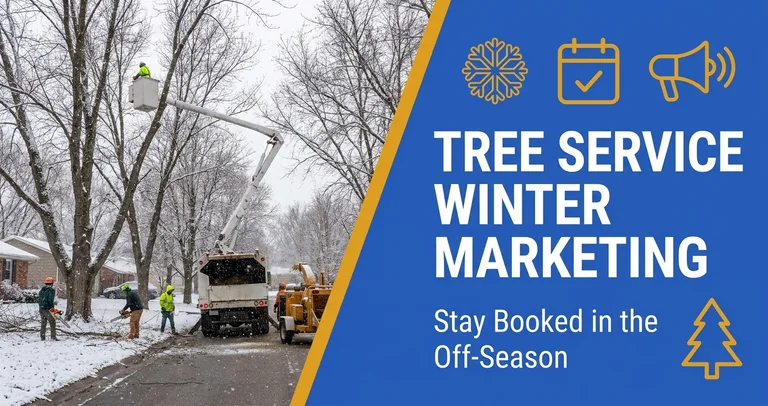
Winter Isn’t Your Slow Season - It’s Your Competitor’s Slow Season
While other tree services are cutting marketing budgets, letting their Local Service Ads go dark, and “waiting for spring,” you have a four-month window to capture market share they’re abandoning. The tree service companies that grow 40-60% year-over-year don’t slow down in winter - they shift strategy and dominate when competition disappears.
Here’s what most tree services get wrong about winter: they assume low search volume means no opportunity. Reality: winter search volume drops 35-40% from peak season, but your competition drops marketing spend by 60-70%. That math creates opportunity. When 8 companies normally compete for “tree removal [city]” searches, suddenly only 2-3 are still visible.
Your cost per lead drops, your ad positions improve, and you’re top-of-mind when spring hits. The tree services generating $80K-$120K in winter revenue aren’t relying on emergency storm calls. They’re running strategic marketing campaigns through Facebook ads targeting homeowners planning spring projects, direct mail hitting affluent neighborhoods before everyone else does, and maintaining Local Service Ad presence at reduced costs. While competitors go dormant, they’re capturing customers at 40% lower acquisition costs than summer.
This complete winter marketing formula breaks down exactly how to leverage Facebook ads to generate qualified tree service leads at $28-$45 each, structure direct mail campaigns that produce 6-10:1 ROI even with slower response rates, and optimize Local Service Ads to maintain visibility while competition vanishes.
You’ll discover the specific messaging that converts winter prospects, how to budget across three channels for maximum impact, and why companies that market aggressively in winter dominate their markets year-round.
Why Winter Tree Marketing Works Better Than You Think
The tree service industry sees predictable seasonal patterns: peak demand May through October, decline November through February. But customer acquisition follows different rules than customer demand. Understanding this distinction is what separates $400K companies from $1M+ companies.
The Winter Marketing Advantage: Competition drops 60-70%: When 10 companies fight for attention in summer, only 3-4 maintain marketing in winter. Your ads face less competition, lower costs, and higher visibility.
Customer quality improves: Winter leads aren’t desperate homeowners dealing with emergencies - they’re thoughtful planners researching providers for spring projects. These customers compare fewer companies and are less price-sensitive.
Ad costs decrease 30-50%: Facebook ad costs drop dramatically when competition disappears. Google Ad costs decline 20-35%. Local Service Ad costs decrease 25-40%. Same budget gets 40-60% more reach.
Market positioning for spring: Customers researching providers in January remember who was visible. When they’re ready to book in March, you’re their first call - not the 5th company they’re comparing.
The Strategic Shift Required: Winter marketing isn’t about selling emergency tree removal (though storm work happens). It’s about capturing future customers, building spring pipelines, and staying visible while competitors go dark. The formula combines three channels working together:
- Facebook Ads: Build awareness and capture spring planners
- Direct Mail: Reach affluent homeowners before everyone else
- Local Service Ads: Own position 1-2 when competition vanishes
Each channel plays a specific role in keeping your calendar full through winter and pre-booked for spring.
These winter-specific tactics are part of a year-round marketing strategy that successful tree services use to dominate their markets.
Channel #1: Facebook Ads for Winter Lead Generation
Facebook ads work exceptionally well in winter because you’re targeting homeowners in their homes, on their phones, during months they’re spending more time indoors. You’re not competing with nice weather and outdoor activities for attention.
The Winter Facebook Ad Strategy
Targeting Parameters That Work:
- Location: 15-mile radius from your service area center
- Age: 35-65 (homeowners with established properties)
- Household income: Top 25% in your market (these homeowners maintain properties proactively)
- Homeowner status: Own home (exclude renters)
- Interests: Home improvement, gardening, landscaping, property maintenance
- Additional: Target people who’ve engaged with home service businesses recently
Budget Allocation: $800-$1,200 monthly ($25-$40 daily)
Campaign Structure:
Campaign 1: Spring Planning Awareness ($15/day)
Ad Message: “Planning Spring Tree Work? Book Now & Save 15%”
Visuals: Before/after photos of overgrown trees transformed. Show dramatic improvements in property appearance.
Body Copy Example: “Smart homeowners book spring tree services in winter. Here’s why: ✓ Schedule your preferred dates (March-April fill up fast) ✓ Save 15% with our winter booking discount ✓ Trees are easier to assess without leaves ✓ Avoid the spring rush when everyone calls simultaneously We’re scheduling spring removals, trimming, and stump grinding now. Free estimates. Fully insured. 4.9 stars with 127 reviews. Claim your spot before your neighbors fill our calendar.”
Call-to-Action: “Schedule Free Estimate”
Campaign 2: Storm Damage Emergency Response ($10/day)
Ad Message: “Ice Storm Damage? We Respond Same-Day”
Visuals: Dramatic storm damage photos, crews working safely in winter conditions
Body Copy Example: “Winter storms don’t wait. Neither do we. Same-day response for: – Fallen trees on homes/vehicles – Dangerous hanging branches – Trees leaning toward structures – Ice storm damage cleanup Available 24/7. Emergency crews ready. Insurance claims assistance included. Call now: [phone number]”
Call-to-Action: “Call Now” (phone number)
Campaign 3: Property Value/Safety Angle ($10/day)
Ad Message: “Dead Trees Decrease Property Value By $1,200-$7,000”
Visuals: Dead/damaged trees next to healthy properties
Body Copy Example: “That dead tree in your yard isn’t just ugly - it’s costing you money. Appraisers deduct $1,200-$7,000 for dead/hazardous trees. Plus: – Insurance liability if it falls and damages neighbor’s property – Risk of $15K-$50K damage to your own home – Storm damage waiting to happen Winter is the perfect time for removal: – Ground is often frozen (less lawn damage) – Crews have more availability – Book now for early spring completion Free estimate. Same-week scheduling available.”
Call-to-Action: “Get Free Estimate”
Advanced Facebook Tactics for Winter
Retargeting Sequences: Set up three-stage retargeting:
Stage 1 (Days 1-7): Target people who clicked your ad but didn’t submit estimate request. Show them customer testimonials and 5-star review screenshots.
Stage 2 (Days 8-21): Target people who visited your website but didn’t call. Offer stronger incentive: “$200 off jobs over $2,000 if booked by [date]”
Ensure your website is optimized to convert these retargeted visitors when they return.
Stage 3 (Days 22-45): Final touch with urgency: “Spring schedule filling up. Last chance for March/April dates.”
Lookalike Audiences: Upload your customer list (email/phone from past 2 years) to Facebook. Create lookalike audience of people similar to your best customers. These convert 2-3x better than cold traffic.
Seasonal Creative Rotation: Change ad creative every 2-3 weeks to prevent ad fatigue:
- Weeks 1-2: Before/after transformations
- Weeks 3-4: Customer testimonial videos
- Weeks 5-6: Educational content (why winter is ideal for tree work)
- Weeks 7-8: Urgency-focused (spring schedule filling up)
Expected Results from Winter Facebook Ads: Monthly budget: $1,000
- Reach: 15,000-25,000 homeowners in your service area
- Website clicks: 400-600
- Estimate requests: 22-35
- Cost per lead: $28-$45
- Close rate: 25-30% (winter leads are higher quality)
- New customers: 6-10 monthly
- Average job value: $1,650
- Revenue generated: $9,900-$16,500
- ROI: 9.9:1 to 16.5:1
Maximize these close rates by implementing proven sales techniques that convert 70-75% of qualified leads
The key advantage: these are warm leads who’ve been educated by your ads, understand your value, and are comparing fewer competitors than summer leads.
To understand how winter advertising fits into your complete paid advertising strategy, see our guide to all high-performing advertising channels.
Channel #2: Direct Mail for Winter Market Domination
Direct mail works exceptionally well in winter for tree services because affluent homeowners (your ideal customers) are home more, spending time on property planning, and actually open mail during slower months. Your postcard arrives when they’re thinking about spring projects - not during summer chaos when they’re traveling and busy.
The Winter Direct Mail Strategy
Target Selection (Critical for ROI): Don’t mail everyone. Target specific characteristics that predict high-value tree service needs:
- Home age: Built before 1995 (mature trees, established landscapes)
- Property value: Top 30% in your market (homeowners who maintain properties)
- Lot size: 0.25+ acres (more trees = more work)
- Homeownership length: 5+ years (invested in property)
- Age of homeowner: 45-75 (responsive to direct mail, maintain properties)
Where to Get Lists: Use services like USPS Every Door Direct Mail (EDDM) with demographic filters, or purchase targeted lists from InfoUSA, Melissa Data, or AccuData.
Mail Piece Specifications: Format: 6×9 postcard (oversized = higher response than standard 4×6)
Front Side Design:
- Dramatic before/after photo (split down the middle)
- Bold headline: “Your Neighbors Are Booking Spring Tree Work NOW (Here’s Why You Should Too)”
- Your logo and Google rating badge (4.9 stars, 127 reviews)
- Photos should show properties similar to recipient neighborhoods
Back Side Copy: Headline: “Book January-February, Save 15% + Get Your Choice of Spring Dates”
Body Copy: “Smart [City Name] homeowners schedule spring tree services in winter.
Here’s what you get:
✓ 15% Discount on All Services (Expires February 28th)
✓ Priority Scheduling: Choose March-April dates before the spring rush
✓ Better Assessment: Bare trees let our arborists spot problems invisible in summer
✓ Frozen Ground: Less lawn damage during removal
Services: Tree Removal | Trimming & Pruning | Stump Grinding | Storm Damage What [City Name]
Homeowners Say:
★★★★★ “Incredible work. Removed three large oaks with zero damage to our lawn.” – Jennifer M.
★★★★★ “Booked in January, work completed in March. Perfect timing!” – Robert K.
WINTER SPECIAL: $200 Off Jobs Over $2,000 | $100 Off Jobs Over $1,000 Free Estimates. Fully Insured. Licensed & Certified Arborists.
Call Today: [PHONE – Large, Bold] Or Visit: [Website URL]”
Visual Elements:
- Professional photos (no stock images - use your actual work)
- Trust badges (BBB, ISA Certified, Insurance badges)
- QR code linking to landing page with booking calendar
- Prominent call tracking phone number
The Three-Drop Winter Mail Campaign
Don’t send one mailing. Execute three drops to the same neighborhoods:
Drop 1: Early January
- Message: “Book now, save 15%, get spring dates”
- Mail to: 5,000 targeted homes
- Cost: $3,000-$3,500 (design, printing, postage)
Drop 2: Mid-February
- Message: “Spring schedule 60% full. Last chance for preferred dates”
- Mail to: Same 5,000 homes (repetition builds recognition)
- Cost: $2,800-$3,200 (design already done, slight volume discount)
Drop 3: Early March
- Message: “Spring has arrived. Schedule your tree work before we’re fully booked”
- Mail to: Households who haven’t responded yet (or all 5,000 for maximum impact)
- Cost: $2,800-$3,200
Why Three Drops Works: Marketing research shows 3-5 touches generate 300% better response than single contact. First postcard builds awareness, second creates consideration, third drives action. Many homeowners see your first card but aren’t ready to act. Second card reminds them. Third card with urgency converts them.
Tracking Direct Mail ROI
Use unique tracking methods:
- Dedicated phone number on postcards only (track calls)
- Unique promo code: “WINTER25” (track who mentions it)
- Specific landing page URL: yoursite.com/winter (track visits)
- QR codes with unique links
Expected Results from Three-Drop Campaign: Total investment: $9,000-$10,000 for three mailings to 5,000 homes
- Response rate: 1.5-2.5% (75-125 responses across three drops)
- Estimate requests: 65-95
- Close rate: 30-35% (direct mail leads are high quality)
- Jobs booked: 20-33
- Average job value: $1,800
- Revenue generated: $36,000-$59,400
- ROI: 3.6:1 to 5.9:1
Key Success Factor: Targeting is everything. Mailing 15,000 random homes gets 0.5% response and poor ROI. Mailing 5,000 highly targeted homes with mature trees and affluent demographics gets 2%+ response and strong ROI.
Channel #3: Local Service Ads Winter Optimization
Local Service Ads are the most reliable winter lead source because they capture high-intent searchers actively looking for tree services right now. While search volume drops 35-40%, competition drops 60-70% - meaning your ads show more prominently at lower costs.
Winter LSA Strategy
Budget Optimization: Don’t turn off LSAs in winter. Reduce budget strategically:
Summer budget: $800-$1,200 weekly
Winter budget: $500-$700 weekly (35-40% reduction matching search volume decrease) Why maintain presence:
- You rank #1-2 when 6 competitors go dark
- Cost per lead drops 25-40% (less competition)
- You capture 100% of available winter searches instead of 15-20%
- You’re visible when spring search volume spikes in February-March
Service Prioritization: Adjust which services you emphasize:
Priority Services (75% of budget):
- Storm damage/emergency tree removal
- Hazardous tree removal
- Dead tree removal
- Winter trimming/pruning
Secondary Services (25% of budget):
- Tree health assessment
- Preventive maintenance
- Stump grinding (low demand in winter)
Service Area Strategy: Consider tightening service area in winter to reduce drive time and improve crew efficiency:
Summer: 25-30 mile radius (maximize coverage)
Winter: 15-20 mile radius (focus on core profitable areas) This maintains lead volume in your best neighborhoods while reducing windshield time in slower months.
Response Time Becomes Even More Critical
With fewer tree service leads coming in, you cannot afford to miss any. Winter LSA leads are gold:
- 5-minute response rule: Answer or call back within 5 minutes (Google tracks this)
- Enable SMS notifications: Get instant alerts on phone
- Weekend coverage: Don’t let weekend leads wait until Monday
- After-hours voicemail: “Emergency? Call [cell number]. Estimates? We’ll call you first thing tomorrow morning.”
Companies responding within 5 minutes to winter LSA leads close 45-50% (vs. 30-35% in summer when customers contact 5+ companies).
Beyond fast response, implementing a systematic qualification process ensures you’re prioritizing the highest-value opportunities.
Review Generation Through Winter
Use slower winter months to aggressively build reviews (which improve your LSA ranking):
- Text every completed job within 2 hours: “Can you leave us a quick Google review? [link]”
- Offer small incentive: “$25 off your next service when you leave a review”
- Goal: Add 15-25 reviews December-February
- Respond to every review within 24 hours
More reviews = better ranking when spring search volume explodes in March.
Expected Winter LSA Performance:
Monthly budget: $2,400 (vs. $3,600 in summer)
- Leads: 45-65 (vs. 70-90 in summer)
- Cost per lead: $37-$53 (vs. $55-$75 in summer - lower due to reduced competition)
- Close rate: 35-40% (vs. 28-32% in summer - higher quality, less competition)
- New customers: 16-26 monthly
- Average job value: $1,750
- Revenue generated: $28,000-$45,500
- ROI: 11.7:1 to 18.9:1
The math is compelling: spend 33% less, get 30% fewer leads, but close them at higher rates and lower costs. Net result: comparable or better profitability per marketing dollar.
Learn the complete framework for improving close rates from industry average to top-performer levels.
The Complete Winter Marketing Budget Allocation
Here’s how to allocate $4,200-$4,600 monthly across all three channels for maximum winter impact: Total Monthly Budget: $4,400 Local Service Ads: $2,400 (55%)
- Why highest allocation: Captures ready-to-buy leads actively searching
- Expected results: 16-26 customers monthly
- Best for: Immediate revenue generation
Facebook Ads: $1,000 (23%)
- Why second priority: Builds awareness and captures spring planners
- Expected results: 6-10 customers monthly
- Best for: Pipeline building and brand awareness
Direct Mail: $1,000 (22%)
- Why valuable: Reaches affluent homeowners planning spring projects
- Expected results: Spread across 3 drops, 20-33 customers total (7-11 monthly average)
- Best for: High-value customers and market positioning
Combined Expected Results: Total monthly marketing spend: $4,400
- Total leads: 85-120
- Total customers: 29-47 monthly
- Average job value: $1,700
- Monthly revenue: $49,300-$79,900
- Combined ROI: 11.2:1 to 18.2:1
Understanding how to calculate the true value of leads from different sources helps you optimize winter budget allocation.
For Smaller Budgets ($2,000-$2,500/month):
- LSAs: $1,400 (60%)
- Facebook: $600 (25%)
- Direct Mail: $400 (15% – do one 2,500-home drop instead of three)
For Larger Budgets ($6,000-$8,000/month):
- LSAs: $3,600 (maintain closer to summer levels)
- Facebook: $1,800 (expand reach and retargeting)
- Direct Mail: $2,000 (mail 10,000 homes across three drops)
Your 4-Month Winter Marketing Timeline
November: Setup and Launch Week 1-2:
- Design direct mail postcard (hire designer or use template services like Vistaprint)
- Order mailing list targeting homes built before 1995, property values top 30%
- Set up Facebook ad campaigns with winter messaging
- Reduce LSA budget to winter levels ($500-$700 weekly)
Week 3-4:
- Launch Facebook campaigns ($25-$40 daily)
- Monitor LSA performance (should see cost-per-lead decreasing)
- Order direct mail printing for January drop
- Create landing page for winter promotions
Expected November Results: 20-30 customers as transition begins
December: Optimization and Consistency
Week 1-2:
- Analyze Facebook ad performance, pause underperforming ads
- Launch new Facebook creative (prevent ad fatigue)
- Maintain LSA presence while competitors reduce spend
- Finalize January direct mail drop (ready to mail January 2-5)
Week 3-4:
- Holiday slowdown - maintain ads but expect lower volume
- Use downtime to generate reviews from recent customers
- Plan January-February content calendar
Expected December Results: 15-25 customers (holiday slowdown is normal)
January: Full Winter Campaign Launch
Week 1:
- Mail first direct mail drop (5,000 homes, arrives January 5-8)
- Increase Facebook ad spend slightly ($35-$45 daily) as people return from holidays
- Ensure LSA settings optimized for storm season
Week 2-3:
- Phone should be ringing from direct mail drop - track with unique number/code
- Launch Facebook retargeting campaigns to website visitors
- Monitor LSA lead quality and close rates
Week 4:
- Analyze direct mail drop results
- Adjust February mailing based on response patterns
- Refresh Facebook ad creative
Expected January Results: 30-45 customers (direct mail kicks in) February: Ramp Up for Spring Week 1-2:
- Mail second direct mail drop (same neighborhoods, “last chance” messaging)
- Shift Facebook messaging toward urgency: “Spring schedule filling up”
- Consider increasing LSA budget 20% as February search volume rises
Week 3-4:
- Heavy phone volume from combined channels - ensure coverage
- Start pre-booking March and April jobs
- Prepare for March transition back to peak season marketing
Expected February Results: 35-50 customers (momentum building for spring)
March Transition:
- Mail third direct mail drop early March
- Increase LSA budget back toward summer levels
- Shift Facebook messaging from “book now” to “emergency service + immediate availability”
Winter Marketing Mistakes That Kill ROI
Mistake #1: Going Dark Completely Turning off all marketing because “it’s slow season” means you have zero pipeline when spring hits. You’re scrambling while competitors who marketed through winter are already booked.
Fix: Reduce spend 35-40%, but maintain presence across key channels.
If you need to quickly ramp up customer acquisition after going dark, implement these fast-track strategies.
Mistake #2: Using Same Summer Messaging “Emergency tree removal” might work in summer, but winter requires different angles: spring planning, property value, safety, booking preferred dates.
Fix: Adjust messaging to match winter buyer psychology.
Mistake #3: Cutting Direct Mail Because “It’s Slow” Direct mail response rates in winter are often higher than summer because affluent homeowners are home, planning projects, and actually reading mail instead of traveling.
Fix: Winter is ideal for direct mail to the right demographics.
Mistake #4: Not Tracking Channel Performance Running three channels without knowing which produces customers at what cost means you’re flying blind. You might be funding a losing channel while underfunding a winner.
Fix: Use unique phone numbers, promo codes, and landing pages for each channel.
The right software automates this tracking and provides real-time dashboards showing which channels produce customers
Mistake #5: Giving Up After One Month “We tried winter marketing and it didn’t work” usually means they ran ads for 3 weeks in December (worst month) and quit. Winter marketing requires 3-4 month commitment.
Fix: Commit November through February. Judge results across the full period, not week-to-week.
How Home Service Direct Manages Winter Marketing for Tree Services
Running a coordinated three-channel winter marketing campaign while managing crews, handling estimates, and dealing with storm emergencies is nearly impossible for most tree service owners. The companies that execute winter marketing successfully either have dedicated marketing staff or outsource to specialists. At Home Service Direct, we manage complete winter tree service marketing campaigns for tree service companies, handling everything from Facebook ad creation to direct mail design to Local Service Ad optimization. Our winter marketing services include:
- Facebook Ad Management: We create, launch, and optimize winter campaigns with proven messaging and targeting that generates $28-$45 cost-per-lead
- Direct Mail Campaigns: Complete service from list selection to design to three-drop execution, typically generating 6-10:1 ROI
- LSA Optimization: Strategic budget management and response time monitoring that maintains visibility while reducing costs 25-40%
- Unified Tracking: Single dashboard showing which channels produce customers and at what cost, allowing real-time optimization
Our clients running winter marketing campaigns average 25-40 customers monthly November through February - compared to 8-15 for companies that go dark. That’s an additional $75K-$150K in winter revenue that funds equipment upgrades, crew retention, and competitive positioning for spring.
Ready to dominate winter while your competitors hibernate?
Contact us today to discuss how we build and manage winter marketing systems that keep your crews busy and your spring calendar pre-booked.
The Companies That Win Winter Win the Year
Tree services stuck at $300K-$400K annually go dormant in winter. They reduce marketing to zero, lose momentum, watch cash reserves dwindle, and start each spring from zero. They’re reactive - hoping the phone rings when weather warms up.
Tree services scaling past $1M stay aggressive through winter. They understand that November through February isn’t about maximizing revenue - it’s about maintaining market presence, capturing spring pipeline, and positioning as the obvious choice when demand spikes in March. They’re strategic - investing $15,000-$18,000 in winter marketing to generate $150K-$200K in winter revenue plus another $100K-$150K in spring jobs booked early.
The math is simple: spend $4,400 monthly on Facebook ads, direct mail, and Local Service Ads from November through February ($17,600 total investment). Generate 100-180 customers across four months with average job value of $1,700. That’s $170,000-$306,000 in revenue. ROI: 9.7:1 to 17.4:1.
But the real advantage isn’t the winter revenue - it’s the market position. When spring hits and everyone starts marketing again, you’ve already captured mind share. You’ve got 50+ new reviews from winter customers. Your spring schedule is 60% pre-booked from January and February prospects. Your competitors are scrambling for customers while you’re managing a full calendar.
Winter isn’t your slow season. It’s your opportunity season. The only question is whether you’ll seize it while your competitors sleep, or whether you’ll join them in hibernation and wonder why they captured the market share you’re fighting for in summer.
Tree Service Winter Marketing FAQ
How do you market a tree service in the winter?
You market a tree service in winter by shifting your message and staying visible while the other guys go dark. Run three channels together: Facebook ads aimed at homeowners planning spring tree work, direct mail to older, higher-value neighborhoods with mature trees, and Local Service Ads kept on at a reduced budget so you own the top spot when only a few competitors are still showing up. Drop the “emergency removal” pitch and lead with spring booking discounts, property value, and safety instead, because winter buyers are planners, not panic callers. Keep enough budget running November through February so you build a spring pipeline instead of starting from zero in March. If you would rather have it handled for you, we run these winter lead campaigns for tree service companies start to finish.
Is winter a good time to advertise a tree service?
Yes, and it is usually a better time than most owners think. Search volume drops 35-40% in winter, but your competition cuts their ad spend by 60-70%, so the few who keep advertising get cheaper clicks, better ad positions, and more of the available calls. Ad costs on Facebook, Google, and Local Service Ads typically fall 25-50% because there are fewer companies bidding. The trade-off is patience: winter is about booking spring jobs and staying top of mind, not packing the schedule this week, so judge it across the full season instead of week to week.
What tree services should you promote in winter?
Lead with the work that still makes sense when it is cold: storm and ice damage cleanup, hazardous and dead tree removal, and dormant-season trimming and pruning. Bare trees actually make it easier for your crew to spot structural problems, and frozen ground means less lawn damage during a removal, so those are honest selling points to put in your ads. Push stump grinding and routine cosmetic work to the back, since demand for those is low until spring. Then layer in “book now for spring” offers to fill your March and April calendar before everyone else starts calling.
How much should a tree service spend on winter marketing?
A common range is roughly $2,000 to $4,500 a month across all three channels, but the right number depends on your market size and how aggressive you want to be. A smaller company might put $1,400 into Local Service Ads, $600 into Facebook, and $400 into a single direct mail drop. A larger company chasing market share might run $3,600 in LSAs, $1,800 in Facebook, and $2,000 in direct mail across three mail drops. Treat every dollar figure here as an illustrative starting point, track which channel actually books jobs with unique phone numbers and promo codes, then move money toward whatever is producing the most paid work.