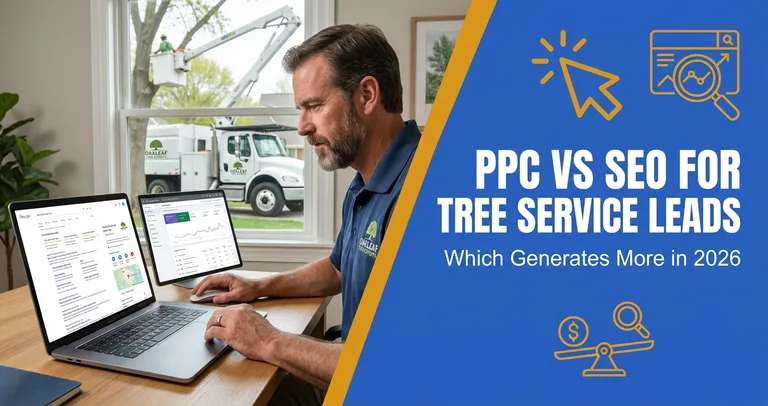
PPC vs SEO: The Real Question For Tree Companies
If you already run crews and bid jobs every week, you are not asking whether marketing works. You know it does. The real question is sharper than that: where does the next dollar of your marketing budget book the most tree work? That is what the PPC vs SEO tree service debate actually comes down to, and most of the advice floating around answers it for a brand-new one-truck operation, not for a company doing real volume.
Here is the short version, then we will back it up. PPC (Google Ads and Local Services Ads) buys you booked jobs starting this week. SEO and your Google Business Profile build a stream of cheaper, higher-trust calls that compounds for years. Speed versus durability. The moment you stop paying for ads, the phone goes quiet. The moment your organic and map rankings are built, they keep calling whether you spent a dollar that day or not.
For an established, growing tree service, this is not really an either-or fight. The owners who win run both, with a budget split that matches their season and their goals. But to split a budget intelligently, you have to understand exactly what each channel is good at, what it actually costs per booked job, and when one clearly beats the other. That is what the rest of this is for.
PPC for Tree Service: Speed, Control, and the Meter That Never Stops
PPC is the channel you reach for when you need work in the calendar now. You turn on Google Ads, you bid on terms like tree removal and emergency tree service in your towns, and within a day or two you are in front of homeowners who are actively searching with a chainsaw problem they want gone. No waiting six months to rank. That speed is the entire pitch, and for a company that just hired a second crew or bought a new bucket truck, it is a big deal.
The control is the other reason owners love it. You decide which towns you appear in, which services you push, what hours your ads run, and how much you spend per day. Slow Tuesday and the crews are standing around? Bump the budget. Booked solid three weeks out? Pull back. You can favor the high-ticket work, removals and large takedowns, and dial down the cheap trimming calls that clog your schedule. Few channels give you that much steering.
Then there is the storm. When a windstorm or ice event rolls through, search volume for emergency tree work spikes overnight, and PPC is the only channel that lets you capture it in real time. Owners who keep a campaign ready to scale on a moment's notice catch the surge while competitors are still figuring out their phone is ringing. SEO cannot do that on demand.
The catch is simple and it never goes away: it is a meter, and the meter only runs while you are paying. Stop the budget and the leads stop the same day. Every booked job came from a dollar you spent that week, and next week you start over from zero. On top of that, tree service clicks are not cheap. In competitive metros, a single click on a removal term can run real money, and not every click is even a qualified lead. You are paying for the traffic, then your phone team and your close rate decide whether that traffic turns into a signed estimate.
SEO and Google Business Profile: Slow to Start, Then It Compounds
SEO and your Google Business Profile are the opposite trade. They are slow to get going and then they pay you back for years. Show up first in the organic results and the map pack for tree service in your city, and you get calls from people who never see an ad, do not feel sold to, and trust you more because Google put you at the top. That trust shows up in your close rate, not just your call volume.
The map pack, those three businesses Google shows with the little map, is the single highest-leverage piece of local marketing for a tree company, and it lives or dies on your Google Business Profile. A complete profile, the right service categories, real photos of your crews and equipment, your service area set correctly, and a steady flow of genuine reviews will out-pull a thin profile every time. Reviews are the engine here. The company with 180 reviews at 4.9 stars beats the company with 22 reviews on almost every search, and that gap takes a competitor months or years to close.
The organic side, your website ranking for searches across all your towns, is where content does the work. City and service pages that actually answer what homeowners ask, written for the specific towns you serve, pull in searches you would otherwise pay for on every click. The honest part is that none of this is instant. A new site or a neglected one can take several months to climb, and you have to keep at it. But once it ranks, the cost per booked job keeps dropping because the traffic is no longer metered. You did the work once and it keeps producing.
This is also the part most owners are too busy running crews to handle well, which is exactly why it gets neglected and exactly why it is such an edge when you do it right. If you would rather book the jobs than write city pages and chase reviews, this is the kind of thing you hand to a team that does tree service SEO for a living.
Cost Per Lead: What the Numbers Actually Look Like
Forget national averages for a second, because tree service economics are local and seasonal. What matters is the shape of the cost, and the shape is what makes the decision for you. Treat the numbers below as clearly illustrative ranges to show the pattern, not promises, because your market, your towns, and your close rate move all of them.
On PPC, your cost per lead is roughly flat for the life of the campaign. If clicks in your market run higher and a chunk of them never convert, you might land somewhere in the range of $80 to $200-plus to generate one phone call or form fill, and that number does not improve much with time. It can even drift up as more competitors bid against you. You can sharpen it with better targeting, tighter ad copy, and a faster phone team, but you do not age into a discount. Year three costs about what year one did.
On SEO, the cost per lead starts ugly and gets better every month. Early on, when you have spent on content and profile work but rankings are still climbing, your effective cost per lead can look worse than PPC. Then the curve bends. Twelve to eighteen months in, as a single page ranks and pulls calls month after month with no new spend per call, the effective cost per lead on your organic and map traffic can fall well below your PPC number, sometimes a fraction of it. The leads were front-loaded in cost and the returns are spread across years.
So the real comparison is not which is cheaper today. PPC is almost always cheaper per lead in month one. SEO is almost always cheaper per lead by year two. One buys you now, the other buys you later, and an established company that plans to still be in business in three years cares about both.
Where Local Services Ads Fit In
There is a third option that sits between the two, and serious tree companies should not skip it: Google's Local Services Ads, the listings at the very top with the top Local Service Ads spot. LSA is technically paid, but it behaves differently from regular Google Ads in two ways that matter to you.
First, you pay per lead, not per click. A homeowner has to actually call or message you before you are charged, so you are not burning budget on tire-kickers who click and bounce. Second, the top Local Service Ads spot does some of your trust-building for you, the same job your reviews do on the organic side, which tends to lift your contact rate. To run it you go through Google's screening and verification, which is friction up front but also a moat, since it keeps the fly-by-night operators out of that ad slot.
The way to think about it: LSA sits at the top of the page above the map pack, so it captures intent before SEO even gets a look, but it shares SEO's trust advantage through the badge and reviews. For an established company, LSA is often the most efficient paid lead source you have, and it pairs naturally with strong organic rankings rather than competing with them. Most owners doing real volume run LSA, Google Ads, and SEO together, each catching a different slice of the same searches.
When PPC Wins and When SEO Wins
Strip away the theory and it comes down to your situation. Here is when each one is clearly the right call to lean into.
Lean into PPC and LSA when:
- You need booked jobs in the next two weeks, not next quarter. New crew to keep busy, slow stretch to fill, a truck payment that just started.
- A storm just hit and emergency search volume is spiking. This is PPC's home-field advantage and nothing else captures it as fast.
- You are entering a new town or county and have zero organic presence there yet. Paid puts you in front of those searches immediately while your rankings catch up.
- You want to push specific high-margin services or steer volume toward the work your crews do best.
Lean into SEO and your Google Business Profile when:
- You plan to be in these markets for years and want your cost per booked job to keep falling instead of staying flat forever.
- You are tired of every lead renting attention and want an asset you own that calls even on the months you spend less.
- You compete against companies with hundreds of reviews and a strong map presence, and you know matching them is the only way to win the calls that never click an ad.
- You want the trust that comes from ranking at the top organically, which tends to bring better-qualified callers and an easier close on the estimate.
Notice that almost no established company falls cleanly into one bucket. That is the point. The honest answer for a growing tree service is rarely PPC or SEO. It is the right mix of both.
The Budget Split Most Established Tree Companies Should Run
So how do you actually divide the money? There is no single magic ratio, but there is a sound way to think about it that beats guessing.
Treat PPC and LSA as your floor and SEO as your compounding investment on top. Paid is your reliable, controllable baseline of booked jobs, the volume you can count on this month and dial up or down at will. SEO and your Google Business Profile are the long game you fund consistently so that a year from now a meaningful share of your calls cost you almost nothing per lead. A common shape for a company doing steady volume is a majority of the marketing budget on paid for predictable now-revenue, with a real and protected slice carved out every month for SEO and review generation so the compounding never stalls.
The mistake is treating SEO as the thing you fund only when you have spare cash. That is exactly backward, because SEO is the part that needs time and consistency to pay off, so starving it for a few good months sets you back further than the months you saved. Fund it like rent, not like a bonus.
Adjust the mix with your season. Heading into storm season or a slow patch, weight harder toward paid so you can capture spikes and fill the calendar fast. In steadier stretches, keep the SEO investment flowing so your organic and map presence keeps climbing while competitors coast. The owners who grow are the ones who never fully turn either channel off.
If running both well sounds like another full-time job on top of running crews, that is because it usually is. Plenty of established owners would rather just get the exclusive tree service leads in their calendar and keep their attention on the work, the bids, and the payroll.
Frequently Asked Questions
Is PPC or SEO better for a tree company?
Neither is universally better, they are better at different things. PPC and Local Services Ads get you booked jobs fast and let you scale instantly for storms, but the cost per lead stays flat and stops the day you stop paying. SEO and your Google Business Profile take months to build but produce cheaper, higher-trust leads that compound for years. Most established tree companies run both and split the budget rather than choosing one.
How long does SEO take to bring in tree jobs?
Plan on several months before organic rankings and map-pack presence start producing steady calls, often in the range of six to twelve months depending on your market and where you are starting from. Google Business Profile improvements and review growth can move the needle faster than website rankings. The trade-off is worth it because once it ranks, the cost per booked job keeps dropping while paid stays flat.
Should I use Google Ads or Local Services Ads for my tree company?
Most established tree companies should run both, but if you start with one, Local Services Ads is often the more efficient paid source because you pay per lead instead of per click and the top Local Service Ads spot builds trust that lifts your contact rate. Standard Google Ads gives you more control to steer toward specific services and towns and to scale fast during storm spikes. They capture different slices of the same searches, so the strongest setup runs LSA, Google Ads, and SEO together.