The Real Problem Usually Isn't Lead Volume
You're already running crews, bidding jobs, and making payroll every week. So when growth stalls, the gut reaction is to buy more leads. But for most established home service companies, the leak isn't at the top of the funnel, it's in the middle. Leads come in, somebody calls once, nobody picks up, and that lead quietly dies in a spreadsheet or a text thread. You paid for it, and you never even talked to the person.
Here's the uncomfortable math. If you're closing 20% of the leads you generate and a competitor down the road is closing 35% off the exact same lead source, they're not better marketers. They follow up faster and more times than you do. That gap is pure margin, and it costs you nothing in ad spend to fix. Tightening up how you convert leads into customers is almost always cheaper and faster than buying your way to more volume.
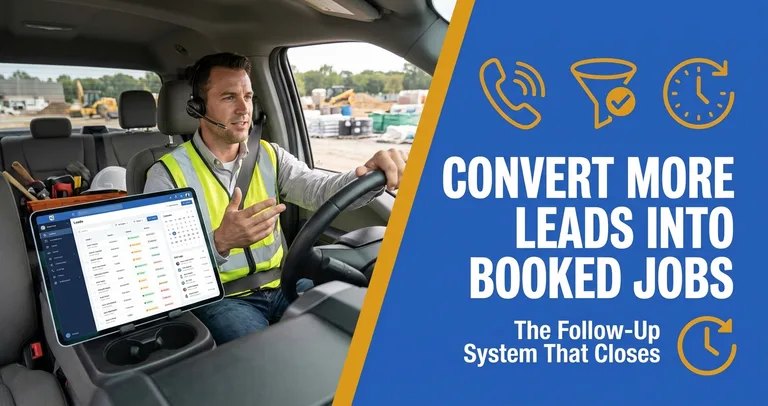
This is the full playbook for the home service sales process that turns inquiries into booked jobs: responding in minutes instead of hours, running a real multi-touch follow-up sequence, using your CRM to do the boring work automatically, handling the no-answers, and keeping the not-ready-yet leads warm until they're ready to buy. Get this system running and you'll book more jobs out of the leads you already have.
Speed-to-Lead: The First 5 Minutes Decide Everything
Speed is the single biggest lever you control. A lead that fills out your form or calls about a job is hottest in the first few minutes, while they're still sitting at their computer or standing in the yard looking at the problem. Wait an hour and they've already called two of your competitors. Wait a day and the job is gone.
The benchmarks here are brutal. Studies of inbound leads consistently show that contacting a lead within roughly 5 minutes versus 30 minutes can make you many times more likely to actually connect and qualify them. Connection rates fall off a cliff after the first hour. For a home service company, that means the lead who calls at 2pm and doesn't hear back until you wrap the day at 6pm is mostly wasted money.
What fast actually looks like:
- Call within 5 minutes of a new lead, during business hours, every time. Not when the crew gets back. Not after lunch.
- Text within 1 minute, automatically, even before the call. A simple "Hi {name}, this is {company}, saw you reached out about {service}, calling you in a minute" sets the appointment expectation and keeps them from wandering off.
- Have someone assigned to lead response so it doesn't fall on whoever happens to see the notification. If your estimator is up a tree or your office manager is on another call, leads slip.
If you're a growing company, the honest fix is usually a dedicated person or a call-handling setup that answers in seconds, plus automation that texts instantly. The owner who insists on calling every lead personally is the bottleneck the day the lead count doubles.
Why Most Leads Need 3 to 5 Touches (And You Probably Stop at 1)
Here's the pattern that quietly kills conversion in most shops: one call goes unanswered, maybe a voicemail gets left, and the lead is marked dead. Meanwhile the homeowner was on a roof, in a meeting, or screening an unknown number. They weren't saying no. They just didn't pick up the first time.
The data on this is consistent across industries. A large share of sales happen after the fifth contact attempt, yet most salespeople give up after one or two. In home service it's even more pronounced because your customer is often unavailable during the day and you're catching them between a job, dinner, and the kids. Plan on 3 to 5 touches minimum before you call a lead truly cold, and mix the channels.
A realistic sequence over the first week looks something like this:
- Minute 0: Instant text confirming you got the request.
- Minute 5: First phone call. Leave a short, specific voicemail if no answer.
- Minute 6: Follow-up text right after the missed call ("Just tried you, happy to text if that's easier, when works for a quick look?").
- Hour 4 to 6: Second call attempt, different time of day.
- Day 2: Third call plus an email with your pricing approach and a couple of recent local jobs.
- Day 4 and Day 7: A check-in text and a final call before the lead moves to long-term nurture.
Notice this isn't five identical voicemails. It's a deliberate mix of call, text, and email at different times so you actually catch them when they're free. The point of lead follow up isn't to nag, it's to be the company that's still there when the homeowner finally has a free minute.
Building the Multi-Touch Follow-Up Cadence
A cadence is just your follow-up sequence written down so it happens the same way every time, no matter who's doing it. Without one, follow-up depends on mood and memory, which is why it falls apart the week you get busy. Build it once and you get consistent lead nurturing across every lead and every team member.
Match the channel to the moment:
- Text is your workhorse for the first week. It gets read fast, it's low-friction for a busy homeowner, and it lets people respond on their own time. Most of your early connections will come from text, not voice.
- Phone is where you qualify and book. Once they reply, get them on a call or to a scheduled estimate. Texting is for connecting, talking is for closing.
- Email carries the proof and the detail: how you price, what the process looks like, photos of recent work in their area, reviews. It does the trust-building that a text can't fit.
Write the actual messages in advance. Don't leave your team to improvise. Have a tight set of templates with the lead's name, the service they asked about, and your city worked in, so every message sounds personal but nobody is staring at a blank screen. Then track what happens. If you record and review your calls, you'll quickly see which openers book estimates and which ones get hung up on. Tools like call tracking let you tie a specific message or ad source to whether the job actually got booked, so you're improving the cadence with real evidence instead of guesses.
Let Your CRM Do the Boring Work
Here's the truth no busy owner wants to hear: a manual follow-up system will fail the exact week you need it most, when you're slammed and short-staffed. The only follow-up that survives a busy season is the kind that runs whether your team remembers it or not. That's what a CRM with automation is for.
You don't need enterprise software. You need a system that does these jobs without anyone thinking about it:
- Instant response: The second a lead hits your form, the CRM fires the welcome text and creates a task to call. No lead waits in an inbox.
- The cadence on rails: Each touch in your sequence is scheduled automatically. The system reminds the right person to call on Day 2 and Day 4, and sends the email touches itself.
- No lead falls through: Every lead has a status. Anything that hasn't been contacted in X hours flags itself so it never just disappears.
- One place for the history: Every call, text, and email on a lead lives in one record, so whoever picks it up next knows exactly what's been said.
The goal is to improve your lead nurture process so it doesn't depend on heroics. Your people focus on the conversations and the estimates, the human work that actually closes jobs, while the software handles the reminders, the timing, and the paper trail. If standing all of this up sounds like one more project you don't have time for, that's exactly the gap we fill: HSD provides exclusive leads plus the system to close them, so the follow-up runs without you building it from scratch.
Handling No-Answers, Voicemails, and the Long Nurture
Two situations sink more leads than any other: the person who never picks up, and the person who's interested but not ready yet. Both are recoverable if you have a plan for them instead of writing them off.
For the no-answers, stop relying on the phone alone. After a missed call, text immediately, because a homeowner who screens unknown numbers will often happily reply to a text. Vary your call times across morning, midday, and early evening, since the person who's never free at 1pm might answer at 5:30. Always leave a short voicemail that says who you are, the specific job, and that you'll text too. Persistence across channels, not just more rings on the same channel, is what turns a no-answer into a booked estimate.
For the not-ready-yet leads, understand that a big chunk of any home service lead pool isn't buying this week. They're getting a few prices, waiting on a paycheck, or it's not an emergency yet. That branch is dead leaf, not the tree. Most companies forget these people entirely. The ones who win drop them into a long-term nurture: a light-touch email or text every few weeks that stays useful and stays top of mind, so when the limb finally comes down on the fence or the season changes, you're the company they already know.
A simple long nurture might include a seasonal reminder relevant to your trade, a recent job from their neighborhood, a genuinely helpful tip, and a low-pressure "still happy to take a look whenever you're ready." It costs almost nothing to run on autopilot and it quietly converts leads months after your competitors gave up on them.
Measure What Matters and Tighten It
You can't fix a conversion problem you can't see. Most owners track leads and closed jobs and nothing in between, which means they have no idea where the drop-off actually happens. Put numbers on the middle of your process and the weak point becomes obvious.
The handful of numbers worth watching:
- Speed to first contact: Median minutes from lead received to first real attempt. If this is in hours, fix it before anything else.
- Contact rate: What percent of leads you actually reach a human at. Low here means your cadence isn't deep enough or fast enough.
- Lead-to-estimate rate: Of the leads you reach, how many turn into a booked estimate. This is your follow-up doing its job.
- Estimate-to-job rate: Your true close rate once you're in front of them or on the phone. This is about pricing and pitch, not follow-up.
Review these monthly. If contact rate is your weak spot, add touches and tighten speed. If lead-to-estimate is low, your messaging or qualifying needs work. If you're great until the estimate and then lose them, that's a sales conversation, not a nurture problem. The discipline of measuring each stage is what separates a company that guesses from one that compounds. Small, steady gains at each step multiply into a meaningfully higher close rate off the same ad spend.
Frequently Asked Questions
How fast do I really need to respond to a new lead?
As close to 5 minutes as you can manage during business hours, with an automatic text in the first minute. Connection and qualification rates drop sharply after the first hour, so the company that responds in minutes wins the job over the one that calls back at the end of the day. If you can't hit that consistently with your current setup, that's the first thing to fix.
How many times should I follow up before I give up on a lead?
Plan on at least 3 to 5 touches across phone, text, and email before you stop active follow-up, and even then move the lead to a long-term nurture rather than deleting it. A large share of jobs close after the fifth contact, yet most companies quit after one or two. A no-answer is almost never a no, it's usually just bad timing.
Do I need a CRM, or can my office manager just handle follow-up?
A person handles it fine until you get busy, and busy is exactly when manual follow-up breaks and leads slip. A CRM with simple automation guarantees the instant text, the scheduled call reminders, and the long nurture all happen regardless of how slammed your team is. It's not about replacing your people, it's about making sure no lead ever falls through the cracks on a chaotic week.