Why Your Competitor Owns the Top of Google (And You Don't)
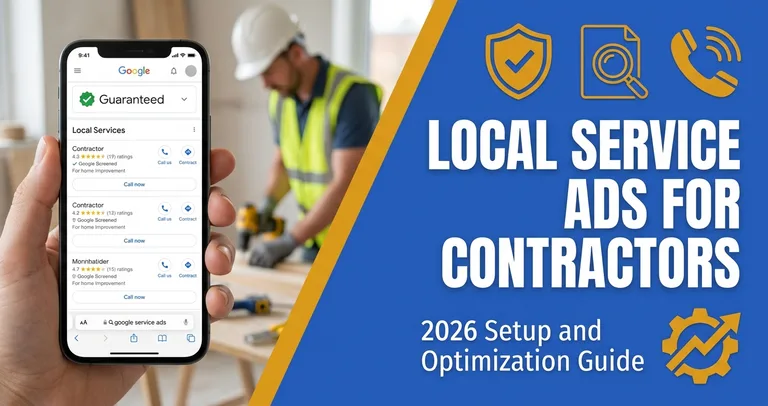
You already run a real company. Crews are out, trucks are rolling, and you are writing paychecks every two weeks. So when you search your own trade plus "near me" and watch three other companies sit above your paid ads, above the map pack, above everything, with that green Local Service Ads badge and a tap-to-call button, it stings. They are getting the first call. You are fighting for fourth place before the prospect even scrolls.
That top block is Google Local Service Ads, and for an established home service business it is one of the highest-intent lead channels available in 2026. Regular Google Ads charge you every time someone clicks, whether they call or not. Local service ads for contractors charge you per lead, not per click, and only when a real person calls, messages, or books through the ad. Google screens the contacts and credits back the obvious junk. You are paying for conversations with buyers, not for window shoppers who bounced off your site.
This guide is written for the owner who is past the startup phase and wants more booked jobs at a better margin. We will cover how local service ads actually work, how the top Local Service Ads spot and verification differ by trade, the exact ranking factors (reviews, response time, budget, hours), how to optimize and drive your cost per booked job down, how to dispute bad-lead charges so you stop overpaying, and how LSAs stack up against SEO and traditional Google Ads. If a channel can hand you the first call on every emergency search in your market, you should run it on purpose, not by accident. You can run it in-house with what is below, or have us handle it as managed Local Service Ads.
How Local Service Ads Actually Work for Contractors
Google launched Local Service Ads in 2015 and rolled them out to most contractor categories between 2019 and 2022. By 2026 they are the default top result for high-intent local searches, and most of your serious competitors are already in them. Here is the part that trips owners up: LSAs do not work like regular Google Ads. There is no keyword bidding war and no Quality Score. You verify your business once, set a weekly budget, and Google ranks you on the strength of your actual reputation and responsiveness.
The flow is simple from the homeowner's side. They search something like "emergency tree removal" or "furnace not heating," your ad shows at the very top with your star rating, review count, the top Local Service Ads spot, and a call button. They can do three things:
- Call directly. They tap and the phone rings. Google records the call and charges you only if it is a valid lead.
- Message you in the platform. They send job details, you reply, and the clock on your response time starts.
- Book a slot. Some categories allow direct booking; most contractor trades route to a quote first.
Every interaction is logged, which is what makes the billing fair. If someone calls and hangs up in eight seconds, dials the wrong number, or wants a service you do not offer, you dispute it and usually get credited. A real lead is billable even if they do not hire you, so the channel rewards companies that answer fast and close well. That is the whole model: pay per qualified lead, ranked by reputation, with a built-in path to claw back the garbage. Understand that and you already know more than most owners running LSAs blind.
The Local Service Ads Badge, Eligibility, and Verification by Trade
You do not get to skip the line into LSAs. Google gates the platform behind verification, and that gate is the badge's whole value: it filters out the fly-by-night operators so the green checkmark actually means something to a homeowner. For an established company this is good news. You already clear the bar that scares off the one-truck competitors.
To earn the Local Service Ads badge, you generally need:
- Current licensing for your trade. Whatever your state, county, or city requires (contractor license, electrical, plumbing, HVAC, tree care certs where applicable) must be active and verifiable.
- General liability insurance meeting Google's minimum, commonly around $1M, with some trades requiring more.
- Background checks on the owner and customer-facing staff, run through Google's screening partner. Budget roughly $50 to $100 per person and about a week of turnaround.
- Business verification with your EIN, business address, and license documents.
Verification varies by trade
Two things differ by category. First, availability: heavily licensed trades like electrical, plumbing, and HVAC face the strictest license checks, while trades like tree service, landscaping, and junk removal verify on insurance and background checks more than state licensing. Second, the badge type. License-heavy trades get the green Local Service Ads badge. Some professional or advertiser-screened categories instead show Google Screened. Both put you in the top block; the difference is the trust language. Check your specific category inside the Local Services Ads sign-up before you assume you qualify, because Google adds and shifts categories every year. The upside of the paperwork is durable: once you are verified, that badge is a wall your unverified competitors cannot climb.
The Ranking Factors: Reviews, Response Time, and Budget
This is where owners win or lose. Since there is no bidding war, your placement comes down to signals you control. Get these right and you sit at the top for the same spend a sloppy competitor wastes on position five.
1. Proximity to the searcher. The closer your verified address and service area are to the person searching, the more often you show. This is why a tight, well-chosen service area beats a sprawling one.
2. Review volume and rating. Volume matters more than perfection. A company with 120 reviews at 4.7 stars usually outranks one with 25 reviews at 4.9. Reviews on your Google Business Profile and your LSA profile both feed this, so a steady review engine is the single biggest lever an established company can pull.
3. Response time and answer rate. Google watches how fast and how often you respond. Answer leads within a few minutes, nearly every time, and you climb. Let calls go to voicemail and reply hours later, and Google quietly drops your placement. First responder wins the job and the ranking.
4. Business hours and availability. Companies open longer, including weekends or 24/7 emergency lines, show up for more searches. Someone searching at 8pm Saturday sees the companies open then ranked first.
5. Budget consistency. Your weekly budget does not directly buy ranking, but going dark mid-week because you capped your budget trains Google, and customers, to call the competitor who stayed on. Steady, full-week coverage protects your placement over time.
Notice what is missing: clever ad copy and keyword tricks do not move LSA ranking. Operational excellence is the ad. That is exactly why this channel favors a real company with crews and a track record over a startup with a logo and a phone.
How to Optimize Google Local Service Ads and Lower Your Cost Per Lead
Getting into LSAs is table stakes. The money is in optimization, because the same channel can run at a 3:1 return or a 12:1 return depending on how tightly you run it. The goal is never "cheaper leads" in a vacuum. It is a lower cost per booked job. Here is the playbook.
1. Answer inside five minutes, every time
Turn on push notifications, and put a backup person on the LSA inbox when you are on a job. A lead you call back in three minutes books at a far higher rate than one you reach two hours later, and fast response directly lifts your ranking. If you can only fix one thing, fix this.
2. Build a review engine, not a review habit
Aim for 100-plus reviews and keep them coming. Text every completed customer the same day with a direct review link, automate the request through your CRM, and reply to every review within a couple of days so Google sees an active profile. Reviews are the lever that compounds: more reviews lift ranking, which lowers your effective cost per lead.
3. Tighten your service area
More coverage is not more leads. A company locked on a tight radius ranks one or two consistently; a company chasing the whole metro ranks five to seven and gets fewer total jobs. Start where you already do most of your work, dominate it, then expand.
4. Match your services and hours to demand
List your specific services so Google sends buyers, not browsers, and extend your hours to cover evenings and weekends if you can staff them. An after-hours emergency line, even one routed to an answering service and then your cell, captures the searches your nine-to-five competitors miss.
5. Adjust budget by season
Do not set and forget. Push budget up in your busy season (storm season for tree and roofing, summer and winter for HVAC, freeze events for plumbing) and pull it back when demand drops. Spending the same in every month leaves money on the table in peak weeks and wastes it in slow ones.
6. Track quality, not just count
Log every lead: service requested, estimated value, whether it booked, and final revenue. Then watch your real numbers, average job value, close rate, and cost per acquisition by trade. A $70 lead that closes a $9,000 job is cheap. A $30 lead that never books is expensive. When you optimize against cost per booked job instead of cost per lead, the whole channel changes shape.
Disputing Bad-Lead Charges the Right Way
Google does not get every charge right, and the credits add up over a year. Disputing well is part of running LSAs profitably, not a sign you are nickel-and-diming. You can dispute and typically get credited for:
- Wrong service type. They wanted a service you do not offer.
- Spam and telemarketers. Robocalls, sales pitches, and bots.
- Immediate hang-ups, generally calls under about ten seconds with no real conversation.
- Duplicate contacts from the same person across calls and messages.
- Out-of-area requests, someone well outside the service area you defined.
Submit disputes promptly, usually within a day or two while the call is fresh, and keep it honest. Note the reason and, where you can, the detail that proves it. Do not dispute real leads just because they did not hire you, since an inflated dispute rate gets your claims scrutinized and can slow approvals. Keep your dispute rate reasonable and Google tends to approve clean disputes quickly. The practical move: have whoever handles your phones flag bad calls in real time and clear the dispute queue weekly. A few credited leads a week is real money back in the truck.
LSA vs SEO vs Google Ads: Where Each One Earns Its Keep
The owner question behind "SEO vs LSAs for contractors" is really: where should my next marketing dollar go? The honest answer is that these are not rivals, they are a stack, and each one does a different job.
Local Service Ads turn on fast and put you at the top of ready-to-hire searches today. You pay per lead, the badge builds instant trust, and they crush it for emergency and same-week work. The catch: the phone goes quiet the day you stop paying, and reach is capped to a service area.
SEO and your Google Business Profile are slower to build and take steady work on your site, content, and reviews. But once you rank in the map pack and organic results, those leads do not cost you per call, and they compound month after month. This is how an established company lowers its blended cost per lead over the long haul.
Traditional Google Ads (PPC) fill the gaps LSAs cannot: services that need education before someone buys, broader geographic targeting, retargeting the visitors who did not convert, and categories where LSAs are not offered in your area.
The play most growing contractors land on is straightforward. Run LSAs to fill the schedule now, let SEO compound in the background so more of your leads eventually come in without a per-lead charge, and use PPC and retargeting to mop up the intent the first two miss. A common starting split is roughly half the paid budget to LSAs, a third to PPC, and the rest to retargeting, then you shift the mix toward whatever produces the cheapest booked jobs once you have ninety days of real numbers. The owners who win are not the ones who picked the "right" channel. They are the ones who ran all three on purpose and tracked which one actually filled the calendar.
The Best Google Maps Marketing Package Is an Integrated One
Owners shopping for the "best Google Maps marketing package" usually get pitched a pile of directory listings and a monthly report. Skip it. For a local service pro, the only package worth paying for is the one that ties your three Google assets together, because they feed each other: your Google Business Profile, your reviews, and your Local Service Ads all draw from the same reputation and proximity signals. Improve one and you lift the others.
A package that actually rings your phone does four things:
- Locks your NAP consistent everywhere. Name, address, and phone identical across your profile, your site, and every listing, so Google trusts the data.
- Runs a real review engine. Steady, automated review requests after every job, not a one-time push, so your count keeps climbing and your map pack and LSA ranking climb with it.
- Manages your LSAs end to end. Verification, service-area tuning, budget by season, and weekly dispute clearing.
- Adjusts to your demand. More spend and coverage in your busy season, less in the slow weeks.
Anything sold as "500 citations" with no review system and no LSA management is the part that does not move the needle. If you would rather not run the GBP, reviews, and LSA machine yourself, this is exactly the kind of work we handle as done-for-you lead generation for established home service companies, so your crews stay busy without you babysitting three dashboards. Run it in-house or hand it off, but run it as one connected system, not three disconnected line items.
The Mistakes That Quietly Drain Your LSA Budget
Most LSA waste is not dramatic. It is a handful of quiet defaults that bleed money every week. Fix these five and the channel cleans up fast.
Service area set too wide. Chasing the whole metro dilutes your ranking everywhere and lowers total leads. Lock onto your core territory and earn the right to expand.
Slow lead response. Treating LSA leads like inquiries you will "get to later" tanks your ranking and burns the spend, because these people are calling three companies and the first to answer wins. Build a system so a few-minute response is non-negotiable.
No review requests from LSA jobs. LSA customers close well, which makes them your best review targets, yet most owners never ask. Automate the request within a day of every completed job and your ranking climbs on autopilot.
Budget set too low. A budget that runs out Wednesday means you go dark Thursday through Sunday while competitors keep showing. Fund full-week coverage, even if that means a tighter service area, so you never train customers to call someone else.
Tracking count instead of profit. "Thirty leads this month" is meaningless without close rate and revenue. Track every lead to a booked job and a dollar figure, by trade, or you cannot tell a good month from an expensive one.
Local Service Ads: Frequently Asked Questions
How do local service ads actually work for contractors?
A homeowner searches something like "roof repair near me" and your LSA shows at the very top with your verified Local Service Ads listing, star rating, and a tap-to-call button. They call, message, or book straight from the ad, and you are charged only when a real lead reaches out, not per click. Google ranks you on proximity, your review count and rating, how fast you respond, and your hours. The closer and more responsive you are, the more leads you get, and you can dispute spam or wrong-service charges and usually get credited back.
How do I optimize Google Local Service Ads to lower my cost per lead?
Win the leads you already pay for. Answer every lead inside five minutes, build past 100 reviews and keep them coming, and tighten your service area to where you actually want jobs instead of spreading thin. List your specific services so Google sends buyers not browsers, push budget up in your busy season and pull it back when demand drops, and dispute the junk leads within a day. Then track cost per booked job, not cost per lead, because a $70 lead that closes a $9,000 job is cheaper than a $30 lead that never books.
SEO vs LSAs for contractors, which should I run?
Run both, because they do different jobs. LSAs turn on fast and put you at the top of "near me" searches today, which is why they win for emergency and ready-to-hire work, but you pay per lead and the phone quiets the day you stop. SEO and your Google Business Profile are slower to build and take consistent work, but once you rank, those leads do not cost you per call and they compound month after month. Use LSAs to fill the schedule now while SEO works in the background so more of your leads eventually come in without a per-lead charge.