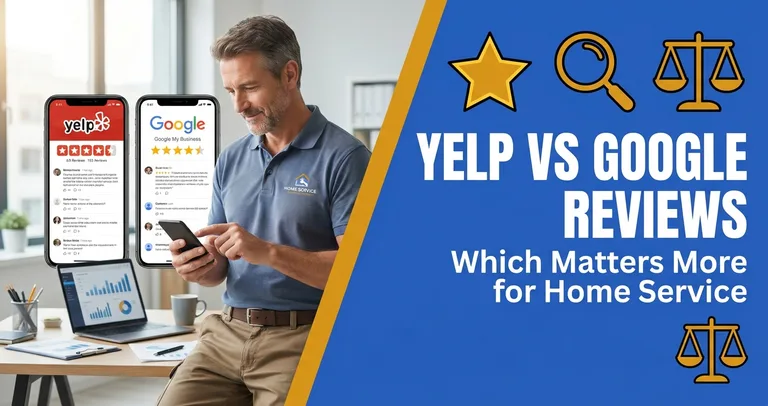
Yelp vs Google Reviews: The Short Answer for Home Service Owners
You already run crews, bid jobs, and write paychecks. You don't need a lecture on why reviews matter. What you need to know is where to point your time so the phone rings more, and the honest answer to Yelp vs Google reviews is simple: for a home service company, Google wins, and it is not close.
Here is why that matters in dollars. When a homeowner needs a tree taken down, a roof patched, or windows replaced, they pull out their phone and search Google. Your star rating shows up right in the map pack, next to a tap-to-call button, at the exact moment they are deciding who to call. That same homeowner almost never opens Yelp. So the company with 90 Google reviews at 4.8 stars gets the call, and the company with 140 Yelp reviews and 14 Google reviews gets skipped, even if it is the better outfit with bigger trucks and a better crew.
This post breaks down the real difference between google vs yelp reviews: where each platform shows up, how Google reviews feed your map rankings and your ads, why Yelp's filter buries the reviews you earn, where Yelp still has a little reach, and exactly where an established owner should spend the next 90 days. No theory, no fluff, just what actually moves booked jobs.
Where Google and Yelp Actually Show Up When Someone Needs You
The whole google reviews vs yelp debate comes down to one question: when a homeowner in your service area decides they need work done, which platform is in front of their face? Reviews only help you if a buyer sees them at the moment of decision.
Where your Google reviews show up:
- The map pack. When someone searches "tree removal near me" or "roof repair [your city]," Google shows three local businesses in a map at the top. Each one displays a star rating, a review count, and a call button. That is the most valuable real estate on the internet for a home service company, and your Google reviews are what put you there.
- Google Maps itself. A huge share of "near me" searches happen right inside the Maps app. Your rating shows on the pin before anyone taps it.
- The knowledge panel. When someone searches your business name directly, your profile, your rating, and your most recent reviews appear on the right side of the page.
- AI Overviews and Local Service Ads. Google's AI answers and its Local Service Ads both lean on Google review signals to decide who gets recommended and who shows up at the top.
Where your Yelp reviews show up:
- On Yelp.com, and basically nowhere else.
That is the gap in one line. A 5-star Yelp profile is only seen by the small slice of buyers who go to Yelp first, which for most home service trades is a side street most customers never drive down. Your Google profile sits on the main road where everyone already is.
Google Reviews Feed Your Map Rankings and Your Ads (Yelp Reviews Feed Nothing on Google)
This is the part that separates a vanity metric from a money metric. Google reviews are a real local ranking factor. Industry analysis consistently puts review signals in the neighborhood of 15% of what decides who lands in the map pack. Yelp reviews are worth exactly zero of that. Google does not pull Yelp data into its ranking math. You could have 500 five-star Yelp reviews and not move up a single spot on Google.
Here is what Google's local algorithm actually rewards, and why it compounds for an established company that does this on purpose:
- Quantity and recency. Total review count matters, but so does a steady drip of fresh reviews. A profile that adds reviews every week reads as an active, in-demand business. A profile frozen at 60 reviews from two years ago reads as stale.
- Rating and detail. A 4.7 to 4.9 average is the sweet spot, and reviews that mention the actual service and city ("they ground out three stumps in Plano in one afternoon") help you rank for those exact searches.
- Owner responses. Replying to reviews, good and bad, is a ranking and trust signal. It tells Google and the buyer that there is a real operator behind the profile.
There is a second payoff most owners miss: your Google reviews also lift your Local Service Ads and your paid search. Google's "Local Service Ads" badge and LSA ranking lean heavily on your review profile, so a strong profile makes every ad dollar work harder. Reviews are not a side project, they are the engine under your local visibility. If you would rather not run that engine yourself, this is the kind of system we build inside our local SEO and review strategy work, so the reviews, rankings, and ads pull in the same direction.
Why Are Yelp Reviews Worse Than Google? The Filter Is the Real Reason
Let's answer this head-on, because it is the question owners actually type into Google. Why are Yelp reviews worse than Google? It is not that the customers are worse or that the reviews are dishonest. It is that you do more work, lose more of it, and get less back. Three things stack up against you.
1. Yelp's filter buries the reviews you earn. Yelp runs "recommendation software" that hides reviews it deems not recommended. These hidden reviews do not count toward your star rating and live in a collapsed section almost nobody clicks. What gets filtered? Reviews from people with new Yelp accounts, few friends, or little review history, which describes almost every happy homeowner you serve. So you can ask ten satisfied customers, watch them all leave glowing reviews, and find that six of them got filtered into the void. That is the single biggest reason Yelp feels broken to contractors.
2. Yelp tells you not to ask. Yelp's own policy says businesses should not solicit reviews. Google encourages it. That one rule difference means you cannot systematically build a Yelp profile the way you can on Google, where you can text a review link the second a job wraps.
3. The work doesn't compound. On Google, every review you collect ranks you higher and sticks around feeding new calls for years. On Yelp, a chunk of your effort gets filtered, the rest never touches your Google ranking, and most buyers never see it anyway. Same effort, far less return.
So when an owner says Yelp reviews are "worse," what they really mean is that Yelp reviews are harder to earn, easier to lose, and pull less weight. All three are true.
Yelp's Trust Problem and Why Contractors Resent the Platform
Beyond the filter, Yelp has earned a reputation among home service owners that is hard to shake, and it shapes the yelp vs google decision for a lot of established companies.
Aggressive ad sales. Ask around any contractor group and you will hear the same story: pushy sales calls pressuring you to buy Yelp advertising, sometimes followed by a suspiciously timed shift in which of your reviews are visible. Yelp denies any pay-to-play behavior, but the perception is widespread enough that many owners simply do not trust the platform with their reputation.
Competitor abuse. Because Yelp reviews are easy to post and hard to verify, fake negative reviews from competitors are a known headache, and getting them removed is a slog.
Friction for the customer. Leaving a Yelp review is a chore. The customer often needs a Yelp account, has to verify it, and is nudged to write a long review, and even then it might get filtered. Leaving a Google review takes about thirty seconds because almost everyone is already signed into a Google account through Gmail, Chrome, or Android. Friction kills review volume, and Yelp is full of friction.
Google's structural advantage. Google has no reason to manipulate your reviews to sell you something. Its business is showing searchers the best local options, and reviews are a core data point for that. So legitimate reviews stay up, the rating reflects reality, and the platform is not actively working against you. For a company protecting a hard-earned reputation, that difference is not small.
Where Yelp Still Has Reach (And When to Bother)
Being honest about google vs yelp reviews means admitting Yelp is not pure dead weight. There are a few situations where keeping a clean Yelp presence is worth a small slice of attention, just never your main effort.
- Certain metros. In a handful of dense, Yelp-heavy markets, mostly large coastal cities, more buyers still start on Yelp than the national average. If you operate in San Francisco, Los Angeles, or a similar market, a tidy Yelp profile carries a little more weight.
- Higher-ticket, research-heavy jobs. For big remodels and projects where a homeowner is comparing several companies carefully, some buyers will cross-check Yelp as a second opinion. A profile with no reviews or an ignored 2-star looks worse than a modest, well-managed one.
- It is a backlink and a citation. Your Yelp listing is one more place your name, address, and phone number live consistently online, which is a minor positive for local SEO. Worth claiming and keeping accurate, not worth chasing reviews for.
The move for an established owner is simple: claim your Yelp listing, fill it out completely, keep your NAP consistent, respond to any reviews you do get, and then stop thinking about it. Make it accurate, then ignore it. Every hour you free up goes to the platform that actually books jobs.
Where to Put Your Effort: A 90-Day Google Review Plan for Established Companies
If you are already doing volume, you have a built-in advantage most companies do not: a steady stream of finished jobs and happy customers. That is review fuel. Here is how to turn it into a profile that out-ranks the competition, without adding a full-time job to your plate.
Days 1-30: Mine your existing customers. Pull your last year of completed jobs and text your 50 to 75 happiest customers a direct Google review link. Keep it human: "Hey [Name], it's [You] from [Company]. Glad we got that [job] handled for you. If you've got 30 seconds, a quick Google review really helps us out: [link]. Thanks." An established company can pull 15 to 25 reviews from past customers in the first month alone.
Days 31-60: Build it into the job, not on top of it. The reviews that compound come from a system that fires after every single job. The crew lead or office mentions a review when the work is done and the customer is happy, then a text with the review link goes out the same day, with one follow-up two or three days later if there is no response. Done consistently, 30 to 50% of customers leave a review. If you close even 40 jobs a month, that is 12 to 20 fresh reviews monthly, every month.
Days 61-90: Respond and tighten. Reply to every review, thank the good ones by name and reference the job, and answer the rough ones calmly and professionally. Watch which crews and which office staff drive the most reviews and coach the rest to match. By day 90 a busy company can realistically add 50 to 70 reviews and pull clear of most local competitors.
This is the highest-leverage marketing an established home service company can do, and it costs almost nothing but consistency. If your team is already maxed out and you would rather it run on autopilot, that is exactly what our done-for-you marketing handles: the automated review requests, the follow-ups, and the responses, wired into your local SEO so the reviews actually turn into booked jobs.
Yelp vs Google Reviews: Common Questions
Why are Yelp reviews worse than Google for a contractor?
Mostly because of Yelp's filter. It hides reviews from new or low-activity accounts, which is most of your happy customers, so a big share of the honest reviews you earn never count toward your rating. Add in the fact that Yelp tells you not to ask for reviews and that Yelp reviews do nothing for your Google ranking, and you end up doing more work for less return. That is why owners say Yelp reviews feel worse: harder to earn, easier to lose, and they pull less weight.
Do Yelp reviews help my Google ranking at all?
No. Yelp reviews live on Yelp and Google does not feed them into its local ranking. You could have hundreds of five-star Yelp reviews and it would not move you up one spot in the map pack. Google reviews, on the other hand, are a real ranking factor, somewhere around 15% of what decides who shows up locally. If ranking on Google is the goal, and for most home service owners it is, Google reviews are the ones that count.
Should an established home service company even bother with Yelp?
Claim your listing, fill it out, keep your name, address, and phone number consistent, and respond to any reviews that come in. That is it. Treat Yelp as one accurate citation among many, not a place to spend real effort. Put the time you would have spent chasing Yelp reviews into your Google profile, where the customers and the ranking power actually are. If juggling any of it is a hassle, a done-for-you system can keep both profiles handled and run your review requests automatically.