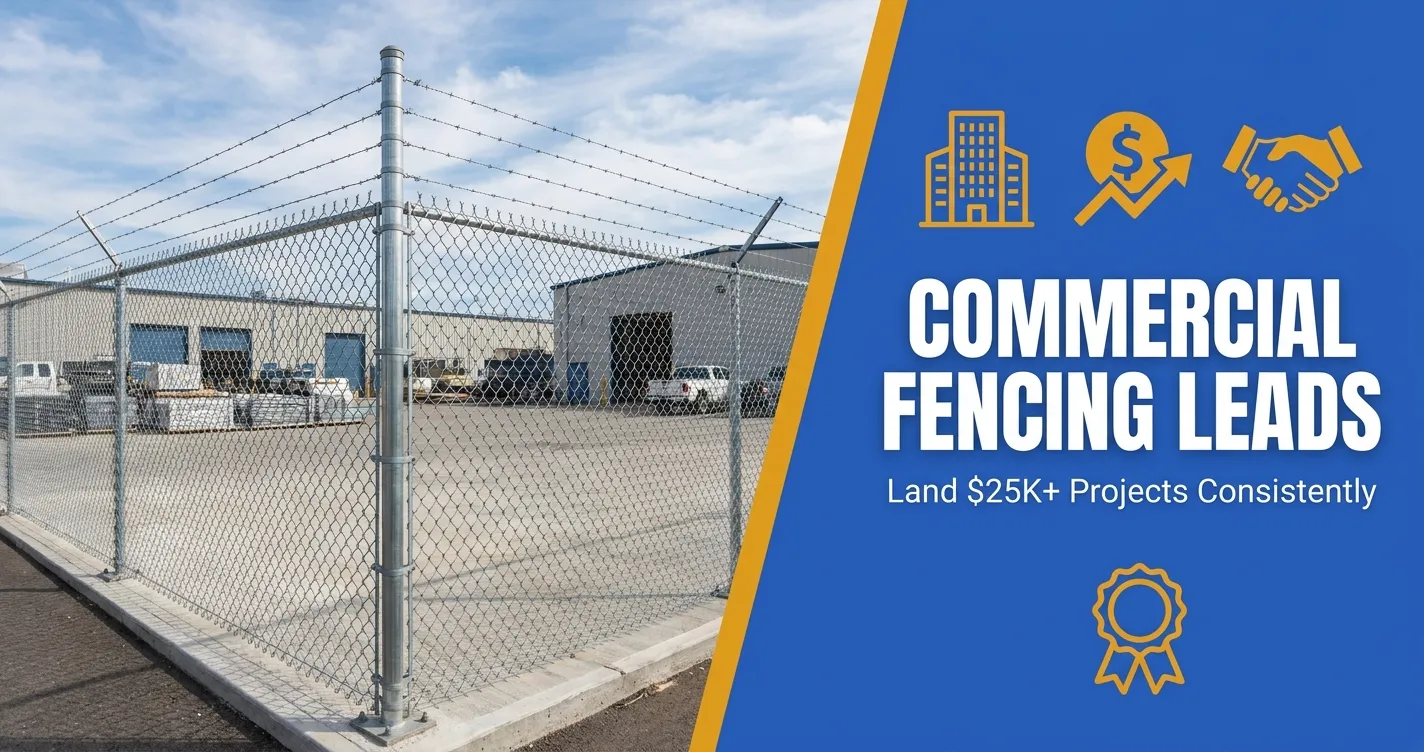
Why Commercial Fencing Is Worth Going After
Your residential fence company does $450,000 a year with 3 guys on payroll. Average job: $5,500. You need 82 residential jobs annually to hit that number. That is a lot of estimates, a lot of scheduling, and a lot of homeowners who "need to think about it."
One commercial fencing contract is worth $25,000-$75,000. Three per quarter - that is $300,000 in additional annual revenue. Same crew. Same equipment. Different customer. Bigger checks.
Commercial fencing includes: perimeter fencing for industrial sites, security fencing for warehouses and storage facilities, ornamental fencing for office parks and corporate campuses, athletic field fencing for schools and parks, temporary construction fencing, and access control/gate systems.
The margins are better too. Residential margins: 18-25%. Commercial margins: 22-35%. Why? Commercial clients value reliability and compliance over price. They need a licensed, insured contractor who can pull permits, meet safety codes, and finish on deadline. They are willing to pay 15-20% more for a contractor they trust.
Most fence contractors never pursue commercial work because they do not know how to find it. The sales cycle is different. The decision-makers are different. The proposal format is different. But the work itself is the same posts, rails, and panels you install every day.
Finding Commercial Fencing Opportunities
Commercial fencing projects do not come from Google Ads or Facebook. They come from relationships, bid boards, and direct outreach combined with strong local SEO. Here is where to look:
General contractor relationships: GCs need fencing subcontractors for every commercial construction and renovation project. Identify the 10-15 largest GCs in your metro. Send a capability statement (1-page PDF: your licenses, insurance, equipment, completed commercial projects, and references). Follow up monthly. One GC relationship can produce 3-8 projects per year.
Government bid boards: Every state, county, and city government posts public bid opportunities. Search your state's procurement portal for "fencing," "perimeter security," "chain link," and "gate installation." School districts, parks departments, and military installations all need fencing. Register as a vendor on every portal in your region.
Property management companies: Companies managing apartment complexes, HOAs, and commercial properties need fence repairs, replacements, and new installations regularly. Identify the 20 largest property management firms in your market. Send a capabilities package and offer a maintenance agreement (quarterly inspections at $200-$400 per visit with repair work billed separately).
Industrial parks and warehouses: Drive through every industrial park in your service area. Note properties with damaged, rusted, or inadequate fencing. Send the property manager a letter: "I noticed your perimeter fencing on [Street] has 3 sections that need attention. Here is a free assessment of what repairs would cost." Cold outreach to a visible problem converts at 8-15%.
The Commercial Proposal That Wins Contracts
Commercial clients do not sign based on a handwritten estimate on the back of a business card. They need a professional proposal that justifies the expense to their board, partners, or procurement department.
Your proposal should include:
Executive summary (1 page): Project scope, total cost, timeline, and why your company is the right choice. Keep it concise. Decision-makers read the first page and skim the rest.
Scope of work (1-2 pages): Detailed description of what you will install, including materials (brand, gauge, height, coating), footage, gates, hardware, and any concrete/grading work. Include a site diagram showing fence placement.
Pricing (1 page): Line-item pricing broken down by phase: site prep, materials, installation labor, gates, hardware, and cleanup. Show the total prominently. Include payment terms (30% deposit, 40% at midpoint, 30% at completion).
Timeline (1 page): Week-by-week project schedule with milestones. Commercial clients care about deadlines. Show them exactly when each phase starts and finishes.
Company qualifications (1 page): Licenses, insurance certificates, years in business, completed commercial projects with photos, and 3 references with phone numbers.
Total: 5-7 pages, professionally formatted with your logo and branding. Email as a PDF and mail a printed copy. Follow up within 48 hours. Commercial proposals that include site photos and diagrams win 30-40% more often than text-only proposals.
Commercial vs Residential: Different Sales Process
Residential: Homeowner calls, you give an estimate, they decide in 3-10 days. One decision-maker. Emotional purchase.
Commercial: Multiple decision-makers (facility manager, operations director, CFO, sometimes a board). 30-90 day sales cycle. Rational, budget-driven purchase. Requires formal proposals, sometimes competitive bidding, and often multiple meetings.
Key differences in approach:
Longer sales cycle: Do not expect a signed contract in one meeting. Plan for 2-4 touchpoints over 30-90 days. Site visit, initial proposal, revision meeting, final approval. Stay patient and professional.
Multiple stakeholders: The facility manager wants quality and low maintenance. The CFO wants the lowest total cost of ownership. The operations director wants minimal disruption to business operations. Your proposal must address all three perspectives.
Compliance requirements: Commercial projects often require specific permits, code compliance (especially for pool fencing, school perimeters, and industrial security), ADA-compliant gate widths, and safety certifications. Know your local codes before you bid.
Payment terms: Commercial clients often pay net 30-60 days. Factor this into your cash flow planning. Do not start a $50,000 project if waiting 60 days for the final $15,000 payment will create a cash crisis. Negotiate milestone payments to manage cash flow.
Warranty and maintenance: Offer a 1-2 year warranty on workmanship plus a maintenance agreement. This creates recurring revenue ($1,200-$3,600/year per property) and positions you as the default contractor for future fence work at that location.
Building a Commercial Fencing Pipeline
Commercial work is lumpy. You might land two $40,000 contracts in March and nothing in April. A pipeline system keeps opportunities flowing consistently.
Month 1-2 (outreach): Identify 50 potential commercial clients (GCs, property managers, industrial facilities, schools, government agencies). Send capability statements to all 50. Follow up by phone 7 days later. Target: 5-8 meetings scheduled.
Month 2-3 (proposals): Submit proposals for every opportunity. Visit every site in person. Take photos and measurements. Submit a professional 5-7 page proposal within 72 hours of the site visit. Target: 8-12 active proposals.
Month 3-6 (closing): Follow up on every proposal every 2 weeks. Address revisions promptly. Offer value engineering options if budget is tight (chain link instead of ornamental, phased installation). Target: Close 25-35% of proposals. That is 2-4 commercial jobs.
Ongoing: Add 5-10 new prospects to your pipeline monthly. Maintain relationships with GCs through monthly check-ins. Attend local construction industry networking events quarterly. Join your state's fence contractors association.
At $35,000 average commercial job value and 3-4 closings per quarter, commercial work adds $105,000-$140,000 per quarter to your revenue. Combined with your residential business, that is the path from a $450K company to a $1M+ operation. Get your fencing leads pipeline generating both residential and commercial opportunities, and your growth becomes predictable instead of seasonal.