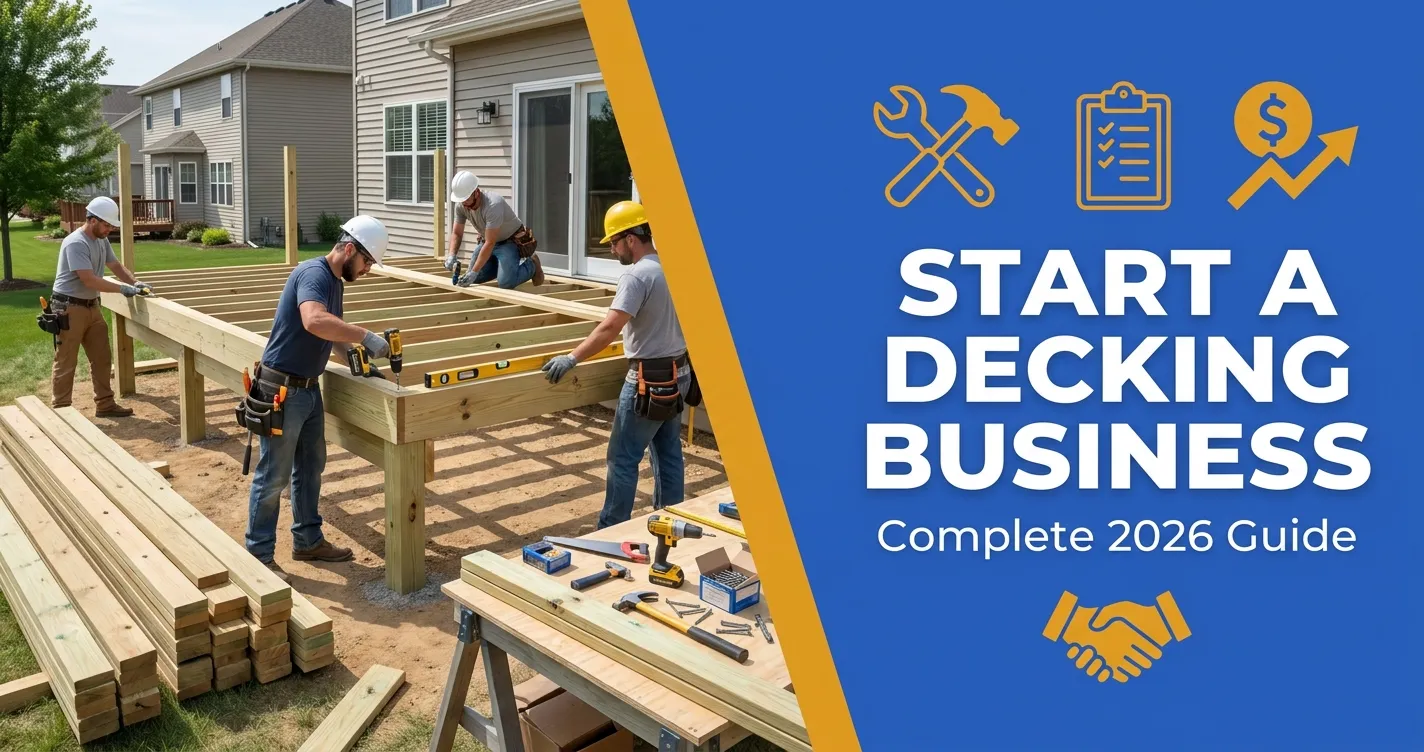
The Decking Industry Is Booming. Most New Builders Still Fail.
The US decking market is worth $11.8 billion and growing 4.2% annually. Homeowner demand for outdoor living spaces surged post-2020 and has not dropped. Average deck project value: $12,000-$22,000 for composite, $7,000-$14,000 for wood. That is serious revenue per job.
But 65% of new contracting businesses fail within 2 years. Not because they can not build. Because they can not sell, price, market, and manage cash flow. You know how to frame a deck. This guide covers everything else.
What you need before your first job: Contractor's license (requirements vary by state - some require exams, bonding, and 2-4 years of experience), general liability insurance ($1M minimum), workers' comp insurance (required if you have employees), a business bank account (separate from personal), and an LLC or S-Corp (talk to an accountant about which saves you more in taxes).
Startup costs: Tools and equipment: $5,000-$15,000 (if you are coming from framing, you have most of it). Truck: $25,000-$45,000 (used F-250 or Ram 2500). Insurance: $2,000-$5,000/year. Licensing: $200-$1,500 depending on state. Marketing: $1,500-$3,000 for initial setup. Website: $1,500-$4,000. Total: $35,000-$70,000 to start properly.
Pricing Your Deck Jobs for Profit, Not Just Revenue
The #1 reason new deck builders fail is underpricing. You price to win the job. You win the job. You lose money on it because you did not account for overhead, callbacks, weather delays, material waste, and the 3 hours you spent driving to the lumber yard.
The formula: Materials + Labor + Overhead + Profit Margin = Price.
Materials: Calculate exact quantities plus 10-15% waste factor. Get quotes from 2-3 suppliers. Do not use Home Depot pricing for estimates - your supplier pricing should be 15-25% lower.
Labor: Your crew cost per hour x estimated hours x 1.3 (to cover callbacks, weather days, and overruns). A 400 sq ft composite deck takes 4-6 days with a 3-person crew. At $35/hour per worker, that is $3,360-$5,040 in labor.
Overhead: Truck payment, insurance, tools, gas, office costs, marketing, and your own salary. Most deck builders need to add 20-30% to direct costs to cover overhead.
Profit margin: 15-25% minimum. Below 15%, one bad job wipes out your profit from the previous 3 jobs. At 20%, you build cash reserves for equipment, slow months, and growth.
Pricing per square foot (2026 averages): Pressure-treated wood: $25-$45/sq ft installed. Cedar: $35-$55/sq ft. Composite (Trex, TimberTech): $45-$75/sq ft. PVC (Azek): $55-$85/sq ft. Premium composite with cable railings: $65-$95/sq ft.
If your price is 20% higher than the cheapest competitor, that is correct. You are licensed, insured, warranty-backed, and permit-pulling. The cheapest guy is none of those things and will not be in business in 2 years.
Getting Your First 10 Customers
Your first 10 customers come from hustle, not ad budgets. Here is the fastest path:
Your personal network (customers 1-3): Tell everyone you know. Post on your personal Facebook and Instagram. "I just started a deck building company. If you or anyone you know needs a deck, I am offering 15% off my first 5 projects in exchange for honest reviews and permission to photograph the completed work." Friends, family, neighbors, your kid's soccer team parents.
Nextdoor and local Facebook groups (customers 4-6): Join every local community group. Do not spam. Respond genuinely to "looking for a deck builder" posts. Post your before/after photos with specs and pricing. Be helpful in other home improvement threads to build credibility.
Google Business Profile (customers 7-10): Set up and fully optimize your GBP on day 1. Get your first 5 customers to leave detailed Google reviews within 24 hours of project completion. A new GBP with 5 five-star reviews and complete profile information can start generating organic calls within 2-3 weeks.
After 10 completed jobs with photos and reviews, you have a portfolio and social proof. Now paid marketing channels become viable because you have project photos for ads, reviews for credibility, and a Google presence for organic traffic.
Your first 6 months should focus on doing excellent work, photographing everything, collecting reviews, and building a portfolio. Marketing your decking business gets dramatically easier and cheaper when you have 20+ completed projects and 15+ five-star reviews to showcase.
Scaling From One Crew to Multiple Crews
One crew doing $15,000/week in revenue caps you at $600,000-$750,000 annually (accounting for weather, holidays, and slow periods). To break $1M, you need a second crew. To break $2M, you need 3-4 crews plus a sales/estimator.
When to add a second crew: When you are consistently booked 4-6 weeks out and turning down jobs. Not when you have one busy month. 3 consecutive months of full backlog is the trigger.
Hiring: Your first hire should be a lead carpenter who can run jobs without you standing over them. Pay 15-20% above market rate. A great lead carpenter who stays 3 years is worth 10x more than 3 mediocre hires who quit in 90 days.
Systems before scaling: You need estimating software (BuilderTrend, CoConstruct, or even a detailed spreadsheet), a CRM to track leads and follow-ups, project management tools, and standardized contracts. Scaling without systems creates chaos - missed estimates, double-booked crews, unprofitable jobs, and customer complaints.
Cash flow planning: The biggest scaling mistake is taking on too many jobs before getting paid for the current ones. Require 30-50% deposit before ordering materials, progress payment at 50% completion, and final payment at walkthrough. Never start a job with less than 30% deposited. Material costs on a $20,000 job are $6,000-$9,000. Floating that out of pocket for 30 days while waiting to get paid will drain your account.
The Marketing System That Keeps Crews Busy
Referrals and repeat customers are great. They are also unpredictable. A marketing system makes revenue predictable.
Month 1-3 (foundation): Google Business Profile (free). Google Local Services Ads ($500-$700/week). Yard signs at every job site ($150 for 50 signs). Personal network and local groups (free). Target: 10-20 leads monthly.
Month 4-6 (growth): Add Google Search Ads ($1,500-$2,500/month). Launch referral program ($300-$500 per closed job). Start posting on Instagram 3-4x weekly. Optimize website for local SEO. Target: 25-45 leads monthly.
Month 7-12 (scaling): Add Facebook lead gen ads ($800-$1,500/month). Launch direct mail to high-value neighborhoods. Build city-specific landing pages. Hire a part-time estimator/salesperson so you can focus on production. Target: 40-80 leads monthly.
The revenue math: At 40 leads monthly, 30% close rate, and $14,000 average job, you are closing 12 jobs/month = $168,000 monthly revenue = $2M+ annually. Two crews at 6 jobs each can handle that volume.
Your total marketing budget at this stage: $4,000-$7,000/month. That is 2.5-4.2% of revenue. Compare that to the 8-12% industry average and you see why running your own marketing system (or hiring a team like Home Service Direct to build it for you) beats buying shared leads from aggregator platforms.
The deck builders who build marketing systems in year 1 scale to $1M+ by year 2-3. The ones who rely solely on word-of-mouth plateau at $400K-$600K and stay there. The work is the same either way. The difference is whether your phone rings 5 times a day or 5 times a week.
Starting a Decking Business: Common Questions
These are the questions deck builders ask most when they are getting a company off the ground. Short, straight answers, no fluff.
How much does it cost to start a decking business?
Plan on roughly $35,000 to $70,000 to start the right way. The big buckets are a work truck ($25,000-$45,000 used), tools and equipment ($5,000-$15,000, less if you already framed for a living), insurance ($2,000-$5,000 a year), licensing ($200-$1,500 depending on your state), and getting a website and basic marketing live ($3,000-$7,000). You can technically start lighter if you already own a truck and tools, but skipping insurance or a real website just moves the cost to later, usually at a worse time. Treat that range as illustrative, your local truck prices and state fees will move the number.
Do you need a license to start a decking business?
In most states, yes, once a job crosses a certain dollar amount (often $500 to $1,000) you need a contractor's license to legally build decks for pay. Requirements vary a lot: some states want an exam, a surety bond, and proof of 2-4 years of experience, while others just require registration. On top of the state license, your city or county may require a separate business license, and almost every deck job needs a building permit pulled before you start. Call your state contractor licensing board before you bid your first job. Getting licensed is also a selling point, it is one of the easiest ways to separate yourself from the cash-only guy who undercuts you.
Is a decking business profitable, and how much do deck builders make?
It can be very profitable if you price for margin instead of just chasing revenue. A healthy deck build runs a 15-25% net profit margin, so on a $15,000 job that is roughly $2,250 to $3,750 in actual profit after materials, labor, and overhead. One crew booked consistently does $600,000-$750,000 a year, and owners who add a second and third crew with systems in place push past $1M-$2M. The builders who stay broke are almost always the ones who underprice to win the job, then eat the callbacks, weather delays, and material waste themselves. Profit comes from your pricing discipline, not just how many decks you build.
How much should I charge to build a deck?
Price the job, not the square foot, but use per-square-foot numbers as a sanity check. As a 2026 ballpark installed: pressure-treated wood runs about $25-$45 per sq ft, cedar $35-$55, composite like Trex or TimberTech $45-$75, and PVC $55-$85. Build your real quote from the bottom up: materials (plus a 10-15% waste factor) + labor (crew hours times 1.3 to cover callbacks and weather) + overhead + a 15-25% profit margin. If your number lands about 20% above the cheapest competitor, that is usually correct, you are licensed, insured, and pulling permits, and they are not. Never lower your price just to match someone who will not be in business in two years.
How do I get customers for a new deck building business?
Your first 10 customers come from hustle, not ad spend. Tell your personal network you are open and offer a small discount on your first few projects in exchange for honest reviews and permission to photograph the work. Answer "looking for a deck builder" posts in local Facebook groups and on Nextdoor without spamming, and set up a fully optimized Google Business Profile on day one so reviews start stacking. Once you have 15-20 finished projects with photos and five-star reviews, paid channels like Google Local Services Ads, search ads, and yard signs start paying off because you finally have proof to show. If you would rather skip the trial and error, you can also have a team like Home Service Direct send you exclusive deck building leads so your crews stay booked while you focus on the build.