Why Google Maps Is the Cheapest Crew You'll Ever Hire
You already run a real tree service. You've got climbers, a bucket truck or two, a chipper that eats your fuel budget, and a phone that needs to ring with the right kind of calls, large removals, storm work, recurring commercial accounts, not tire-kickers asking you to top a tree for fifty bucks. The question isn't whether you can do the work. It's whether the homeowner who just watched a 60-foot oak crack over their roof finds you first, or the guy down the road with a magnetic sign and a chainsaw.
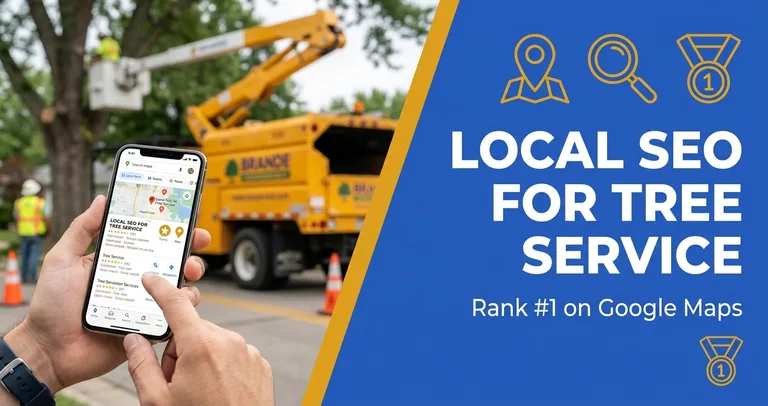
In 2026, that decision happens in the Google Map Pack. When someone searches "tree removal near me" or "emergency tree service," Google shows three businesses in a map at the top of the page before a single regular website appears. The companies in those three spots capture the overwhelming majority of the clicks and calls. Everyone below the fold is fighting over scraps. This is what tree service local SEO is actually about: getting into that pack and staying there in your highest-value zip codes.
Here's the payoff, and why an established owner should care more than a startup ever could. You already have the trucks, the insurance, the crews, and the reviews from years of real jobs. You have everything a new operator spends years building. Most established tree companies just never bothered to organize that reputation so Google can see it. Do that, and the Map Pack becomes the cheapest, most consistent crew you'll ever hire, one that books jobs while you sleep and never asks for overtime. Below is the full playbook to make your Google Maps presence the engine that fills your schedule.
Google Business Profile: The Asset That Decides Everything
Your Google Business Profile (the listing that powers your spot on tree service Google Maps) is the single biggest lever you have. Treat it like a piece of equipment you maintain, not a thing you set up once in 2019 and forgot. Log in, claim it if you haven't, and go through it line by line.
Pick categories like your schedule depends on it
Your primary category carries the most weight Google gives you. For most operations it should be "Tree Service." Then stack relevant secondary categories that match what you actually do and want more of: "Arborist Service," "Stump Grinding Service," "Land Clearing Contractor," "Lawn Care Service" if you cross-sell it. Don't add categories for work you don't want, because Google will send you those calls. If 80 percent of your margin is removals and large-tree work, your primary category and your photos should scream that.
Fill every field, then fill the ones you skipped
Service area set to the cities you actually drive to. Hours accurate, including a 24-hour or emergency note if you run storm response, that one line wins you the 2 a.m. "tree on my house" calls your competitors are sleeping through. Phone number that rings a human or goes to a service that books, not a voicemail. A detailed business description with your real service area and specialties. Add every individual service under the Services section with a short, plain description and a price range where it makes sense.
Photos do the selling
This is where almost everyone is lazy, and it's free leverage. Upload real, recent job photos: big removals, the bucket truck in action, a clean stump grind, before-and-after shots, your crew in branded shirts, your equipment lined up. Tree work is visual and a little dramatic, use that. Aim to add fresh photos every week or two. Profiles with steady, high-quality photo activity get more views and more calls, and a dead photo feed signals to Google that the listing is stale.
Post like it's a job board
Google Posts show up right on your profile. Post a recent job, a seasonal reminder (storm prep, oak wilt season, winter pruning), or a quick offer. You're not writing essays, a photo and two sentences is plenty. The point is a steady signal that the business is active and the work is real.
How the Map Pack Actually Ranks (and How to Win It)
Google ranks the local pack on three things, and once you understand them, the whole game gets simpler. Everything in this playbook ladders up to one of these.
- Relevance - does your profile clearly match what the searcher wants? This is your categories, services, description, and the words in your reviews. A profile that says "Tree Service" with stump grinding, removals, and arborist work listed out beats a vague one every time.
- Distance - how close are you to the searcher? You can't move your truck closer to every customer, but you can rank in more of your service area with city landing pages and consistent location signals (covered below). This is why a single shop can dominate one suburb and be invisible two towns over.
- Prominence - how established and trusted does Google think you are? This is your review count and velocity, your citations across the web, links pointing at your site, and your overall web footprint. Prominence is where an established company crushes a startup, you've earned years of it, you just have to surface it.
The practical takeaway: you win the Map Pack by being obviously relevant (dialed-in profile), reducing the distance problem (geographic content), and stacking prominence faster than the other guys (reviews, citations, links). A startup can't fake prominence. You already have it. The rest of this post is how to make Google count it.
Build a Review Engine, Not a Review Habit
Reviews are the loudest prominence signal in local search, and for tree service they double as your closer, a homeowner about to let a stranger drop a tree near their house wants proof you won't put it through their living room. The companies winning the pack aren't the ones who occasionally remember to ask. They have a system that asks every single customer, every single job, automatically.
Here's the difference between a habit and an engine. A habit is the crew lead saying "hey, leave us a review if you liked it." That gets you maybe one review in ten jobs on a good month. An engine looks like this:
- Ask at the moment of relief. The best time is right after the job, when the customer is standing in their cleaned-up yard looking relieved the dead tree is gone. Have the crew lead hand them a card with a QR code, or trigger a text from the office the moment the job is marked complete.
- Make it one tap. Use a direct review link that opens the review box, not your homepage. Every extra click loses people.
- Text beats email. A short text gets opened and acted on far more than an email that dies in spam. "Thanks for trusting us with that oak removal, Dave. Mind leaving a quick review? [link]"
- Respond to every review, good and bad. Thank the good ones by name and mention the job ("glad we could get that storm-damaged maple down safely"). Respond to the bad ones calm and professional, future customers read how you handle problems, not just the star count. Putting your service keywords and city names naturally into your replies helps too.
Two things matter more than total count: velocity (a steady stream of new reviews beats 200 reviews that all stopped in 2022) and recency. Forty recent reviews can outrank a hundred old ones. If you've done a thousand jobs and have eleven reviews, you don't have a reputation problem, you have a collection problem. Fix the system, not the crew.
NAP and Citation Consistency: The Boring Fix That Moves Rankings
NAP stands for Name, Address, Phone. Citations are the places across the web that list your business, directories, your chamber of commerce, Yelp, Angi, Nextdoor, industry directories, your own site. Google cross-checks all of these to decide how legitimate and established you are. When the details match everywhere, that's a trust signal. When they don't, it's a confusion signal, and confusion costs you rankings.
This is the least glamorous item on the list and one of the most common things holding established companies back, precisely because you've been around long enough to accumulate a mess. You changed your number five years ago and three old listings still show the old one. You moved shops and half the web has the old address. You list yourself as "Smith Tree Service LLC" in one place and "Smith Tree & Landscaping" in another. Every one of those mismatches dilutes you.
- Lock in one exact format for your business name, address, and phone, down to whether you write "Street" or "St." Use it everywhere.
- Audit your existing listings. Search your business name and your old phone numbers and see what comes up. Fix or claim the big ones first: Google, Bing, Apple Maps, Yelp, Facebook, then industry and local directories.
- Get listed where tree companies belong. Local chamber, BBB if you carry it, home-service platforms, and any "best tree service in [city]" roundups, those double as citations and links.
- Keep your own website's footer and contact page matching exactly, with the same phone that's on your Google profile.
None of this is exciting. It's also the kind of grind-it-out cleanup that's easy to put off forever while you run an actual company. This is a textbook case of "do it once correctly, or have someone do it for you," handling citation cleanup and consistency is a core part of professional tree service SEO precisely because owners never have time to chase down forty old directory listings.
City and Service Pages: How You Rank in Towns You Don't Sit In
Remember the distance factor? Here's how you beat it. Your Google profile sits at one physical address, so you naturally rank strongest right around it. But you drive to a dozen towns. To show up in those towns, in both the Map Pack and the regular results below it, you need dedicated pages on your website for each city and each major service.
The principle is simple: one page, one job. A page that says "we serve the whole metro" ranks for nothing. A page titled "Tree Removal in [Suburb]" that talks specifically about that town can rank for exactly that search.
- City pages. Build a real page for each city or suburb you want work in. Not a thin clone with the city name swapped, that gets you nowhere and can get you penalized. Write about that area specifically: the tree species common there, local storm patterns, a neighborhood or two by name, a job you did there, and the services you run in that market. Treat your highest-value towns to the deepest pages.
- Service pages. A standalone page for each money service: tree removal, trimming and pruning, stump grinding, emergency and storm response, land clearing, commercial tree care. Each one targets how people actually search and lets you go deep on what the job involves, what it costs, and why you're the safe choice for big work.
- Cross-link them. Link your service pages to your city pages and back. "Tree removal in [city]" should link to your main tree removal page and your [city] page. This internal linking tells Google how your service area maps together.
Done right, this is how one shop ranks across an entire metro instead of just its home zip. It's also real work to write pages that are genuinely about each town instead of mad-libs, which is why this is the other natural "do it yourself or hand it off" piece, the same way an owner who's tired of cold tire-kickers eventually decides it's worth getting exclusive tree service leads instead of building the whole machine in-house.
On-Page Basics and Local Link Building to Cement Your Lead
Two final layers separate the companies that flirt with the top three from the ones that camp there. Neither is complicated, but both get skipped.
On-page basics that still move the needle
- Title tags and headings on every page should name the service and the place: "Emergency Tree Removal in [City] | [Company]." The words people type should be in your page titles and headers, written for a human, not stuffed.
- Load fast and work on a phone. Most tree searches happen on a cracked phone screen in a panicked moment after a storm. A slow or clunky mobile site loses the call. Compress your photos, keep the click-to-call button obvious, and make the phone number tappable.
- LocalBusiness schema. This is structured data that spells out your name, address, phone, service area, and reviews in a format Google reads directly. It removes guesswork and helps you qualify for rich results.
- An obvious path to call or book on every page. Phone number in the header, a short quote form, no maze. You drove the click this far, don't lose it at the goal line.
Local link building, the prominence accelerator
Links from other reputable local sites tell Google you're an established part of the community, not a fly-by-night. You earn these the way an established company actually can:
- Sponsor local stuff. A youth sports team, a community cleanup, a county fair. Most come with a link from the organization's site.
- Get on local roundups and news. "Best tree services in [city]" lists, and local news after a big storm, you're already out there clearing roads, get credit for it.
- Partner referrals. Landscapers, roofers, property managers, and real estate agents who refer you can also link to you. You refer back. Everybody wins.
- Supplier and association pages. Equipment dealers, your insurer, and arborist associations often list members with a link.
A handful of genuine local links beats fifty spammy ones. The goal is to look like exactly what you are, the established tree company that's been doing the hardest work in town for years.
Tree Service Local SEO FAQ
How long does it take to rank in the Map Pack?
For an established company with real reviews and a long track record, dialing in your Google Business Profile and fixing citations can move things in a few weeks. Climbing to the top three in competitive zip codes usually takes a few months of steady review collection, content, and links. The companies that win treat it as ongoing maintenance, not a one-time project. The good news: your years in business mean you start with prominence a new operator can't buy.
Do I need a website if I have a Google Business Profile?
Yes. Your profile gets you into the map, but the website is what lets you rank in towns away from your shop (through city pages), go deep on your high-margin services, host the reviews and schema that build trust, and capture links. Profile plus website work together, the profile is the storefront, the website is the proof and the reach.
Is local SEO worth it when I'm already busy?
Being busy now and being busy in your slow season are two different things, and local SEO is what fills the calendar when the phone naturally goes quiet. It also lets you be choosier, more inbound calls means you can favor the large removals and commercial accounts that actually carry margin instead of taking every small job to keep crews working. If you'd rather skip the build-out entirely, that's exactly when handing the marketing to a team that delivers booked jobs starts to pencil out against doing it all yourself.