You already run crews, bid jobs, and make payroll every two weeks. You do not need a lecture on how to start a tree service. You need more booked jobs, fatter margins, and a business that keeps growing when the easy storm work dries up. That is a different problem, and most tree service marketing advice ignores it completely because it is written for guys with one truck and a Craigslist ad.
Here is the part nobody tells you once you are past a couple million in revenue: buying more leads stops being the answer. You can spend more on ads and watch your cost per job climb while your close rate stays flat. The companies that break $3M, $5M, and beyond are not just better at getting leads, they are better at marketing the whole business: a brand people trust, a website that closes, reviews that do the selling before you ever show up, and revenue streams that do not vanish in January.
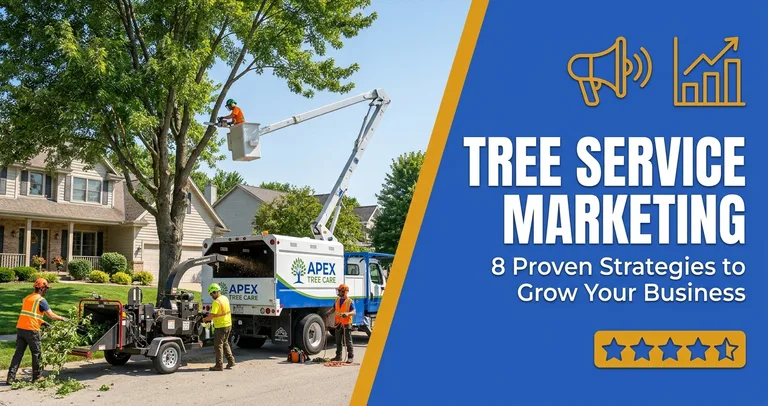
This guide is 8 tree service marketing strategies built for that stage. The goal is not a flood of cheap calls. The goal is to grow the tree service business as a whole, raise what a customer is worth, and stop competing on price. If you also want the fast tactics for filling next week's schedule, we cover those in the companion guide to getting tree service customers fast, and you can grab exclusive tree service leads while these longer plays compound.
1. Build a Brand That Lets You Stop Competing on Price
When a homeowner cannot tell you apart from the other three trucks bidding the same oak, they make the decision on price. Every time. A real brand is what lets you be the $4,200 bid that wins over the $2,900 bid, because the customer already decided you are the safe choice.
This is the most underrated lever in tree service marketing, and it is the one most owners skip because it does not show up on a lead report. But it is the difference between a 20% close rate at thin margins and a 40% close rate at prices that actually pay for your insurance, your equipment, and your time.
What a brand actually means for a tree service:
- Looks the part: Wrapped trucks, clean uniforms, a logo that does not look like it was made in 2009. A homeowner is letting a stranger run a chainsaw 60 feet over their roof. They are buying trust, and trust looks professional.
- Credentials front and center: ISA Certified Arborist on staff, TCIA accreditation, your insurance and workers' comp. Most of your competitors have none of these, or hide them. Put them everywhere.
- A consistent name and message: Same business name, address, and phone on your website, Google profile, truck, and every directory. Inconsistency confuses customers and tanks your local search visibility.
You do not need a six-figure rebrand. You need to look like the established, insured, credentialed company you already are, so the customer stops shopping the moment they see you.
2. Turn Reviews Into Your Best Salesperson
Before a homeowner calls you, they read your reviews. Then they read your competitor's. The one with 180 reviews at 4.9 stars gets the call. The one with 22 reviews at 4.3 stars does not, even if their work is better. That is reputation doing your selling for you, or doing your competitor's.
For an established company, reviews are not a vanity number. They drive your spot in the Google map pack, they raise the price you can charge, and they shorten the sales conversation because the customer already trusts you. This is the highest-leverage reputation work in all of tree service advertising, and it is nearly free.
How to build a review engine instead of begging one at a time:
- Ask every single happy customer, the same day. The crew lead texts a direct review link the moment the chips are blown and the yard is clean. Same-day requests convert far better than an email three days later.
- Make it stupid easy. A short link or QR code on the invoice. Every extra tap loses people.
- Respond to all of them, especially the bad ones. A calm, professional reply to a one-star review sells the next ten prospects who read it. It shows you stand behind your work.
- Aim for steady volume. A few new reviews every week beats a one-time blast. Google rewards recency, and so do customers.
If your competitor with worse crews stays booked solid, this is usually why. They built a review wall and you did not.
3. A Website That Actually Books Jobs
Most tree service websites are expensive brochures. They list services, show a stock photo of a chainsaw, and quietly lose the customer. For a growing company, your website is the place every other marketing channel sends traffic, so if it does not convert, you are paying to fill a bucket with a hole in it.
A website that books jobs does a few things ruthlessly well:
- Phone number top right, big, clickable, on every page. Most tree service customers want to call. Do not bury it.
- A quote form that asks for almost nothing. Name, phone, address, what they need. Every extra field cuts your conversions. You can qualify on the phone.
- Proof above the fold. Star rating, review count, years in business, certifications. Answer "can I trust these people" in the first three seconds.
- Loads fast and works on a phone. Most of your traffic is mobile, often standing in their yard looking at a dead limb. A slow site loses them to the next result.
- Real before-and-after photos of your work. Your actual crew, your actual trucks, your actual jobs. It out-converts stock every time.
Getting more tree service leads is often not a traffic problem at all. It is a conversion problem. The same ad spend on a site that converts at 8% instead of 2% quadruples your booked jobs with zero extra in ad budget. Fix the site before you spend another dollar driving traffic to it.
4. Market on More Than One Channel
If every job you get comes from one source, you do not have a marketing strategy, you have a single point of failure. The day that channel's costs spike or the algorithm changes, your phone goes quiet and your crews sit. Established companies grow by stacking channels that feed each other.
Here is how the main channels play different roles in a mature tree service marketing strategy:
- Local SEO and Google Business Profile: The map pack and "tree service near me" results are the highest-intent, lowest-cost leads you can get. This is a long game that compounds, and once you rank, the leads keep coming without paying per click.
- Google Local Services Ads and Search Ads: Pay-per-lead and pay-per-click at the moment someone is searching. Expensive per lead, but the intent is high and you can turn it on the week you need volume.
- Meta (Facebook and Instagram): Less about "I need a tree removed today" and more about staying top of mind in your service area, retargeting people who visited your site, and showing off dramatic removals that get shared.
- Direct mail and yard signs: Old school, still works in residential neighborhoods, especially after a storm. A sign in a yard where you just dropped a big tree is the cheapest advertising you will ever run.
The point is balance. When SEO is feeding you steady organic calls, you can dial paid ads up and down to control your schedule instead of overpaying for every job. For the channel-by-channel playbook on filling next week fast, send your team to the guide on getting tree service customers fast. If you would rather not build and run all of this in-house, this is exactly the kind of multi-channel system you can have tree service marketing done for you.
5. Mine Your Existing Customers for Repeat Work and Referrals
You spent good money to win every customer in your database. Most tree services then ignore them forever and go pay full price to acquire the next stranger. That is backwards. Your past customers are the cheapest growth you have, and the margins on that work are the best in your business because there is no acquisition cost.
Tree work is not one-and-done. A property with mature trees needs pruning every few years, has more trees than the one you removed, and the neighbor watched your crew work all day. The money is in working that base.
Turn one job into three:
- Walk the property and quote the next job before you leave. You are already there. "That maple in back has deadwood that should come out next season" is the easiest sale you will ever make.
- Run a simple referral offer. A real incentive for a customer who sends you a neighbor that books. Word of mouth is how the best tree companies grow, so put structure behind it instead of hoping for it.
- Stay in touch seasonally. A short email or postcard before storm season and before winter pruning keeps you top of mind. A customer who hears from you twice a year calls you, not the truck that knocked on their door.
- Knock the neighbors while the chipper is running. A flyer or a quick conversation on the same block when your crew is already set up costs you nothing and lands jobs with zero drive time.
A 5-10% bump in repeat and referral work usually beats a 20% increase in ad spend, and it costs you almost nothing.
6. Add Commercial and Municipal Accounts for Predictable Revenue
Residential tree work is lumpy. It spikes after storms and crawls in slow months. If you want to grow past the ceiling that residential-only companies hit, you add commercial and municipal accounts, and you market to them deliberately, because they do not find you on a "tree service near me" search.
These accounts are bigger, more predictable, and far less price-sensitive than a homeowner shopping three bids. A property management company with 40 sites, an HOA, a golf course, a city public works department, a utility right-of-way contract, these are recurring relationships, not one-off jobs.
What it takes to win this work:
- The credentials are non-negotiable. Certified arborists, full insurance, workers' comp, and often specific bonding or safety records. If you built the brand in strategy one, you already have most of this. Now put it on a one-page capabilities sheet.
- You have to go get it. This is outbound, not inbound. A list of property managers, HOAs, and municipalities in your area, and a person whose job is to call and meet them. Marketing here looks like relationships and proposals, not ads.
- Get on the bid lists. Many cities and large properties run formal bids. Register as a vendor, learn their cycle, and be in the running before the work goes out.
- Lead with reliability and safety, not price. These buyers care most about a contractor who shows up, carries the paper, and does not get someone hurt on their property. Sell that.
One solid commercial account can be worth more than dozens of one-off residential jobs, and it keeps your crews busy in the slow weeks when your competitors are sending guys home.
7. Market Through the Seasons Instead of Riding the Roller Coaster
Every tree service owner knows the cycle. Slammed after a big storm, slammed in spring and fall, dead in mid-winter and the dog days of summer. Most companies just ride it and pray. The ones that grow market against the cycle so their schedule stays full year-round.
The trick is matching the message to the season instead of running the same ad all year:
- Before storm season: Push proactive removal of hazardous and dead trees. "Take the widow-maker down before it takes your roof down" sells in the weeks before the wind comes. This is also when your ad costs are lower because demand has not spiked yet.
- Winter and slow months: Push dormant-season pruning, which is genuinely better for many trees, plus discounted rates to keep crews working. A booked crew at a lower margin beats an idle crew at no margin.
- Right after a storm: Be fast and visible. The companies that capture storm work are the ones already ranking, already known, and already set up to respond. You cannot build that reputation the day the storm hits, you build it in the calm months.
- Year-round: Lean on the commercial accounts and referral base from the earlier strategies to smooth out the residential swings.
Seasonality is not something you survive. It is a calendar you market against on purpose, so the same crew that sat idle last January is booked solid this one.
8. Run Marketing on Numbers, Not Gut Feel
Once you are doing real volume, "I think the ads are working" is how you bleed money. The owners who grow fastest treat marketing like any other part of the operation: they measure it, they know their numbers, and they move budget toward what pays.
You do not need a fancy dashboard. You need to know a handful of numbers cold:
- Cost per lead by channel. What you pay to get one phone call from SEO versus Google Ads versus Facebook. They are wildly different, and you cannot optimize what you do not track.
- Close rate. Of the leads that come in, what percent turn into booked jobs. If a channel sends cheap leads that never close, it is not cheap.
- Average job value, and lifetime value. What a customer is worth on the first job, and over years of repeat and referral work. This is the number that tells you what you can actually afford to spend to win one.
- Cost per booked job. The number that matters most. Cheap leads at a low close rate can cost you more per job than expensive leads that close.
Here is the math that changes how you think: if a customer is worth $2,000 on the first job and another $1,500 in repeat and referral work over time, you can afford to spend far more to acquire them than the owner who only counts the first invoice. That is how the bigger companies outbid you for the same lead and still make money. They know their numbers and you are guessing.
Track these, kill what loses, and pour budget into what wins. That is the whole game at scale.
Frequently Asked Questions
What is the most effective tree service marketing strategy for an established company?
There is no single magic channel, and any honest answer that gives you one is selling you something. For a company that already runs crews, the highest return usually comes from the unglamorous foundation: local SEO and a strong Google Business Profile for steady low-cost leads, a wall of recent reviews that closes customers before you bid, and a website that actually converts the traffic you already pay for. Those compound. Paid ads then become a dial you turn up and down to control your schedule, not your only lifeline.
How do I get more tree service leads without just spending more on ads?
Most of the time, more booked jobs do not require more ad spend, they require fixing the leaks. Raise your website conversion rate, build a steady stream of reviews, and mine your existing customer base for repeat and referral work. Those moves grow your booked jobs at almost no added cost. When you do want fast volume on top of that, our guide to getting tree service customers fast covers the paid plays, and you can buy exclusive tree service leads to fill specific gaps in your schedule.
Should I run my tree service marketing in-house or hire it out?
It depends on whether you have someone who will actually own it. Marketing fails when it is the owner's eighth priority and gets touched once a month. If you have a capable person with the time, in-house works. If you do not, and most growing tree companies do not, it is usually faster and cheaper to have tree service marketing done for you by a team that does this every day, so you can stay focused on running crews and closing jobs.