You are already spending real money to make the phone ring. Paid ads, your website, referral programs, the truck wraps, all of it exists to produce one thing: a lead. So here is the question that should keep you up at night. When that lead comes in at 2:14 on a Tuesday, how long does it take before a human being from your company actually talks to that person? Be honest. Not your best day. Your average day, when the crew is short, the office is slammed, and three estimates are already running late.
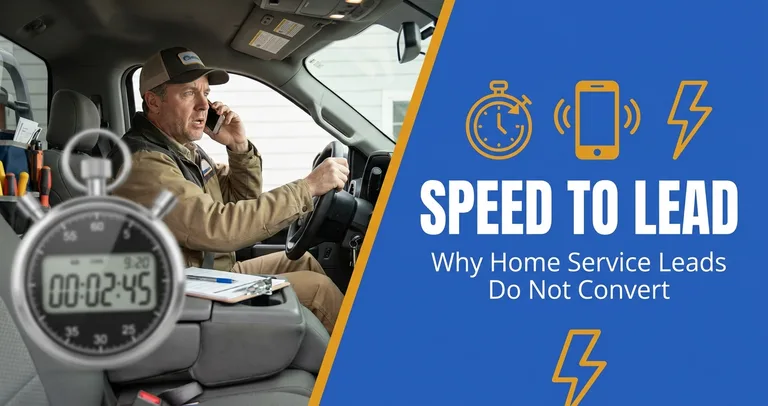
For most established home service companies, the answer is somewhere between 30 minutes and never. And that gap is where your money is going. It is not that your leads are bad. It is that speed to lead is the single biggest reason home service leads don't convert, and almost nobody is measuring it. The first contractor to respond usually wins the job, often before your competitor has even picked up the phone. The lead did not need a better pitch. They needed someone to answer.
The good news: this is the cheapest revenue lever you have. You do not need more leads to book more jobs. You need to answer the ones you already paid for, faster. This post breaks down why response time decides the sale, what the drop-off actually looks like, and the exact systems that make fast lead response automatic so it does not depend on whoever happens to be near the phone.
The First Contractor to Respond Usually Wins
Here is what is really happening on the homeowner's end. A pipe is leaking, a tree is leaning over the garage, the AC died in July. They are stressed, they want it handled, and they do not have a relationship with any contractor. So they do what everyone does now: they fill out two or three forms or call two or three numbers in the span of about ten minutes, then they wait.
Whoever calls back first gets to set the terms. You get to be the calm professional who answers fast, asks good questions, and books the appointment while the other two companies are still letting it sit in a voicemail box. By the time contractor number two calls back an hour later, the job is often already scheduled with you. The homeowner is not comparing five bids on a burst pipe. They are picking the first competent company that shows up and acts like they want the work.
This is why response time beats almost everything else in the sale. It beats being slightly cheaper. It beats a slicker website. It beats a few extra reviews. Reviews and price matter once you are in the conversation, but you cannot win a conversation you are not in. Speed is what gets you into the room. Every minute you make that homeowner wait is a minute you are handing your competitor a chance to call first.
What Happens to Your Leads After 5 Minutes
The reason slow follow-up quietly destroys conversion is that the drop-off is not gradual. It falls off a cliff. The data on this has been consistent across industries for years, and home services is no exception because the buying urgency is so high.
Contact a web lead inside the first five minutes and your odds of actually reaching that person and qualifying them are dramatically higher than if you wait even thirty minutes. Push it out to an hour and the odds of a meaningful conversation drop by a large multiple. Wait until the next day, which is what a lot of "I'll get to it after this job" follow-up really means, and you are often looking at a fraction of the connect rate you would have had in the first few minutes. The lead did not get less valuable. The window just closed.
Two things drive that cliff. First, intent decays fast. The homeowner was motivated in the moment they reached out. An hour later they are back at work, distracted, or already talking to someone else. Second, and this is the part owners underestimate, they are not waiting around for you. They submitted multiple requests. The five-minute window is not really about your lead getting bored. It is about your competitor getting there first.
So when you look at a month where you ran ads, generated 100 leads, and booked 18 jobs, the instinct is to blame the lead quality or the ad. Often the real story is that 40 of those leads never got a fast, human response, and a good chunk of them booked with whoever called back in five minutes.
The Real Cost of Slow Follow-Up
Let's put rough numbers on it, and treat these strictly as illustrative ranges to show the math, not as promises. Say you spend on marketing to generate 100 leads in a month, and your average booked job is worth around 600 dollars in revenue at a healthy margin. Plenty of trades run well above that, but it keeps the example honest.
Imagine your current setup books 18 of those 100 leads because a meaningful share of leads sit unanswered for 30, 60, or 90 minutes before anyone responds. Now imagine you tighten response time so that nearly every lead gets a human or an automated text inside five minutes, and that lifts your booking rate to 28 of 100. That is not a fantasy number, that is the kind of jump companies see purely from answering faster, not from better salesmanship.
Ten extra booked jobs at 600 dollars is 6,000 dollars in additional revenue that month, off the exact same ad spend, the same leads, the same crews. Over a year, that one operational fix is worth tens of thousands of dollars you were already paying to generate and then letting evaporate. Slow follow-up is not a customer service problem. It is a revenue leak. And unlike buying more leads, closing this gap costs you almost nothing in additional spend.
The hidden tax is worse than the lost jobs, too. Every unanswered lead also drives up your effective cost per booked job, because you paid for the click or the form fill whether you answered it or not. Slow response makes your whole marketing budget look like it is underperforming when the real problem is downstream.
How to Answer Every Lead Fast
The fix is a system, not a pep talk. Telling your office team to "call back faster" does not survive a busy week. You need a few layers that catch leads automatically so speed does not depend on anyone remembering. Here is the stack that works for established home service companies.
Live answering for every inbound call
A real human answering the phone, every time, during business hours is still the gold standard. If your office cannot guarantee that because they are also dispatching, invoicing, and handling walk-ins, get a live answering service or a dedicated intake person whose only job is to pick up and book. A missed call from a homeowner with a leaking water heater is not a missed call. It is a job that went to your competitor.
Missed-call text-back for everything you can't catch
You will never catch 100 percent of calls live. When one slips, an automated text should fire within seconds: "Hi, this is [Company], sorry we missed you. Are you looking to get a quote? Reply here and we'll get you taken care of." This one automation recovers an enormous number of leads that would otherwise just disappear, because the homeowner gets an instant response and many will text back rather than call the next company.
Instant response to web and form leads
Every form fill and every "contact us" lead should trigger an immediate text and an email, then a phone call attempt within five minutes. The first text buys you time and signals you are responsive. The call closes it. Do not let web leads sit in an inbox until someone checks email after lunch.
Smart routing so a real person actually follows up
Automation gets the conversation started. A human has to finish it. Route every new lead to a specific person with a clear rule for who calls and how fast, and an escalation if they do not. "Everyone is responsible" means no one is. If you would rather not build and staff all of this yourself, this is exactly the kind of thing where it makes sense to get exclusive leads plus a system to answer them fast so the speed is handled for you.
You Can't Fix What You Don't Measure
Most owners have no idea what their actual lead response time is, which means they cannot fix it. "We're pretty quick" is not a number. Before you change anything, you need to see the truth, and it is almost always worse than your gut says.
Start tracking these few things and review them weekly:
- Average speed to first response. From the moment the lead comes in to the moment a human or an automated message reaches them. Track calls and forms separately.
- Missed-call rate. What percentage of inbound calls go unanswered, and what happens to them after. If you do not know this, assume it is higher than you want.
- Connect rate by response time. Group leads by how fast you responded and look at how many you actually booked. You will see your own version of the five-minute cliff in your own numbers.
- Lead source to booked job. Which channels produce leads you answer fast versus ones that pile up.
The most practical way to get honest numbers is to record and review your calls. When you can actually hear how long the phone rang, whether the lead got booked, and how the call was handled, the problems jump out fast. Setting up call tracking turns "I think we're fast" into a real number you can manage, and it shows you exactly which calls are turning into jobs and which are quietly slipping away.
Pick a target and hold the team to it. "Every lead gets a human or automated response inside five minutes" is a clear, measurable standard. Put it on the board. Review it every week like you review revenue, because it directly drives revenue.
Building Systems That Make Speed Automatic
Here is the trap. Owners hear all this, fire up the team for a week, response times improve, and then the busy season hits and everything slides right back. Willpower does not scale. The only thing that holds is a system that responds even when your people are buried.
The principle is simple: the first touch should never depend on a human being available. A human should always be in the loop to close, but the instant response that keeps the lead warm has to be automatic. That means the missed-call text, the form auto-reply, and the routing all run whether your office is slammed or it is 7pm on a Saturday.
Build it in this order. First, plug the biggest leak, which for most companies is missed calls, with missed-call text-back and live answering coverage. Second, wire up instant auto-responses to web and form leads. Third, set hard routing and follow-up rules so a named person owns every lead with a clear time standard. Fourth, turn on tracking so you can see whether the system is actually working and tune it. Each layer recovers jobs the previous one missed.
You can assemble this from tools and staffing yourself, and plenty of strong companies do. The point is that it has to run without you babysitting it. The owners who win the speed-to-lead game are not the ones working the hardest to call back fast. They are the ones who built a machine that answers every lead in minutes so they can stay focused on running crews, bidding bigger work, and growing margins. Fast follow-up stops being a daily fire drill and becomes just how your company operates.
Frequently Asked Questions
What is a good lead response time for a home service company?
Aim to reach every lead with a human or an automated response within five minutes, and ideally have a real person on the phone within that window for inbound calls. The conversion drop-off after five minutes is steep and gets worse by the hour, so five minutes is the practical target that separates the companies booking the job from the ones calling back to a homeowner who already hired someone else.
Why don't my home service leads convert even though they seemed interested?
Most of the time it is not the lead, it is the wait. Home service buyers reach out to multiple companies at once and hire whoever responds first and acts like they want the work. If you respond in 30 to 60 minutes instead of five, the lead has often already booked with a faster competitor. Slow lead response time, not lead quality, is usually the real reason interested leads don't convert.
Do I really need automation, or can my office just call back faster?
A motivated office team helps, but it will not hold up through your busy season when everyone is buried. Automation like missed-call text-back and instant form auto-replies guarantees the first touch happens in seconds no matter how slammed your people are, then hands a warm lead to a human to close. The goal is to make speed automatic so booking jobs does not depend on someone happening to be near the phone.