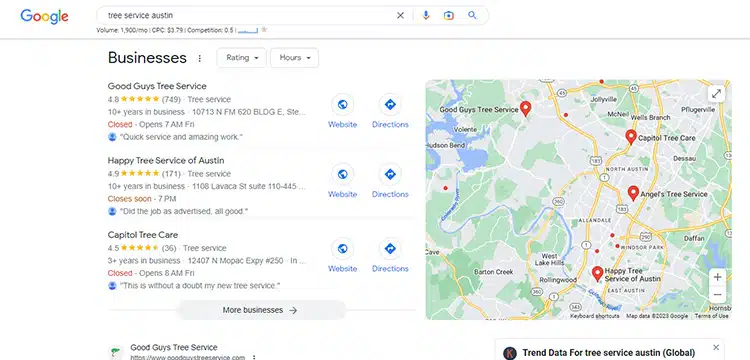
You already know Google Ads can put your tree company at the top of the search the second a homeowner needs a crew. The hard part is not torching your budget on tire-kicker clicks, getting found for the $5,000 removals instead of the $150 trims, and not handing your account to an agency that has never run tree work. That is exactly what we do, run by a team that only does home service.
When a homeowner types "emergency tree removal near me," your ad sits at the top of the search before they ever scroll. Every click gets tracked back to the keyword and ad that booked the job, so your budget chases real removals instead of tire-kickers.
| Service | Avg Job | Leads | Booked | |
|---|---|---|---|---|
| ⚠ | Emergency Removal | $4,800 | 41 | 27 |
| ✓ | Tree Removal | $3,200 | 44 | 28 |
| ⚡ | Storm Cleanup | $5,600 | 28 | 18 |
| ✂ | Tree Trimming | $850 | 26 | 15 |
| ■ | Stump Grinding | $420 | 18 | 8 |
We aim your budget at the high-intent searches behind the dead oak over the roof, the storm cleanup, the big removal. Your ad shows when a homeowner is ready to hire, not when someone is googling how to do it themselves. Bigger jobs, higher close rates on your estimates, and real revenue on the calendar.
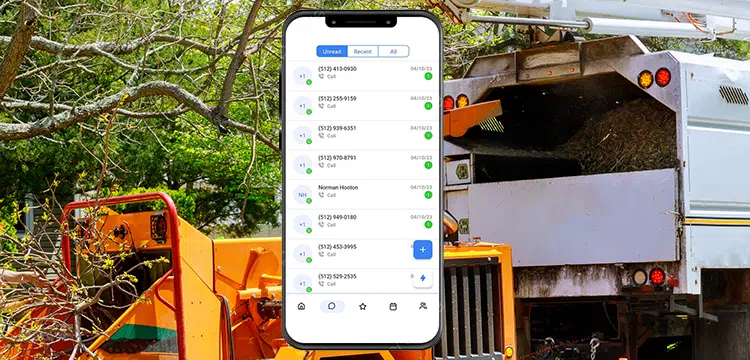
That $5K oak removal came from a $48 click on "emergency tree removal near me." Every call, text, and form is tracked to the exact ad, keyword, and zip code that produced it. You finally see which dollars book real jobs and which ones get wasted, so you can put your budget where the money is.
No "90-day strategy phase." We launch your tree service ads inside your first week, so when the next wind event drops limbs across town, your phone is the one ringing. First calls in 48-72 hours, while most agencies are still sending kickoff decks.
Running tree service Google Ads is not set-it-and-forget-it. We build the campaigns, write the ads, block the wasted spend, build the landing pages, and track every call back to a booked job, so your phone rings for the work that pays. Since 2018 we have done this for 100+ home service companies.
We build your campaigns around how homeowners actually search for tree work, removal, emergency, trimming, stump grinding, split into tight ad groups so each ad and landing page matches the exact job. No lazy "tree service" catch-all that burns money on the wrong clicks.
"DIY", "free", "cheap", "how to", "jobs", "salary" and 190+ more get blocked day one. Most tree companies running their own ads have under 15 negatives. That gap is thousands in wasted spend on people who were never going to hire you.
A click is wasted if the page does not get the homeowner to call. We send your traffic to pages built for one job each, with your reviews, your service area, and a phone number that is hard to miss, so more of your clicks turn into real estimates.
We watch your spend daily and push it toward the searches, zip codes, and hours that book real removals, then pull back on the $150 trim clicks. Same budget, more of the big jobs that actually pay your crew.
When a storm rolls through, demand for emergency tree work spikes for a day or two. We run 24/7 emergency campaigns with weather-triggered bid bumps, so your ads scale up to catch that rush while the other crews are still asleep.
Every click, call, and form is tracked back to the ad and keyword that produced it. You finally see which campaigns book the $5,000 removals and which ones bring the $150 trim calls, so we put your budget where the real money is.
No mystery, no black box. Here is exactly what we build and run on your Google Ads account, all aimed at one thing, putting booked tree jobs on your calendar instead of wasted spend on your card.
High-intent keywords like tree removal, emergency tree service, tree trimming near me, and stump grinding, split into tight ad groups by service type, each one mapped to its own landing page. The right ad for the right job, every time.
We block "DIY", "free", "cheap", "how to", "rental", "jobs", "salary", and 190+ other budget-burners. Most tree companies running their own ads have under 15 negatives. That gap is thousands in wasted spend.
24/7 emergency campaigns with weather-triggered bid multipliers, so when a storm hits, your ads scale up to catch emergency demand that closes at 2 to 3 times the normal rate.
Service-area targeting down to the zip code, so your budget goes to the areas you actually want to drive a truck to, not the ones that just burn money.
Every click, call, and form tracked back to the ad and keyword that produced it, so you know which campaigns book $5,000 removals and which bring $150 trim calls.
Homeowners who visited and did not call get pulled into retargeting. A second touch closes noticeably more leads than cold ads alone, at a fraction of the cost.
Don't take our word for it. These tree crews wasted money on bad marketing before their phone started ringing with real tree service jobs from Google Ads.
"I tried Angi Leads and Thumbtack, just wasted money racing five other crews to call first. Then I landed a $75k lot-clearing job through Home Service Direct. Most leads are $2k+ removals, and they keep my bucket truck busy year-round, even in the slow months. They're legit, and I stand by them."
"In less than six months we added a second crew, a chipper, and a climber, and we're already planning a second yard for spring. The phone rings with real removals, not stump-grind price shoppers. Home Service Direct is the best marketing decision I've made for my tree company."
"Home Service Direct completely changed our business. We're getting 10+ calls daily and booking $50,000 of tree removals every week. In just 6 months we went from a 2-truck operation to 5 trucks and a crane, and we're booked out three weeks."
You can run Google Ads yourself, hand them to a generic agency, or have a team that only does home service run them every day. Here is how those stack up for a tree company.
Every storm that rolls through, the big removal jobs go to the crew the homeowner found first. Here's how to be that crew, not the one finding out about the job a week too late.
If your Google Ads are burning budget on junk clicks, or you have never run them and do not want to learn the hard way, it's time to talk to someone who has booked work for 100+ tree crews. 15 minutes, no pitch deck.
We map the tree removal and trimming searches in your zip codes, what a click and a booked job should cost in your market, and the keywords and negatives we will build your campaigns around. You hang up knowing exactly where your next removals come from, built for your market, not a cookie-cutter template.
Your ads go live, calls start hitting your phone, your estimators stay busy, and your crews get booked out for weeks, so you win the $5K removals and crane jobs and become the tree service homeowners call first in your area.
Most tree companies we work with start somewhere in the $1,500 to $4,000 a month range, plus our management. The right number depends on your market and how many trucks you want to keep busy, not on a one-size-fits-all package.
The figure that actually matters is not the budget, it is your cost per booked job. A $5,000 removal that came from $200 of clicks is a great month. We build and manage toward that, so your spend tracks to real work on the calendar.
That is the most common story we hear, and it usually comes down to the same handful of things, a loose keyword list, almost no negative keywords, one catch-all campaign, and clicks dumped onto a homepage that does not push anyone to call.
We rebuild the account from scratch with tight tree-specific ad groups, 200+ negatives day one, and landing pages built to book the call. Same platform, completely different result, because the setup is the difference between booked jobs and wasted spend.
Search ads can show the same day they go live, so the first clicks and calls often come within the first few days. There is no 90-day waiting period like there is with SEO.
The first couple of weeks are where we tighten things up, cutting wasted search terms and shifting budget toward the keywords that book real removals. By the end of the first month most accounts are running clean and predictable.
It starts with 200+ negative keywords on day one, blocking "free", "DIY", "how to", "cheap", "jobs", "salary", and the rest of the searches from people who were never going to hire you. Then we keep reading your search terms every week and add more negatives as junk shows up.
On top of that we target down to your zip codes and aim bids at the high-intent removal and emergency searches, so your money chases the jobs that pay your crew, not the ones that waste your time.
Yes. The Google Ads account is yours, in your name, and you keep it if we ever part ways. We manage it for you, but we never hold your account, your data, or your campaign history hostage.
That is the opposite of a lot of agencies that run everything inside their own account so you walk away with nothing. We work month-to-month, and what you build stays yours.
Because we only do home service. We have run Google Ads for 100+ tree and home service companies since 2018, so we already know your keywords, your seasons, and how a storm changes demand overnight. A generic agency is learning your business on your dollar.
We also keep it month-to-month, you own your account, and every call is tracked back to the ad that booked it, so you can see exactly what your money is doing instead of taking our word for it.
From 2-truck crews to multi-location operations, tree service owners across North America book more jobs with Home Service Direct.





Hop on a 15-minute strategy call. We'll show you exactly how many tree jobs are up for grabs in your zip codes this month, and how to be the crew that lands them.
If you run tree service, Google Ads for tree service companies is the fastest way to get your phone in front of homeowners the second they search. Done right, Tree Service PPC pulls in high-intent calls all day long. Done wrong, pay-per-click just quietly drains your budget on clicks that never book. That gap is exactly what real Tree Service Google Ads management closes, and it is what this guide walks you through.
That is the story most tree owners tell us about their last run at Tree Service Google Ads. They turned it on with a short keyword list and almost no negatives, sent the clicks to their homepage, and a month later the card was down two grand for a couple of small jobs. The platform was not the problem. The setup was. That same Tree Service Google Ads account, built right, is the most reliable way there is to put a homeowner with a dead oak in front of your phone the second they are ready to hire. This guide breaks down the difference.
Here is what burns most tree companies running their own ads. They chase the cheapest clicks, broad terms like "tree service" or "tree work," because the cost per click looks low. The trouble is those terms pull in everyone, the homeowner pricing a $5,000 removal and the guy googling how to cut a branch himself, at the same price. Half your budget goes to people who were never going to hire anyone.
A click on "emergency tree removal near me" costs more, sometimes a lot more. But it comes from a homeowner with a real problem who is ready to pick up the phone. A higher cost per click that books real removals beats a bargain click that wastes your day every single time. The sticker price on the click is not the number that matters.
The takeaway: stop optimizing for cheap clicks. A cheap click that never books is the most expensive thing in your account.
If there is one thing that separates a Tree Service Google Ads account that books jobs from one that bleeds money, it is the negative keyword list. Negatives are the searches you tell Google to never show your ad on. Without them, your "tree removal" ad fires on "tree removal jobs," "tree removal salary," "free tree removal," "how to remove a tree," and dozens of other dead ends.
Most tree companies running their own ads have fewer than fifteen negatives. We start every account with 200+, blocking "DIY," "free," "cheap," "rental," "jobs," "salary," "training," and the rest of the searches from people who are not customers. Then we read the actual search terms every week and add more as junk shows up. That one habit alone can cut wasted spend by a third or more, money that goes straight back into clicks that book.
Cost per click is the number the platform shows you first, and it is the wrong one to chase. The number that actually runs your business is cost per booked job. You get there by tracking how many clicks turn into calls, how many calls turn into estimates, and how many estimates turn into signed work.
Say you spend $1,000 and it brings forty clicks, ten of those call, and you book four jobs. That is $250 in ad spend per booked job. If your average removal nets $1,800, you turned $1,000 into $7,200 of booked work. A cheaper click that never converts would have left you with nothing to show. You cannot judge a campaign by what a click costs. You judge it by what a job costs, and that means tracking the whole path, not just the top of it.
Here is the mistake almost every DIY account makes: it sends paid clicks straight to the homepage. A homepage is built to do ten things at once, and a homeowner with a limb on the roof does not have the patience to hunt for your phone number. Most of them bounce, and you paid for every one.
A click only earns its money if the page it lands on gets the homeowner to call. That means one page per service, built around that exact search, with your reviews, your service area, a clear photo of real work, and a phone number that is impossible to miss. The same clicks pointed at a page built to convert can double the number that turn into actual estimates. The ad gets you the visitor. The page gets you the job.
Google decides where your ad shows with an auction every time someone searches, and it is not just whoever bids the most that wins. Google rewards ads that match the search and send people to a relevant, fast page. That reward is called Quality Score, and it means a tighter, more relevant tree company can outrank a sloppy competitor while paying less per click.
That is the whole reason we build campaigns in tight ad groups by service type, with the keyword in the ad and a matching landing page behind it. When the search, the ad, and the page all line up, Google charges you less to sit at the top. A loose catch-all campaign does the opposite, it forces you to overpay just to stay visible. The structure is not busywork. It is how you win the top spot without burning your budget to do it.
Tree demand does not move in a straight line. It spikes hard after storms, and those are the $3,000 to $5,000 emergency removals that make a month. The crews that clean up are the ones whose ads scale up the moment the wind hits, not the ones who notice the storm two days later and flip a switch.
That is why we run 24/7 emergency campaigns with weather-aware bidding, so when conditions turn, your ads push harder to catch demand that closes at two to three times the normal rate. Then they pull back when things calm down so you are not overpaying in the quiet weeks. A flat budget all year long leaves the best money on the table.
If you cannot tell which ad booked the crane job, you are flying blind, and you will end up cutting the campaign that was secretly carrying you. Call tracking ties every call and form back to the exact ad, keyword, and zip code that produced it. You hear the calls, you see which searches book removals, and you know which ones bring nothing but $150 trim questions.
That is what lets us shift budget toward what works week after week instead of guessing. Any agency that cannot show you call recordings or tell you your cost per booked job is hiding something. A setup that actually books jobs has no reason to keep that from you.
When a tree owner tells us they lost money on Tree Service Google Ads, it is almost always the same handful of things stacked on top of each other: a loose keyword list, barely any negatives, one giant catch-all campaign, clicks dumped on the homepage, and no call tracking to tell what booked. None of those is fatal alone. Together they guarantee a bad month.
The fix is not magic, it is discipline. Tight ad groups by service, 200+ negatives day one and growing, a dedicated landing page per service, weather-aware bidding for storms, and call tracking on every lead. That is the difference between an account that quietly drains your bank and one that keeps your trucks booked out. The platform is the same. The work behind it is everything.
Call it Tree Service PPC, call it tree service ads, call it Google Ads for tree service, the name changes nothing. What matters is whether your Google search ads turn into booked jobs or wasted spend. That is the only scoreboard we play to.
The takeaway is simple: Tree Service Google Ads done right keeps your phone ringing with homeowners ready to hire, while a sloppy account just buys clicks. That is the whole job of Tree Service Google Ads management, and it is what turns your ad budget into booked work.
We have run Tree Service Google Ads for over 100 tree and home service companies since 2018. We build your campaigns tight, block the wasted spend, point every click at a page built to book the call, and track every lead back to the job it produced. You own your Tree Service Google Ads account, we work month to month because we would rather earn next month than lock you in, and you always see exactly what your money booked. If your trucks have open days on the schedule, that is the problem we solve.
Get My Google Ads PlanGrab a 15-minute call and we'll show you what it takes to get your tree company to the top of Google search in your zip codes without torching your budget. No contracts, no pressure.

Full-service marketing agency serving home service contractors only. Generating 50-300 booked-job leads per month since 2018.