Why Reviews Quietly Decide Most Window Jobs
You already know window installs are a high-trust, high-ticket sale. A full-home replacement runs anywhere from a few thousand to north of twenty grand, and the homeowner is letting your crew pull units out of their walls. Nobody hands that over to a company with eleven reviews and a 4.2 average when the guy down the street sits at 200-plus and a 4.9.
Here is the part most owners miss: your window company reviews are not a vanity number, they are a sales tool that works while you sleep. They close bids you never get to pitch in person, they push you up in the Google Map Pack for "window replacement near me," and they lower what you pay for every lead because a stronger reputation lifts your click-through and your booked-job rate.
The good news: you do not need to be clever about this. You need a system that asks every happy customer at the exact right moment, makes it stupid-easy to leave the review, and handles the responses. This post is that system, written owner-to-owner. No theory, just the timing, the templates, and the follow-through.
Ask at the Peak Moment, Not Whenever You Remember
The single biggest reason window installers do not get more reviews is timing. They ask three weeks later, by email, when the customer has already moved on. The job is forgettable by then. You have to ask while the customer is still standing in front of brand-new windows feeling great about the decision.
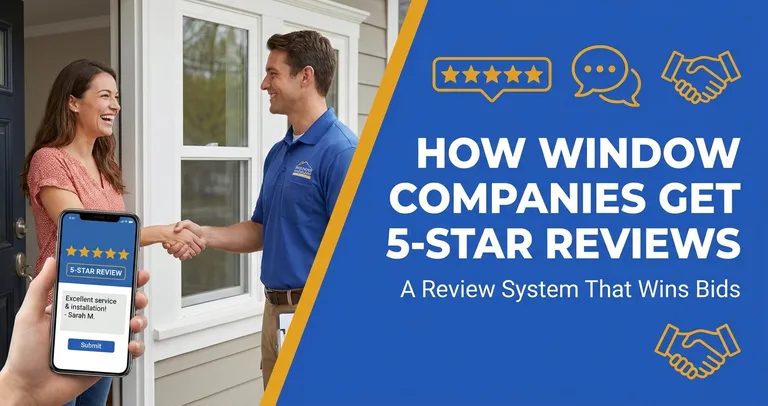
For window work, the peak emotional moment is the walkthrough at the end of the install, when the crew lead points out the new units, shows the smooth operation, and the homeowner sees the difference in their own living room. That is when the goodwill is highest. Your crew lead should be trained to plant the seed right there, in person, then your office fires the actual request to their phone within a few hours.
The timing that actually works
- Single-day installs: seed the ask during the final walkthrough, send the review link by text the same evening.
- Multi-day or whole-home jobs: wait for the final crew to leave and the cleanup to be done, then ask that same day or the next morning.
- Custom or special-order units: ask after the customer has used the windows for a few days, so you capture the "these work great" feeling, but no later than a week out.
Two rules. Always have a real human plant it first, because a cold text out of nowhere gets ignored. And never ask while there is an open punch-list item or a callback pending. Fix the gap first, then ask. Asking a frustrated customer for a review is how you manufacture a 3-star.
Make Leaving the Review Frictionless
Every extra step you put between the customer and the review costs you reviews. "Search for us on Google, scroll down, click write a review" loses half of them. Your job is to get them from your text to a blinking cursor on the star rating in one tap.
Set up your direct review link
Google gives every business a short review link from your Business Profile. Find it in your profile dashboard under the prompt to ask for reviews, or generate the place-ID-based link. It drops the customer straight onto the star-rating box. Save it once, use it forever. Do the same for your other priority platforms if window leads come through them, but for most installers Google is the one that moves the needle on the Map Pack and on ad cost, so lead with Google.
Remove every other point of friction
- Send by text first, email second. Texts get opened and tapped at a far higher rate than email. Email is your backup for the customers who never reply to the text.
- Pre-load the praise. When your crew lead asks in person and the customer says "the windows look amazing," that is the line they will type. You just told them what to write without telling them what to write.
- Make it one link, one platform per ask. Do not send three links and let them choose. Choice is friction. Pick Google, send Google.
- Keep the message short. Two sentences and a link. Nobody reads a paragraph from a contractor.
If you would rather not build and run this yourself, this is exactly the kind of thing handled for you when you run window installation marketing through a partner, so the asks go out automatically after every job without your office staff having to remember.
Text and Email Templates You Can Steal Today
Here are the actual messages. Swap in your company name and review link, keep them this short, and do not add a wall of marketing copy. These are written for window installers specifically, so they reference the install and the windows, not a generic "thanks for your business."
Text template (your primary ask)
"Hi [First Name], it's [Your Name] from [Company]. Hope you're loving the new windows! If you've got 30 seconds, a quick Google review would mean a lot and helps other homeowners find us: [review link]. Thank you!"
Email template (your backup, sent 2-3 days later if no review yet)
Subject: How are the new windows treating you?
"Hi [First Name], thanks again for trusting [Company] with your window replacement. We'd really appreciate it if you'd share your experience in a quick Google review, it helps other folks in [City] feel confident choosing us. It only takes a minute: [review link]. And if anything isn't right, reply to this email and we'll take care of it. Thanks, [Your Name]."
The one-time follow-up nudge
If they still have not left one a few days after the email, one soft text is fair: "Hi [First Name], just following up, no pressure at all. If you have a sec for that review here's the link: [review link]. Either way, thanks for letting us do your windows!"
Notice the email line "if anything isn't right, reply." That is a quiet pressure valve. Unhappy customers vent to you privately instead of in public, and you get a shot at fixing it before it becomes a one-star. Do not turn this into a survey that filters out bad reviews, that is against Google's policy and it backfires, but giving an off-ramp to complain directly is just good service.
Respond to Every Review, Good and Bad
Getting reviews is half the job. Responding to them is the half that most window companies skip, and it is free leverage. Google rewards profiles that get owner responses, and prospects read your responses to judge how you handle problems. A wall of five-stars with zero replies looks like nobody is home.
For the five-stars
Keep it short, specific, and human. Mention the window detail when you can. "Thanks, Karen! Glad the new double-hungs are already cutting the draft in that front room. Enjoy them, and call us anytime." Specific beats "Thank you for your feedback" every time, and it signals to readers that real people did the work.
For the negative ones
This is where you win or lose future buyers, because they read the one-stars first. Stay calm, do not argue the details in public, and move it offline.
- Acknowledge the frustration without admitting things that are not true.
- Take ownership of making it right. "That's not the experience we want any customer to have."
- Move it to a phone call. Drop your direct number and a name.
- Never blame the customer, the manufacturer, or the weather in the reply. Future buyers do not care whose fault it was, they care how you handled it.
A well-handled one-star response can actually win you jobs, because it proves you do not disappear when something goes sideways with a window order, a backordered unit, or a callback. That is the exact fear every homeowner has about contractors.
How a Strong Review Profile Wins Bids and Cuts Ad Costs
Let's connect this to money, because that is why you are reading. A strong review profile pays you three different ways, and most owners only think about the first one.
1. It closes bids you are not in the room for
When a homeowner has quotes from three window companies on the table, they Google all three. The one with 250 reviews at 4.9 wins the tie even if their number is higher, because price anxiety on a five-figure window job gets beaten by trust. Reviews let you hold your margin instead of racing to the bottom on price.
2. It moves you up the Map Pack and lowers your cost per lead
Review count, rating, and recent velocity all feed your ranking in the local pack for "window replacement" and "window installer" searches. More visibility there means more calls you did not pay for. And on the paid side, when your profile and landing experience are strong, your click-through and your booked-job rate go up, which means the same ad budget produces more actual installs. A better reputation literally lowers what every booked job costs you.
3. It compounds
Reviews do not expire. The 40 you collect this quarter are still selling for you next year. A window company that systematically asks after every install builds a moat that a competitor cannot buy their way past quickly, because Google weighs steady, recent velocity and you cannot fake months of it overnight.
If you want the calls flowing while the reputation builds, that is the other half of the equation: a steady stream of exclusive window installation leads that are not resold to four of your competitors, so the jobs you close turn into the reviews that win the next round of bids. Reviews and lead flow feed each other.
Window Company Review FAQs
How many Google reviews does a window installer actually need?
There is no magic number, but you want to clearly out-review the local competitors a homeowner is comparing you to. In most markets that means getting past the 50-to-100 range so you do not look new, then never stopping. Steady recent velocity matters more than a big stale pile, so aim to collect reviews every single month rather than in occasional bursts.
Can I offer a discount or gift card for leaving a review?
No. Paying or incentivizing reviews violates Google's policies and risks your reviews getting filtered or your profile penalized, which torches the asset you are trying to build. You do not need to pay for them anyway. A well-timed ask after a clean install converts plenty of happy customers on its own. Earn them, do not buy them.
What do I do about a clearly fake or unfair one-star?
First, respond publicly, calm and professional, noting you have no record of the job if that is the case, so future readers see your side. Then flag it to Google for removal as a policy violation. Removal is not guaranteed and can be slow, so the best defense is volume: keep collecting real five-stars so one bad-faith review barely moves your average.