If you build decks for a living, you already know the job is won or lost long before the first joist goes down. It is won in how fast you get back to the homeowner, how tight your estimate is, and whether the proposal makes them picture the finished deck instead of just a number. The right deck building software stack is what makes all three of those happen without you living on your phone at 9pm.
The problem is that most deck builders are running their whole business on a spreadsheet, a notepad, and memory. That works at five or six jobs a month. It quietly bleeds money once you are running multiple crews, juggling material lead times, and bidding cedar against composite against PVC on the same week.
This is an owner-to-owner breakdown of the software categories an established deck company actually needs in 2026: estimating and takeoff, CRM and lead follow-up, project management and scheduling, and 3D design and proposals. What each one does, what to look for, and how a tighter stack lifts your close rate and protects the margin you are already leaving on the table.
Deck estimating software: stop bidding from memory
Estimating is where margin lives or dies on a deck job. Lumber and composite pricing move, fastener and hardware costs creep, and the difference between a 12 percent net job and a 4 percent net job is usually a few line items you forgot to price. Good deck estimating software turns a bid from a gut feel into a repeatable number you can defend.
The core job of estimating software is simple: take your real costs (material, labor hours, equipment, dump fees, permits) and apply your markup so you stop quoting low to win and then eating the difference. The better tools let you build assemblies so a section of deck framing, decking, and railing prices itself once you enter the square footage and product line.
What to look for
- Assembly-based pricing. You should be able to price a 16x20 composite deck with cocktail railing in minutes, not rebuild it line by line every time.
- Live or easily updated material costs. When board prices jump, your bids should jump with them. Bidding on last quarter's lumber number is how you frame a deck for free.
- Labor hours, not just material. Most deck builders price the boards fine and lowball the labor. The tool should let you set production rates (square feet of framing per man-hour, linear feet of railing per hour) so labor is real.
- Multiple product tiers. Pressure-treated, cedar, mid-grade composite, premium capped composite, and PVC should each be their own cost line. Homeowners trade up when you can re-price on the spot.
Estimating tools range from deck-and-fence specific calculators to broader construction estimating platforms used across remodeling. The category matters more than the brand: if it lets you store assemblies, set your markup, and spit out a clean number, it will pay for itself on the first job you do not underbid.
Deck takeoff software: measure once, price right
Takeoff is the step most deck builders do in their head or with a tape and a napkin, and it is where quantity errors sneak in. Deck takeoff software lets you measure the deck off a plan, a site sketch, or a satellite image and pull accurate quantities (square footage of decking, linear feet of railing, number of footings, board counts) straight into your estimate.
For a custom deck, takeoff and estimating usually live in the same tool, and that is what you want. The point of digital takeoff is to stop two specific leaks: under-ordering material so a crew sits waiting on a delivery, and over-ordering so you eat the waste or haul it back. Both cost you, and both come from a sloppy count.
What to look for
- On-screen measuring. Drop points on a drawing or aerial and let it calculate area and perimeter. This alone removes most math mistakes.
- Waste factors built in. Picture-frame borders and diagonal decking patterns burn more board. A good tool lets you set a waste percentage by pattern so you order right.
- Direct hand-off to the estimate. A takeoff that does not feed your pricing is just a fancy ruler. The quantities should flow into your bid automatically.
You do not need a heavy commercial takeoff suite built for general contractors doing million-dollar bids. For a deck company, a focused takeoff that handles area, perimeter, footing counts, and railing runs is plenty, and it shortens the time from site visit to delivered quote, which is itself a close-rate weapon.
CRM and lead follow-up: the money is in the speed
Here is the uncomfortable truth: most deck companies lose more revenue to slow follow-up than to losing bids head-to-head. A homeowner who fills out a form or calls for a deck quote is shopping three or four builders that same week. Whoever answers and gets in front of them first usually wins, and it is often not the cheapest one. A CRM is the software that makes sure no lead falls through the cracks while you are up on a job.
For a deck builder, the CRM does three jobs: it captures every lead in one place, it reminds you (or texts the homeowner automatically) to follow up, and it tells you which marketing actually produces booked jobs versus tire-kickers. That last part matters once you are spending real money to get the phone to ring.
What to look for
- Fast text and call from one place. Speed to lead is the whole game. The tool should let you or your office answer in minutes, not hours.
- Automatic follow-up. A simple sequence (text within five minutes, follow up day two, follow up day five) recovers jobs you would otherwise never hear back from.
- Lead source tracking. You need to know which source produces signed contracts so you double down on what works and kill what does not.
- Estimate and proposal status in one view. Quoted, follow-up needed, signed, scheduled. If you cannot see at a glance who is waiting on you, somebody is.
Plenty of contractors run a general home-service CRM and it works fine. The honest catch is that a CRM only converts the leads you already have. If your calendar is not full enough to feed it, the bottleneck is not your software, it is your lead flow. That is where it makes sense to either tighten your own marketing or have someone bring you exclusive deck building leads so the follow-up system actually has something to chew on.
Project management and scheduling: run more crews without the chaos
One crew is easy to run from your truck. Two or three crews across multiple jobs, with material deliveries, inspections, and weather all moving, is where things start falling through. Project management and scheduling software is what lets you grow past the point where everything lives in your head.
For deck work specifically, the scheduling problem is sequencing. Footings have to cure, inspections have to pass before you cover framing, and composite and railing often arrive on different trucks. A good system keeps the crew, the homeowner, and the supplier looking at the same plan so a delayed railing delivery does not turn into a crew standing around on the clock.
What to look for
- A real calendar your crews can see. Crew leads should know where they are tomorrow without calling you. Their wasted morning is your lost margin.
- Job stages and checklists. Permit pulled, footings poured, framing inspection, decking, railing, final walkthrough. Checklists keep a callback from becoming a reputation problem.
- Photo and note logging on the job. Documenting the build protects you in a dispute and gives your sales and marketing real before-and-after proof.
- Customer communication built in. Homeowners who get a heads-up about timing leave better reviews and stop calling your cell every afternoon.
The payoff here is not just being organized. Tighter scheduling means fewer days where a crew is idle, fewer trips back to a job because something was missed, and more decks finished per month with the same headcount. That is the most direct margin lift in the whole stack, because your crew is your most expensive line item and idle crew time is pure loss.
3D design and proposals: sell the finished deck, not the price
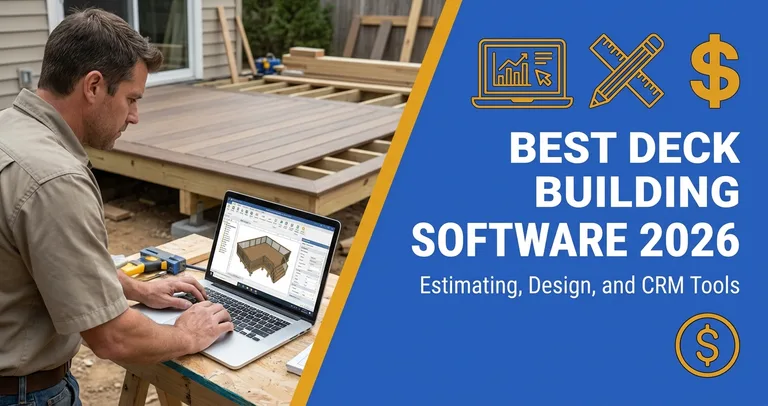
This is the category that separates deck builders who compete on price from the ones who close at a premium. Deck design software that produces a 3D rendering and a clean proposal lets the homeowner see their actual deck, with their decking color, their railing, their layout, before they sign. When they can picture it, the conversation stops being about your number and starts being about their deck.
Deck builders sit in a great spot for this because a deck is visual and the upgrade ladder is real. Once a homeowner sees their deck in capped composite with a lighting package and a picture-frame border, the upsell sells itself. A flat quote on a piece of paper cannot do that. A rendering and a side-by-side good-better-best proposal can.
What to look for
- 3D rendering you can build fast. If a design takes you two hours, you will not do it for every lead. If it takes fifteen minutes, you will, and you will close more.
- Real product lines and colors. Letting a homeowner toggle between decking brands and railing styles makes the upsell visual instead of a sales pitch.
- Good-better-best proposals. Three tiers on one proposal anchors the middle and lets the homeowner trade up themselves. Single-option quotes leave money on the table.
- E-signature and deposit collection. Sign and pay the deposit while the excitement is high. Every day of delay is a day a competitor can get back in.
Some decking manufacturers offer their own design and visualizer tools, and there are dedicated deck and outdoor-living design platforms as well. The right one for you is whatever your salespeople will actually use on a kitchen table or a tablet at the homeowner's house. A beautiful tool nobody opens does nothing. If you would rather have the design-and-close engine plus the steady flow of homeowners to use it on handled for you, that is exactly what deck building marketing is built to do.
How to build your stack without overbuying
You do not need all of this at once, and you definitely do not need the most expensive option in every category. The mistake is buying five tools that do not talk to each other and then having your office re-type the same job into all of them. Pick the bottleneck that is costing you the most right now and fix that first.
A simple way to sequence it for an established deck company:
- If you are losing jobs to slow response, start with the CRM and follow-up. Fastest payback, because you are already paying to generate those leads.
- If you are winning jobs but margins are thin, fix estimating and takeoff. Pricing right on every bid drops straight to the bottom line.
- If you are busy but chaotic, add project management and scheduling so you can run more crews without the wheels coming off.
- If you are competing on price and hate it, add 3D design and proposals so you can sell up instead of down.
Look hard at whether the tools integrate, because a stack where the estimate flows into the proposal and the signed job flows into the schedule is worth far more than four best-in-class tools that force double entry. The whole point of software is to remove steps your team does by hand, not add a new tab they have to babysit.
And keep this in front of you: software converts and protects the work. It does not create demand. The tightest stack in your market still needs a steady flow of real deck jobs coming in the door. Get the lead flow right first, or in parallel, and let the software do what it is good at, which is turning those leads into signed, profitable, well-run jobs.
Deck building software FAQ
Do I really need separate estimating and takeoff software?
Not as separate products. For deck work, the best setup is one tool that handles both, where you measure the deck and the quantities flow straight into a priced estimate. You only end up with separate tools when you outgrow a basic calculator and move to a fuller construction platform. The thing to avoid is doing takeoff in your head and pricing in a spreadsheet, because that is where the quantity and margin errors hide.
What is the most important software for a deck company to get first?
It depends on your bottleneck, but for most established deck builders it is the CRM and follow-up system, because you are already spending money to make the phone ring and slow response is quietly killing your close rate. Fix the leak before you optimize anything else. If your real problem is thin margins on jobs you already win, start with estimating instead.
Will deck design software actually help me close more jobs?
Yes, when your salespeople use it. A 3D rendering lets the homeowner see their finished deck and makes the upsell to better decking and railing visual instead of a pitch. Pair it with a good-better-best proposal and e-signature and you shorten the time from quote to signed contract. The catch is adoption: a tool nobody opens at the kitchen table does nothing, so pick one your team will actually run on every estimate.