Why Your Close Rate Is the Cheapest Growth You Own
You already know how to build a deck. The crews show up, the joists are level, the picture-frame border lands clean. The thing quietly bleeding money out of your business is not the build. It is the gap between estimates given and jobs booked. If you run 10 estimates a week and close 3, you are leaving 7 conversations on the table every single week, and most of those 7 went to a builder who was not better than you. They were just better at the close.
Here is the math that should keep you up at night. Lifting your deck estimate close rate from 30 percent to 45 percent on the same number of leads is a 50 percent revenue jump with zero extra marketing spend. No new trucks, no new ad budget, no new lead source. Same phone ringing, more jobs on the board. That is why deck sales is the highest-leverage skill an established builder can sharpen, and it is the one most owners never actually work on.
This is not about pricing. Pricing is the math. This is the human part: who you agree to drive out and see, what you say standing on their patio, and what you do in the two weeks after you hand over the number. Get those three right and you win bids you are losing today.
Qualify Before You Burn a Drive: The Phone Screen That Saves Your Day
The most expensive part of an estimate is not the time you spend writing it. It is the windshield time getting there and back. A deck consult that runs 45 minutes on-site plus 40 minutes each way is the better part of a half-day once you account for the write-up. Run three unqualified estimates like that and you have torched a day for nothing. So the close starts on the phone, before you ever load the truck.
You are not interrogating people. You are finding out, in five minutes, whether this is a real job and whether you are the right builder for it. A short, confident phone screen also does something else: it positions you as a pro who is in demand, not a guy who shows up to anything that moves.
Ask these before you book the visit:
- Scope and material. Are they picturing pressure-treated, cedar, or composite? Resurface on existing framing or full tear-out and rebuild? A 12x16 ground-level platform and a second-story deck with stairs and a roof are different businesses.
- Timeline. "Are you looking to build this spring, or just getting numbers for later?" A real buyer has a season in mind. A tire-kicker says "just curious."
- Budget reality. You do not need an exact number, but you need a band. "A composite deck this size usually lands somewhere between X and Y depending on railing and footings. Does that line up with what you had in mind?" If they gasp at the floor of your range, you just saved yourself a drive.
- Decision makers. "Will both of you be there when I come out?" If the spouse who controls the checkbook is not home, you are presenting to a messenger. Reschedule so everyone is on the patio.
- How many bids. If they are getting five quotes, you are a price-shopping exercise. If you are one of two, you have a real shot.
Qualifying does not shrink your business. It concentrates your hours on the conversations you can actually win. If your problem is not your close rate but that the phone is not ringing enough qualified jobs to begin with, that is a lead-volume problem, not a sales problem, and it is worth fixing separately with a steady flow of exclusive deck building leads so your screening time goes toward booking, not weeding.
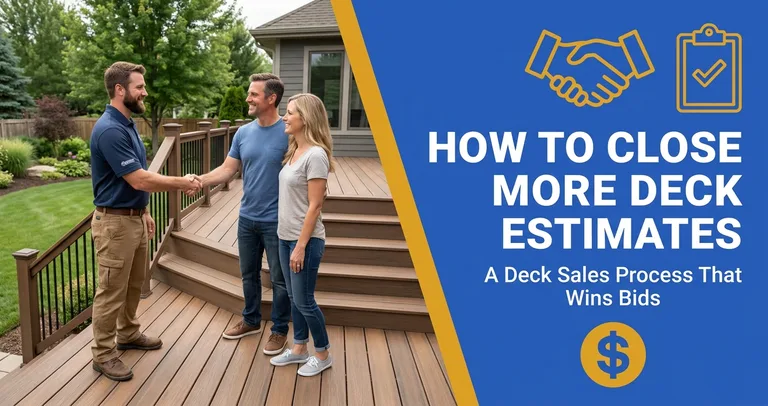
The On-Site Presentation: Sell the Build, Not the Price
Most deck guys walk the yard, take measurements, say "I'll email you a quote," and leave. That is not a sales call. That is data collection. You handed the entire decision over to a PDF that the homeowner will open next to four other PDFs and sort by the bottom number. You lose on price every time you let the number do the selling for you.
The on-site visit is where you win the job, so treat it like the presentation it is. The homeowner cannot judge your joist spacing, your flashing, or your footing depth. They will judge you on whether you seem like the builder who will not disappear mid-job. So sell that.
Run the visit like this:
- Walk the space and ask what they actually want. Not "how big." Ask how they will use it. Grilling? Hot tub later? Kids? Entertaining 20 people? You are building their vision, and people pay more for a deck that solves their life than for square footage.
- Diagnose out loud. Point at the grade, the drainage, the ledger on the house, the existing footings. "See how this slopes? That is why your old deck rotted at the band board. Here is how we flash and pitch it so this one does not." Now you are the expert, and the cheap bid down the street suddenly looks risky.
- Show proof in your hand. A tablet with 15 photos of your own finished decks, especially the framing and the hidden details homeowners never see, does more than any brochure. Before-and-afters. A composite board sample they can hold. Your insurance certificate and license, mentioned casually.
- Price on the spot when you can. The single biggest close-rate lever in closing deck jobs is presenting the number while you are standing there, not three days later by email. If your scopes are clean enough, build the estimate in the driveway and walk back up with it. The buying emotion is highest while you are there. Every day you wait, it cools and a competitor's quote lands in their inbox.
If you cannot price on the spot because the job is complex, set the next step before you leave: "I'll have this to you tomorrow by noon, and I'll call you at 5 to walk through it together." Never end a visit with a vague "I'll be in touch."
Handling "That's More Than I Expected" Without Caving on Price
You will hear it on a third of your estimates: "That's a lot more than I thought." The reflex move, the one that quietly destroys your margins, is to immediately discount. Do not. The price objection is rarely about the total dollar number. It is about value not being clear yet, or sticker shock from a homeowner who Googled "deck cost" and saw a number that did not include footings, permits, or composite.
First, do not flinch. Silence is your friend here. Let them sit with it for a beat. Then get curious instead of defensive.
- Find out what they compared it to. "When you say more than expected, what number did you have in your head?" Half the time they were pricing a pressure-treated platform and you quoted a composite deck with aluminum railing. You are not even talking about the same product.
- Break the number down. A homeowner sees one scary total. Walk them through it: footings and concrete, framing and hardware, decking material, railing, labor, permit, cleanup, your warranty. When they see it is not one number but a dozen real costs, the total stops feeling like a markup and starts feeling like a build.
- Re-anchor on the cheap bid. If they wave a lowball quote, do not trash the other guy. Ask one question: "Did their number include the permit and engineered footings?" Usually it did not. The gap between your bid and theirs is often the exact stuff that fails in three years.
- Adjust scope, not price. If the budget truly will not stretch, do not cut your margin. Cut scope. Drop from composite to pressure-treated, simplify the railing, phase the build, do the deck now and the pergola next year. You protect your rate and still book the job.
Discounting to win a job teaches the customer that your first number was fake, and it trains you to work for less. Defend the price by making the value undeniable, and only move on scope.
Offer Financing on Every Job, Not Just When They Ask
A 14x20 composite deck with railing and stairs can run well into five figures. That is a real check for most households, and "that's more than I expected" is often code for "I can't write that check this month," not "it's not worth it." Financing turns a scary lump sum into a monthly number people can say yes to, and it is the most underused close tool in the deck trade.
The mechanics are simple. There are contractor-focused lending platforms built exactly for this, the same ones roofers and HVAC companies lean on, where the homeowner gets approved in minutes from their phone and you get paid as you would on any job. Names you will run into in the home-improvement space include providers like GreenSky, Hearth, and Wisetack. Get set up with one before your next estimate, not after you have already lost a job to budget.
How to use it without it feeling like a car lot:
- Present it as a payment, not a loan. "This deck works out to about X a month" lands far softer than the full total. You are not lowering the price, you are changing how it feels.
- Offer it to everyone, every time. Do not pre-judge who needs it. Plenty of homeowners who can pay cash would rather keep their cash and finance at a decent rate. Make it a standard line in your presentation, not a rescue move.
- Let it save the discount conversation. When someone hesitates on price, financing is your answer instead of a price cut. It protects your margin and still gets you to yes.
Builders who offer financing routinely close jobs at a higher average ticket, because the buying decision stops being "can I afford the whole thing" and becomes "can I fit this payment." That is a much easier yes.
The Follow-Up Cadence That Wins Bids You Already Lost
Here is the uncomfortable truth most owners ignore: a big share of the deck jobs you "lost" were never lost. They went quiet. The homeowner got busy, the spouse wanted to think, life happened, and you never called back because you assumed silence meant no. Meanwhile, the builder who followed up a third time got the signature. The job did not go to the best deck. It went to the one who stayed in front of them.
Decks have a slow buying cycle. People sit on a five-figure outdoor project for weeks. Your job is to be the builder still standing there when they finally decide. A simple, disciplined follow-up cadence is the difference, and almost nobody in this trade runs one.
A cadence that works:
- Same day: A short text or email with the quote attached and a photo of a similar deck you built. "Great meeting you both. Here's the number and a deck we did last summer that's close to what you're after."
- Day 2: A call to walk through the estimate live and answer questions. This is where most jobs close. Do not skip it.
- Day 5: A value touch, not a "just checking in." Send a relevant photo, mention a railing option they liked, or note your spring schedule is filling up. Give a reason to move.
- Day 10 to 14: A soft deadline or seasonal nudge. "We've got an opening in the build schedule in three weeks. Want me to hold it?" Scarcity that is true creates a decision.
- Day 30+: Drop them into a long-term list and touch them once a month. Spring buyers go quiet in winter and come roaring back. The builder whose name is in their inbox in March wins.
Use whatever keeps you honest: a CRM built for contractors like Jobber, Housecall Pro, or JobNimbus, or even a spreadsheet with reminders. The tool matters less than the discipline of never letting a qualified estimate die from silence. If chasing every quote is falling through the cracks because you are also running crews and bidding new work, that follow-up engine is exactly the kind of thing a done-for-you deck building marketing partner can run for you, so no booked-ready homeowner slips away while you are on a roof.
Frequently Asked Questions
What is a good close rate on deck estimates?
It varies by how you get your leads, but most established deck builders land somewhere between 25 and 40 percent on qualified estimates. If you are below that, the problem is usually one of three things: you are driving out to unqualified jobs, you are emailing quotes instead of presenting them on-site, or you are not following up past the first contact. Fix the front-end qualifying and the on-site presentation first, and the rate moves fast.
Should I charge for deck estimates?
For standard residential decks, no. A paid estimate adds friction to a buyer who is comparing builders, and you will lose volume. Where a design or consultation fee makes sense is on complex, multi-level, or heavily custom projects that require real drawings and engineering, where the design work has standalone value. Even then, credit the fee toward the job if they sign, so it never feels like a penalty.
How do I beat a lowball competitor without dropping my price?
Do not match their number and do not trash them. Ask the homeowner one question: did the cheap bid include the permit, engineered footings, proper flashing, and a written warranty? It usually did not, and the gap between your price and theirs is exactly the stuff that fails in a few years. Sell on the build quality they cannot see and the fact that you will still be in business to honor the warranty. If price is a genuine wall, move on scope or offer financing, not a discount.