Your Close Rate Is Cheaper Than More Leads
If you run an established fence company, you already know the math nobody likes to say out loud: most of the estimates you drive out for never turn into a job. A lot of owners sit somewhere around 25 to 35 percent on residential bids, and they assume the fix is more leads. It usually isn't. More leads at the same close rate just means more windshield time and more gas burned on jobs you were never going to win.
Here is the part that should get your attention. If you run 40 estimates a month and close 30 percent, that's 12 jobs. Tighten the same process to 40 percent and you close 16 jobs off the exact same lead count. Four extra jobs a month, no new ad spend, no new estimator. On fence work that's real money, and it compounds every single month.
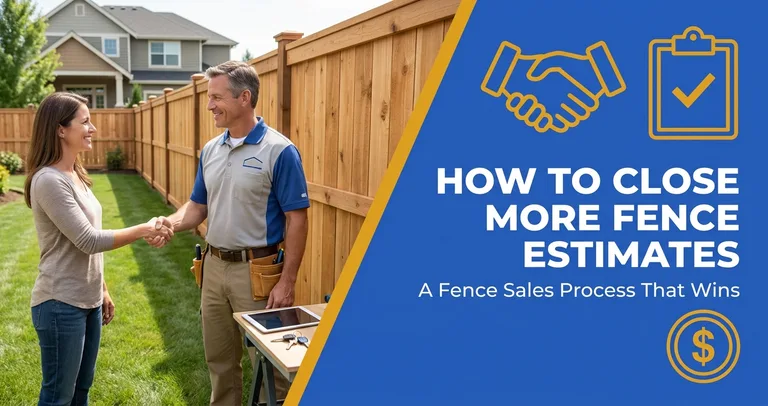
This post is about the sales conversation, not the price. We're talking fence sales as a repeatable process: qualifying before you drive out, how you run the on-site walk, handling the price objection without caving, offering financing, and the follow-up that actually wins bids. Get these right and closing fence jobs stops feeling like luck.
Qualify Hard Before You Burn a Truck Roll
The cheapest way to raise your fence estimate close rate is to stop quoting people who were never going to buy from you. Every estimate you run costs you a half day between drive time, measuring, and writing it up. If a third of those are tire-kickers or three-bid shoppers who already picked the cheap guy, you're bleeding capacity.
Before anyone schedules a site visit, get answers to a few things on the phone or through your intake form:
- Timeline. Are they ready to put fence in this season, or just pricing it for next year? "Someday" leads get a follow-up date, not a truck roll.
- Decision makers. If it's a couple, both need to be there for the walk. Quoting one spouse and hoping they sell the other for you is how you lose deals you should win.
- Scope reality. Linear footage, fence type they think they want (wood privacy, vinyl, chain link, aluminum/ornamental), and whether there's old fence to tear out. Tear-out and haul-off changes the number a lot, and you want them braced for it.
- Budget signal. You don't need an exact number, but "we're getting three quotes and going with the lowest" tells you exactly what kind of job this is. Sometimes the right move is to politely pass.
None of this is about being picky for the sake of it. It's about pointing your estimating time at jobs you can actually close. If your problem is too few qualified jobs to begin with, that's a marketing problem, not a sales one, and you can either fix your lead flow or have someone bring you exclusive fence installation leads so your estimators only ride out for people who are ready to buy.
Run the On-Site Walk Like a Pro, Not a Tape Measure
The site visit is where most fence jobs are actually won or lost, and most estimators waste it. They show up, measure, mumble a number, and leave a flyer. That's not selling. That's quoting. The homeowner can't tell you apart from the other two trucks that did the exact same thing.
Walk the property with them, not ahead of them. Ask what's driving the fence: a new dog, kids, a pool that needs code-compliant enclosure, a neighbor problem, privacy from a new build behind them. The reason behind the fence is the thing you sell to later when price comes up. Write it down.
While you walk, narrate what they can't see but will care about:
- The hard stuff. Slope, rock, tree roots, a buried gas or irrigation line, a retaining wall, a corner that needs racking. Point it out and explain how you handle it. This is where you separate from the cheap bid that's going to hit a rock and either eat it or hit them with a change order.
- Gates and access. Walk gate vs. drive gate, swing direction, where they'll actually carry the trash can or mower through. Cheap bids forget gates. Yours won't.
- Lines and permits. Property line, setbacks, HOA approval, and the call to 811 for utility locates. Saying "we handle the locate and the HOA packet" out loud takes a headache off their plate and makes you the easy choice.
Then present on the spot whenever you can. Even a ballpark range delivered confidently while you're standing in their yard beats a polished PDF that lands in their inbox 48 hours later, after the competitor already closed them. Same-visit pricing is one of the single biggest levers on close rate in this trade. If you can't price every job on site, at least price the simple ones there and reserve the written-up version for the complex stuff.
Present the Price So Cheap Bids Look Cheap
How you hand over the number matters as much as the number itself. If you just say "it'll be about eight grand," you've turned your bid into a line item the homeowner compares straight against two other line items, and the lowest one wins. Your job is to make the comparison about more than the bottom number.
Build the estimate so the value is visible, not hidden in your head:
- Spell out materials. Post size and spacing, concrete footings depth, whether posts are set in concrete or driven, picket grade, hardware (galvanized vs. coated screws, hinge and latch quality). A homeowner who can't see the difference will assume there isn't one.
- Spell out labor and process. Tear-out, haul-off, utility locate, who pulls the permit, cleanup, and your warranty on workmanship. Cheap crews skip half of this and the homeowner finds out the hard way.
- Anchor with options. Give a good/better/best when it fits, like cedar vs. pressure-treated pine, or 4-foot vs. 6-foot, or standard vs. upgraded gate hardware. Three choices shifts the question from "do I buy?" to "which one?" and it makes your middle option feel safe.
When you do this, the bid that's two grand cheaper stops looking like a deal and starts looking like a question: what did they leave out? You don't have to trash the competitor. You just have to make your scope so clear that the gap explains itself.
Handle the Price Objection and Offer Financing
"That's more than I wanted to spend" is not a no. It's the start of the actual sale, and how you respond decides the job. The worst reaction is to immediately knock money off, because the second you discount without a reason, you've told them your first number was made up and the only question left is how much more they can squeeze.
Instead, slow down and find out what "too much" means:
- Is it the total or the monthly? Plenty of homeowners can do the job at $90 a week but choke on a $7,000 sticker. That's a financing conversation, not a price problem.
- Is it scope? If the number genuinely doesn't fit, change the job, not just the price. Drop from 6-foot to 5-foot, do the priority side now and the back later, or switch a material. You protect your margin and they still get a fence.
- Is it trust? Sometimes "too much" really means "I don't know if you're worth it." That's where your reason-for-the-fence note, your warranty, and your reviews do the closing.
Financing is a close rate tool, not a favor
If you're not offering financing on residential fence work, you're leaving jobs on the table, full stop. Plenty of owners use a consumer financing platform built for home-services contractors (Hearth, GreenSky, Wisetack, and Synchrony are the names you'll see most), and presenting a monthly payment next to the total reframes the whole conversation. A $7,500 fence is a wince. "About $160 a month" is a yes. Quote the monthly on every bid above a certain size and watch your fence estimate close rate move. Just be straight about the terms and any dealer fee so it never feels like a bait and switch.
Follow Up Until They Buy or Tell You No
Here's where most fence companies quietly lose a quarter of their winnable jobs: they quote once and never call back. The homeowner gets busy, the competitor follows up, and the job they should have had goes to the company that simply stayed in front of them. Closing fence jobs is often just out-following-up everyone else.
Build a dead-simple follow-up cadence and actually run it:
- Same day: send the written estimate while you're still fresh in their mind, with a photo or two from the walk and a one-line recap of why they wanted the fence.
- Day 2-3: a quick call or text. "Any questions on the quote? Happy to walk through the gate options again." Not "just checking in," which sounds like begging. Give them a reason.
- Day 7-10: a value or urgency touch. Material lead times, your booking calendar filling for the season, or a financing reminder with the monthly number.
- Day 21+: the breakup. "Want me to close out your file or hold your spot?" The breakup message pulls more replies than people expect.
You don't need fancy software to do this, a CRM built for contractors like Jobber, Housecall Pro, or ServiceTitan makes it automatic, but a spreadsheet and a phone alarm will beat doing nothing. The point is that follow-up is a system, not a mood. Track your close rate by estimator and by lead source so you can see what's actually working instead of guessing.
And if the real bottleneck is that you don't have enough qualified jobs hitting the calendar to make any of this matter, that's the part to fix at the top of the funnel. We do fence installation marketing for established fence companies so your crews stay booked and your estimators are closing instead of chasing.
Fence Sales FAQ
What is a good close rate on fence estimates?
Most residential fence companies land somewhere around 25 to 35 percent without a real sales process. With on-site qualifying, same-visit pricing, financing, and consistent follow-up, 40 to 50 percent is a realistic target on qualified leads. The exact number matters less than tracking it and improving it month over month.
Should I give a price on the first visit or send it later?
Price on the first visit whenever you can, especially on straightforward jobs. Same-visit pricing is one of the biggest levers on close rate because you're still standing in their yard, you've built rapport, and no competitor has gotten to them yet. Save the written-up, sent-later version for genuinely complex jobs with heavy tear-out, slope, or permit work.
Does offering financing actually help me close more fence jobs?
Yes, especially on bids above a few thousand dollars. A lot of homeowners can comfortably handle a monthly payment but balk at the full sticker price. Presenting the monthly number next to the total reframes an expensive job into an affordable one. Contractor financing platforms make this easy, just be upfront about the terms and any fees so it never feels like a trick.