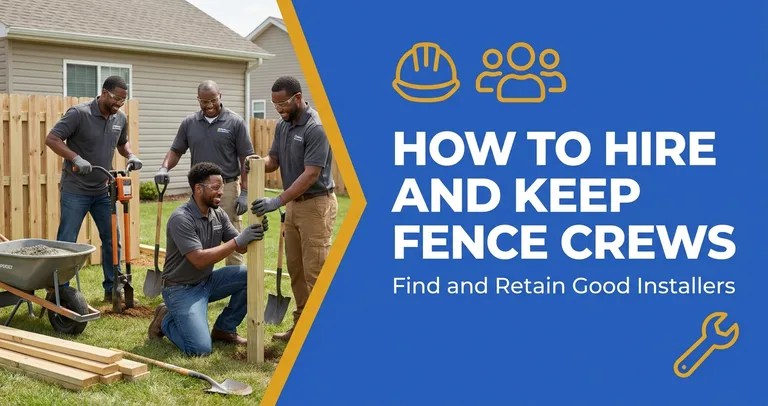
You already know the math. A two-man crew that knows what it's doing can set and hang a 150-foot wood privacy fence in a day. A green crew can turn that same job into a two-day disaster with crooked posts, gaps under the bottom rail, and a callback you eat. The difference between those two outcomes isn't your bid, your sales, or your marketing. It's the people swinging the post-hole digger.
The hard part of running a fence company was never finding work. In most markets you can keep three crews busy off referrals and a halfway-decent web presence. The hard part is having enough good hands to actually install the work you've already sold, and keeping those hands from walking to the guy down the road for a dollar more an hour in July.
This is owner-to-owner, the stuff nobody tells you when you go from swinging hammers yourself to running crews. Where to actually find fence labor that lasts, how to screen so you stop wasting two weeks on a guy who quits, what pay structure keeps your best installer from leaving, and whether you should even be carrying employees at all. Get this right and you stop turning down work because you're short-handed.
Where to Actually Find Fence Installers (Not Just Warm Bodies)
The single biggest mistake established owners make is treating recruiting like an emergency. You only post a job when you're already buried, you're desperate, you hire the first guy who shows up, and you've taught yourself that hiring produces garbage. The owners with stacked crews are always recruiting, even when they're full. A good installer who walks in the door in February is worth keeping a spot warm for.
Here's where the people who can actually hire fence installers worth keeping tend to find them:
- Your own crews. Your best installer knows three other guys who can do the work and aren't happy where they are. Pay a referral bonus, half on hire, half at 90 days so they only bring you people who'll stick. This is the highest-quality channel you have and it costs you almost nothing.
- Material yards and supply houses. The counter guys at your fence supplier, the lumber yard, the concrete supplier, they see every crew in town. They know who's reliable and who bounced a check. Tip them, buy them lunch, and tell them you're hiring. They'll send you names.
- Adjacent trades that are slow. Deck builders, landscapers, concrete finishers, and general laborers already know how to work outside, run a level, and dig. A landscaper who's tired of seasonal layoffs can be a strong fence installer in a couple of weeks.
- Facebook groups and local job boards over the big sites. Indeed will bury you in applications from people who've never held a tamping bar. Local trade Facebook groups, community pages, and even a yard sign on a job site that says "Now Hiring Installers" with your number pull people who already live and work in your area.
- Spanish-speaking labor networks. A huge share of the fence trade runs on Hispanic crews who are excellent installers. If you don't have a bilingual lead or foreman, that's a gap worth closing, because it opens a whole recruiting pool most of your competitors can't reach.
The point is to have three or four channels always running so you're choosing from a few candidates, not begging the one guy who answered. When you're picking from a position of strength, your whole crew gets better.
Screening for Skill and Reliability Before You Waste Two Weeks
Skill you can teach in a season. Showing up you cannot. The most expensive hire in the fence business isn't the unskilled guy, it's the guy who's great on the days he comes in and disappears the other two. Your screening has to sort for reliability first, hands second.
A resume tells you almost nothing in this trade. Run a working interview instead:
- Put them on a job for a day, paid. Bring a candidate out to a real install as a paid trial. In one day you'll see everything: do they show up on time, do they hustle or lean on the truck, can they read a string line, do they take direction without attitude, and are they still moving at 2pm. One real day beats three interviews.
- Watch how they handle the unglamorous parts. Anybody can carry a panel. The job is digging in clay, mixing concrete in the heat, pulling old chain link, and cleaning up the site. If they're picky about the dirty work on day one, they'll be a problem on day thirty.
- Ask trade-specific questions. How do you set a corner post so it doesn't lean. How do you keep a long run straight on a slope. What do you do when you hit a buried line or rock. Their answers, or honest "I'd ask the lead," tell you if they've actually done the work or just rode along.
- Check the boring stuff that predicts reliability. Do they have a valid license and reliable transportation, because a guy who can't get to the yard is useless no matter how good he is. If they'll be driving your truck or pulling a trailer, run the motor vehicle record. One DUI on your insurance can cost you more than the hire is worth.
- Call the last real boss, not the reference they hand you. Ask one question: "Would you hire him back?" The pause before the answer tells you more than the answer.
Set a 90-day window in your head where you're still deciding. Plenty of guys look great for two weeks and fall apart in week six. Don't hand out the keys to the truck and the company card until someone's earned a season of trust.
Pay Structures: Hourly vs Piece vs Production
How you pay your crew shapes how they work, more than any pep talk you'll ever give. The three models in this trade each pull behavior in a different direction, and the right answer is usually a blend.
Hourly
Simple, predictable, and what most installers expect when they start. The problem is hourly pays for time, not output, so a slow crew costs you the same as a fast one and your sharpest installer subsidizes your laziest. Hourly makes sense for new hires, for complicated custom work where speed creates callbacks, and for laborers who aren't running the job. Expect a wide range depending on your market, roughly entry laborers on the low end and a seasoned lead installer or foreman commanding a real premium above that.
Piece rate
You pay per unit installed, say a set dollar amount per linear foot of standard wood privacy or per chain-link panel. This rewards speed and your best hands love it because they can out-earn an hourly cap. The danger is quality. When a crew is paid by the foot, they'll be tempted to rush the bottom rail, skimp on concrete, and leave you the callback. Piece rate only works if you inspect the work and dock or refuse pay for anything that has to be redone. It fits clean, repetitive production work like long stretches of standard residential fence on flat lots.
Production or split pay
This is where most established companies land. You pay a base hourly so the crew has a floor and isn't gambling on weather, plus a production bonus tied to completing jobs cleanly and on schedule. A common version is a per-job or per-week bonus the crew splits when the work passes inspection and the customer signs off with no callbacks. It rewards speed and quality at the same time, which is exactly what you want.
- Tie bonus money to passing inspection, not just finishing. The crew gets the bonus when the job is done right, the gate swings true, the posts are plumb, and the site is clean. Build callbacks into the formula so a sloppy job costs them, not you.
- Pay your lead more for what the lead actually does. The foreman who lays out the job, keeps the line straight, and handles the homeowner is worth a real step up over a laborer. Pay for that or you'll train leads for your competitors.
- Be transparent about the math. Crews work harder when they can see exactly how today's job turns into Friday's check. Hide the formula and they assume you're skimming.
Whatever you choose, run the numbers on your actual installed labor cost per foot, not a feeling. If you don't know what it costs you in labor to put up a foot of fence, you can't tell whether your pay structure is making you money or quietly bleeding it.
Sub vs Employee: Which One Fits Your Company
This is the decision that quietly determines your margins, your risk, and how much you can grow. Plenty of fence companies run entirely on subcontracted crews, plenty run on W-2 employees, and the right call depends on where you are.
Subcontractor crews give you flexibility and lower fixed overhead. You're not carrying payroll, workers' comp, or unemployment between jobs, and when work is slow you're not paying people to sweep the shop. The trade-offs are real, though. You have less control over scheduling and quality, the crew can take a better-paying job from someone else and leave you scrambling, and you're competing for the same handful of good subs as every other company in town. There's also legal exposure: if you control how, when, and where a "sub" works, supply their materials, and direct them daily, the IRS and your state may decide they're actually employees, and the back taxes and penalties for misclassification are brutal. Treat real subs like real subs, with their own insurance, their own tools, and their own control over how the work gets done.
W-2 employees cost more on paper, payroll taxes, workers' comp, and the cost of paying through slow weeks, but you get control, loyalty, and a crew that learns your standards and stays. You can train them your way, hold them to your quality, and build the kind of bench that lets you take on bigger contracts because you know the work will get done right.
Most growing companies end up with a hybrid: a core of W-2 employees who carry your standards and your hardest jobs, plus a couple of trusted sub crews you can lean on when you're slammed in peak season. The core keeps your quality and your reputation intact. The subs absorb the overflow so you stop turning down work in June. The key is building that relationship with sub crews in the slow months, not when you're already desperate, because the good ones are spoken for by the time the season hits.
Keeping Your Crew Through the Busy Season
Recruiting is the cost of failing at retention. Every installer who walks costs you the hire, the training, the slower jobs while the replacement learns your standards, and the work you turn down because you're short. In a trade where the whole year's profit gets made in maybe six or seven busy months, losing a lead installer in May is a gut punch you feel all season.
The brutal truth is that good fence installers get poached, especially when everyone's busy and everyone's short-handed. The owner down the street will dangle a dollar more an hour. Money matters, but it's rarely the only reason a good hand leaves, and it's rarely enough on its own to keep one.
- Pay competitively and review it before they ask. If your best installer has to come to you for a raise, you've already half-lost him. Know what the market pays and stay ahead of it for the people you can't afford to lose. A small raise you offer first is cheaper than a counteroffer war.
- Keep them working in the off-season. The fastest way to lose a good crew is to lay them off every winter and hope they come back. Stockpile commercial work, repairs, and gate jobs to bridge the slow months, or be honest about the schedule so they can plan. The crews that stay are the ones that don't have to find a new job every January.
- Buy the right tools and trucks. Nothing burns out a crew like fighting a worn-out auger, a truck that won't start, and not enough panels on the trailer so they make three trips. Good equipment says you respect their time, and it directly speeds up the jobs that earn their bonus.
- Give your leads ownership. Your best people want to run their own crew, make calls on the job site, and be trusted. Promote from within, let your foreman pick his own laborers, and you'll keep the guys who'd otherwise leave to feel like more than a number.
- Don't make payday a fight. Pay on time, pay the right amount, and pay bonuses when you said you would. One late or short check and the trust you spent a year building is gone. This sounds basic because it is, and it's the thing struggling companies screw up most.
- Keep the work coming so nobody sits idle. A crew with steady, well-sold jobs makes money and stays. A crew that's standing around because the schedule has holes starts looking elsewhere. The cleanest way to keep good people is to keep good work in front of them, which is exactly where consistent exclusive fence installation leads earn their keep, because a full schedule is the best retention tool you've got.
Treat your crew like the asset they are, because in this business they're the only thing your competitors can't copy. Anyone can buy the same posts and pickets. Almost nobody can build a crew that shows up, installs it right, and sticks around.
The Real Fix: Keep Crews Busy Without the Feast-or-Famine
Here's the part most owners miss. Your hiring problem and your retention problem are usually the same problem wearing two hats: an inconsistent flow of booked jobs. When work comes in waves, you over-hire in spring, lay off in fall, and burn out the loyalty you spent all summer building. The crews that stick around are the ones who never have to wonder whether there's work next week.
That's why the best operators decouple their crew from the swings. Some build a stockpile of repairs and commercial work to bridge slow stretches. Some keep a tight core of employees and lean on sub crews for the peaks. And some take the headache off their plate entirely by having a steady stream of booked jobs handed to them so the schedule stays full year-round, which is the model behind fence installation marketing done right, the work shows up consistently so your crew always has somewhere to be.
Solve the steady-work problem and the crew problem gets a lot smaller. You hire from strength instead of panic, you pay people to install instead of paying them to wait, and your best installers stay because the paychecks never stop. Whether you build that consistency yourself or have someone bring you the booked jobs, the goal is the same: a full schedule and a crew that never has a reason to leave.
Frequently Asked Questions
How much should I pay a fence installer to keep them?
It depends heavily on your market, but the structure matters more than the number. A floor of competitive hourly pay plus a production bonus tied to clean, completed jobs usually beats a flat high hourly rate, because it rewards your fast, careful installers and lets your best hands out-earn a cap. Pay your lead or foreman a real step above a laborer for laying out the job and handling the customer. The cheapest raise is the one you offer before your best installer goes looking, since a counteroffer war costs more than staying ahead of the market in the first place.
Should I hire fence installers as employees or use subcontractors?
Most growing companies run a hybrid: a core of W-2 employees who carry your quality standards and your hardest jobs, plus trusted sub crews for overflow during peak season. Employees cost more in payroll, comp, and slow-week pay but give you control, loyalty, and a bench you can grow on. Subs lower your fixed overhead and add flexibility, but watch classification carefully, if you control how and when they work and supply their materials, the IRS may rule them employees, and misclassification penalties are severe. Build your sub relationships in the slow months, because the good crews are already booked once the season hits.
Where do I find good fence labor fast when I'm short-handed?
Your fastest quality channels are referrals from your own crew, paid half on hire and half at 90 days, and tips from the counter guys at your material yards who see every crew in town. Adjacent trades that are slow, deck builders, landscapers, and concrete finishers, already know how to work outside and dig, so they ramp up quickly. Skip the giant job boards that bury you in unqualified applicants and lean on local trade Facebook groups and job-site yard signs instead. The real fix, though, is to always be recruiting so you're never actually desperate, because a hire made from panic is the one that quits in week six.