Why Most Fence Pricing Quietly Bleeds Money
Most fence companies do not have a pricing problem on the obvious jobs. The flat backyard, 150 feet of 6-foot cedar privacy, one gate, easy access. You could price that in your sleep and still make money. The bleed happens on everything else: the lots with grade, the demo nobody accounted for, the rock you hit at post 14, the second gate the customer added on a handshake. That is where margin walks out the door one job at a time.
The fix is not charging more. It is having a repeatable method so every estimate gets built the same way and nothing gets forgotten. When you price by feel, you win the easy jobs at a fine margin and lose your shirt on the hard ones, and you never know which is which until the season is over.
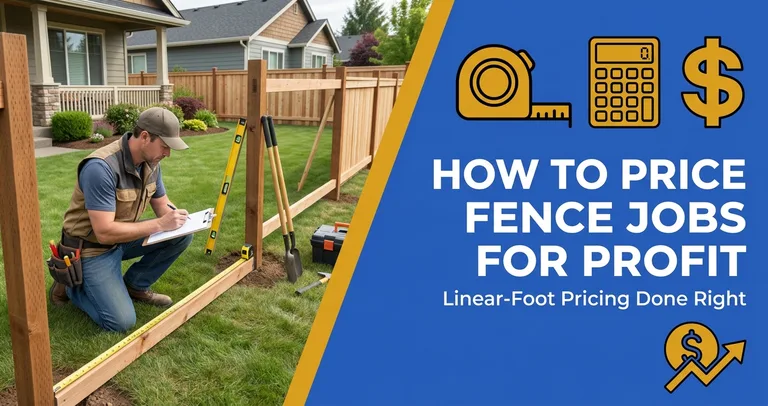
This is the method side of how to price fence jobs. We are going to walk the build of a number from the ground up: linear-foot fence pricing by material, gates, terrain and grade, demo and haul-off, labor and markup, and how to put the number in front of the customer. Margin strategy and sales are their own fights. This is about building a clean, defensible fence estimate every single time.
Start With Linear-Foot Fence Pricing by Material
Linear-foot fence pricing is the spine of every estimate you write. You measure the run, you have an installed per-foot number for each material and height, you multiply. Everything else (gates, grade, demo) gets added on top of that base. The mistake is treating your per-foot number as one number. It is not one number. It is a small grid you build once and update with your real costs.
Your per-foot price has to be material-specific and height-specific, because the spread is huge. Rough, clearly illustrative installed ranges so you see the shape of it:
- Chain-link - the cheapest to install and the fastest. Lowest per-foot of the common materials. Galvanized vs vinyl-coated, and height (4ft vs 6ft) move the number.
- Wood (cedar/pine privacy) - your bread and butter in most markets. Picket spacing, dog-ear vs flat-top, and whether it is shadowbox or board-on-board all change material and labor. Board-on-board uses noticeably more pickets.
- Vinyl - higher material cost, faster install once posts are set, and unforgiving on layout. Vinyl punishes a sloppy line because you cannot rack most panels much.
- Aluminum / ornamental - premium per-foot, panelized, install speed depends heavily on terrain because you are stepping or raking panels on slope.
- Composite - the highest material cost of the group and a real margin opportunity if you sell it right. Heavy panels, specific install steps, and customers who chose it are usually less price-sensitive.
Build the grid as installed cost (material plus your labor to install it), then your selling price sits on top of that. Update it when lumber moves, because it moves. A wood number you set last spring can be wrong by 20 percent now, and if you are quoting off stale costs you are donating margin. Reprice the grid on a set schedule, not when you happen to notice.
Price Gates, Corners, and Terminal Posts Separately
This is the single most common place a fence estimate leaks. A gate is not just a few feet of fence. It is a separate line item with its own labor and hardware, and it should never get buried inside your per-foot number.
A standard 4-foot walk gate carries a full set of hinges, a latch, sometimes a drop rod, the gate frame, and the time to hang it true so it does not sag in six months. A double-drive gate for a driveway is more: heavier frame, drop rods, a center stop, often a wider span that needs bracing. Hanging a gate well takes real time, and a gate that sags is the call-back that eats your Saturday.
Price each gate as its own line:
- Walk gate - flat add per gate that covers hardware plus the labor to hang it.
- Double / drive gate - a bigger flat add, because the span, the drop rods, and the bracing are all more work.
- Terminal, corner, and end posts - these cost more than line posts in material and in setting time. On a layout with a lot of corners (an L-shaped yard, a yard wrapping a deck), the post count and bracing climb fast.
Run the perimeter on paper and count your corners and terminals before you quote. A 200-foot straight run and a 200-foot run with six corners are not the same job, even though the linear feet match. Pricing them the same is how you lose money on the harder one.
Adjust for Terrain, Grade, and Access
Two yards with identical footage can have wildly different labor, and the difference is what is under your boots and how hard it is to get to the line. Flat, soft soil, clear access, dig and set all day. Now add slope, rock, roots, or a backyard you can only reach through a 36-inch gate with a wheelbarrow. The footage did not change. The labor doubled.
The honest answer is you cannot price grade and access accurately from a satellite photo. Walk the line. The drive-by quote is where contractors get buried, because the things that cost you (rock, a steep drop, a tight side yard, a buried irrigation main) do not show up until you are standing on the dirt.
What to read on the walk and load into the number:
- Grade - slope forces you to step the fence (each panel dropped a notch, common on vinyl and aluminum) or rack it (follow the grade, common on wood). Stepping adds layout time and sometimes more posts. Either way it is slower than a flat run.
- Soil and obstacles - sandy soil digs fast; clay and rock do not. If you are likely to hit rock you need a heavier line item or a clear change-order trigger, because a rock clause that you actually invoke beats eating it.
- Access - can the auger or skid-steer reach the line, or is everything coming in by hand through a gate? Hand-digging and hauling concrete by wheelbarrow is a real labor multiplier and it is invisible on a map.
- Locates and obstructions - mark for utilities, and note sprinkler lines, tree roots, old footings. These slow the dig whether or not you priced for them.
Build a simple terrain factor into your method, even if it is just easy / moderate / hard that bumps your labor by a set percentage. The point is to make the adjustment on purpose instead of hoping the easy jobs cover the hard ones.
Account for Demo, Haul-Off, and Disposal
If there is an old fence coming out, tearing it out and getting rid of it is its own job, and it deserves its own line on the fence estimate. Owners who fold demo into the per-foot price are pricing it as if it is free, and it is not even close.
Pulling an old fence is dirty, slow work. Posts set in concrete have to be dug or busted out, and that concrete has to go somewhere. The old panels, the wire, the gates, all of it has to be loaded, hauled, and dumped. Dump fees and trailer time are real costs and they vary by what is coming out.
Price demo and haul-off as a separate line, sized to the job:
- Old fence removal - per linear foot of existing fence, higher if posts are set in concrete versus driven.
- Concrete footing removal - the worst part of demo. Old footings can fight you for an hour each. If the new posts land in the same holes, that is even more digging.
- Haul-off and disposal - your trailer time plus the dump or landfill fee. A torn-out chain-link is light; a heap of pressure-treated wood and concrete is heavy and the fee reflects it.
Keep demo visible to the customer as its own number. It justifies the price, and it protects you when the old fence turns out to be worse than it looked from the curb. A line item you can point to beats an argument about why the total is high.
Layer In Labor, Overhead, and Markup
Now you have material, gates, terrain, and demo. Next you make sure your number actually covers the cost of doing business and pays you to do it. This is where a lot of owners think they are profitable and are quietly just busy.
Start with your true loaded labor cost, not the hourly wage. A crew member is wages plus payroll taxes, workers comp (which is not cheap in fencing), and the truck, fuel, tools, and auger that put them on the job. Your real cost per crew-hour is meaningfully higher than the number on the pay stub. Estimate jobs in crew-hours: a clean wood privacy run might move at a known pace per day, and you should know roughly how many feet your crew sets in a day by material so you can convert footage to hours and hours to cost.
Then there is the part most contractors skip:
- Overhead - your shop, insurance, the phone, the office help, the truck payments, the time you spend quoting jobs you do not win. That all has to be recovered inside your prices. If you only mark up over direct cost, overhead eats the difference.
- Markup vs margin - know which one you are using. A 30 percent markup on cost is NOT a 30 percent margin. Marking up cost by 1.3x leaves you around a 23 percent gross margin. If you want a specific gross margin, divide by (1 minus the margin), do not just add the percentage on top. This single confusion is the most expensive math mistake in the trade.
- Waste and contingency - lumber has cull, pickets crack, you miscount on a long run. Build a small allowance in so a bad bundle of cedar does not erase the job.
Take-off and estimating software (the established fence and contractor estimating tools) helps here, mostly by stopping you from forgetting line items and by holding your unit costs consistent. The tool does not set your prices for you. Your loaded labor rate, your overhead recovery, and your target margin do. The software just makes sure every estimate uses them.
Present the Number So It Reads as Value
You built a clean number. Now do not undersell it by slapping a single total on a scrap of paper. How you present the fence estimate changes whether the price feels expensive or fair, and it changes how many call-back arguments you have later.
Give a line-itemed estimate, not just a total. Material and install, gates broken out, demo and haul-off broken out, any terrain or rock allowance spelled out. The customer sees what they are paying for, and when they ask why you are higher than the guy with the cheaper number, you have the answer in writing. Usually you are higher because you actually priced the demo and the corners that the other guy is going to surprise them with later.
A few things that make the number land and protect your margin:
- Be specific on materials - state the height, the grade of wood, the gauge, the brand of vinyl or aluminum. Vague specs invite the customer to compare you to a cheaper, lesser product.
- Put your terms in writing - what happens if you hit rock, what the deposit is, how change orders work. The handshake second gate is a margin killer; a written change-order line is not.
- Quote a real expiration - material prices move, so your estimate is good for a set window. This is not a sales trick, it is protecting yourself from lumber jumping between the quote and the build.
- Lead with the work, not the price - the post depth, the concrete, the bracing, the warranty. When the customer understands the build, the number stops being the only thing on the page.
Pricing is only half the equation. The other half is having enough jobs to quote so you are not tempted to cut your number just to keep crews busy. If keeping the schedule full is the real problem, that is a different fix than your spreadsheet, and you can either build that lead flow yourself or have us bring you exclusive fence installation leads so you are pricing from a position of strength instead of desperation. When you are not starving for the next job, you hold your margin, and held margin is the whole point.
Fence Pricing FAQ
Should I price fence jobs per linear foot or per job?
Build the number per linear foot by material and height, then add the per-job items on top: gates, demo and haul-off, terrain and access, and your overhead and markup. Pure per-foot pricing ignores the things that actually vary job to job, and pure per-job feel pricing forgets line items. The method is per-foot base plus itemized add-ons. That is how you get a fence estimate that holds up on the easy job AND the ugly one.
How do I handle a job where I might hit rock or roots?
Walk the line first so you are not guessing, and put a written allowance or change-order trigger in the estimate for unforeseen conditions. Spell out what happens and what it costs if you hit rock, an old footing, or a buried line. A clear clause you actually invoke beats eating the cost, and customers accept it far better when it was in writing before you started than when it shows up as a surprise.
What is the difference between markup and margin in fence pricing?
Markup is what you add on top of your cost; margin is what you keep out of the final price. They are not the same number. Marking up cost by 30 percent (multiplying by 1.3) leaves you around a 23 percent gross margin, not 30. If you want a specific gross margin, divide your cost by (1 minus the margin) instead of adding the percentage. Owners who confuse the two think they are more profitable than they are, and it shows up at the end of the season. If you would rather spend your time bidding and building than running marketing, fence installation marketing is the do-it-for-you side of keeping the schedule full.