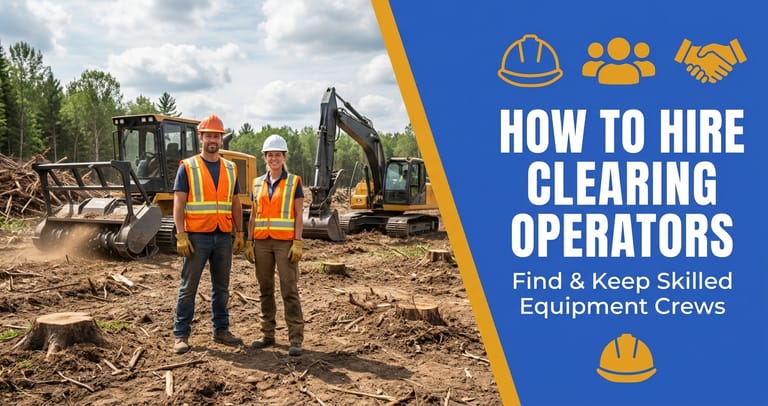
One Bad Operator Can Cost You $25,000 in a Single Afternoon. Here's the Math on Hiring Right.
You already run a real land clearing company. The trucks are titled, the mulcher is paid down or close to it, and you have more work on the board than you can put a machine on.
The bottleneck stopped being leads a while ago. The bottleneck is that you cannot find a guy who can run a track machine in tight timber without tearing up a final drive, and the one good operator you do have is the reason you lie awake wondering what happens if he quits.
This is not a startup problem. It is the problem you earn after you have proven you can sell the work.
You can bid a 40-acre forestry mulching job and win it. You just cannot reliably staff it without pulling your best man off another site or putting a green kid in a $180,000 machine and praying.
Every operator you lose costs you weeks of schedule and thousands in torn-up iron, and every one you keep at the wrong pay is a bad week from a competitor offering him two more dollars an hour.
This guide is for the owner who can win the work but cannot crew it. We will cover where skilled operators actually come from in 2026, what you have to pay to get and keep them, how to screen a man in the seat instead of across a desk, how to grow a green hire into a real mulcher operator, what a bad hire truly costs once you add insurance and downtime, and the retention moves that hold a crew together when the company down the road is poaching.
Why Your Best Operator Is Always One Bad Week From Quitting
Here is the uncomfortable truth most owners never say out loud. Your good operators are not loyal to you. They are loyal to a situation.
The day the situation gets worse than the offer in their pocket, they are gone, and skilled operators always have an offer in their pocket because everybody in your county is short-handed.
A skilled mulcher or excavator operator gets approached constantly. The dirt contractor needs him. The pipeline crew needs him. The competitor who just landed a subdivision needs him yesterday.
He is not looking for a job. The job is looking for him.
So when he has a week where the machine is down, the pay is late, the foreman rode him, and there were no hours because you ran out of staged work, that is the week he answers his phone.
Owners lose operators for reasons that look like culture on the surface and money underneath:
- Inconsistent hours. An operator with a truck payment and a mortgage cannot survive a 30-hour week followed by a 60-hour week. Steady 45 to 50 hours beats a higher rate that comes and goes.
- Junk equipment. Nothing burns out a good operator faster than fighting a worn-out machine all day. He blames the iron, then he blames you for the iron.
- No respect. A skilled operator knows exactly how much money he makes you in a day. Treat him like a body and he leaves for a shop that treats him like the asset he is.
- Getting passed over. You hired a buddy as foreman over a man who has run circles around him for two years. That operator is already updating his references.
Once you accept that operators leave for situations and not just paychecks, the whole problem changes shape. You stop trying to win a bidding war on hourly rate alone and start building a place skilled people do not want to leave.
That is cheaper and it works better. First, though, you have to find them.
Where Skilled Land Clearing Operators Actually Come From
The biggest mistake established owners make is posting one Indeed ad, getting 40 applications from people who have never touched a machine, and deciding there is no talent out there.
There is plenty of talent. It is just not sitting on a job board. Skilled operators are already working, so you have to go where they are.
Poach from adjacent trades, not just competitors
The fastest way to hire is to recruit someone who already runs heavy iron in a related trade. Excavation crews, logging outfits, site-prep contractors, pipeline and utility right-of-way crews, and grading companies are full of men who can run a track machine and just need to learn your heads and production targets.
A logger who has felled timber for ten years already understands trees, terrain, and danger; teaching him a mulcher is a short trip.
Poaching a competitor's operator works too, but the man who jumps to you for two dollars will jump from you for two dollars, so recruit him on the situation and the better-maintained iron, not just the rate.
Word of mouth beats the job board, every time
The best operator you ever hire comes recommended by one you already trust. Good operators know other good operators, and they know exactly who can run a machine and who just talks.
Put a real bird-dog bounty on it: pay your crew $750 to $1,500 for any referral who makes it past 90 days. That is the cheapest recruiting you will ever buy, filtered for quality before the man shows up.
Trade schools, operator programs, and the union pipeline
For green talent you can mold, heavy-equipment operator schools and community college programs turn out people with some seat time, basic safety, and a real career interest.
The International Union of Operating Engineers runs apprenticeships that produce some of the most skilled, safety-trained operators in the country.
Union or not depends on your market, but even a non-union shop can build a relationship with the local equipment school and get first look at the best graduates each year.
Indeed is a funnel, not a hire
Job boards fill the top of the funnel, especially ground crew and entry-level seats. Write the ad like an owner, not a recruiter: name the machines, the pay range, and the hours, and say plainly that you run maintained equipment and pay on time.
The right operator reads that and knows you are serious. Then screen hard, because a board will bury you in unqualified applications.
What You Have to Pay in 2026 to Get and Keep a Crew
You cannot retain people you underpay, and in 2026 the market has moved. Skilled operators know their worth because three other companies told them.
The numbers below are real-world ranges for land clearing and forestry mulching crews in the US. They run higher in high cost-of-living markets, in storm and disaster work, and for specialty heads, and lower in rural low-wage areas.
Use them as a calibration, not gospel, and always check what the dirt and pipeline contractors in your specific market pay, because that is who you are really competing with for talent.
| Role | 2026 pay range | What to look for |
|---|---|---|
| Ground crew / laborer | $17 to $24 / hr | Shows up, works safe, takes direction, willing to learn a machine. This is your farm team. The best ground guys become your next operators. |
| Chainsaw / hand crew (felling) | $22 to $30 / hr | Real saw skill, can read a tree and a lean, knows escape routes. A man who can fell safely is worth far more than his rate. |
| Equipment operator (entry / 0-2 yrs) | $22 to $30 / hr | Some seat time, smooth on the sticks, gentle on the iron. Trainable into a mulcher seat. Hire for feel and attitude over a resume. |
| Skilled mulcher / excavator operator | $28 to $42 / hr | Production speed without tearing up the machine or the ground. Reads terrain, manages the head, works a full day unsupervised. Your money-maker. |
| Lead operator / crew foreman | $38 to $58 / hr (often salary $80k to $120k) | Runs the job and the crew, hits production targets, handles the customer, keeps everyone safe. Can train your green hires. Rare and worth fighting for. |
| CDL driver / lowboy hauler | $26 to $38 / hr | Clean CDL, can haul iron safely and legally, ties down right. Doubles as ground or operator on site when not moving equipment. |
Now do the math most owners skip. The hourly rate is not what an operator costs you. A skilled operator at $35 an hour is not a $35 employee.
Add payroll taxes, workers' comp (brutal in clearing and tree-work classifications), general liability, the vehicle and equipment insurance load, paid time off, any health contribution, and the truck and tools he uses.
Your true loaded cost on a $35 operator lands around $52 to $62 an hour, more in high-comp states. That is the number you bid against and the number a bad hire wastes.
The flip side: a skilled operator on a mulcher producing real acreage generates several times his loaded cost per day. The expensive employee is never the one you pay well. It is the one who cannot produce or tears up your iron.
How to Screen an Operator in the Seat, Not Across a Desk
You cannot tell whether a man can run a machine by talking to him. Operators talk a great game. Every applicant has run every machine and never scratched a thing.
The interview tells you whether you can stand to work with him. The seat test tells you whether he can do the job. You need both, and most owners skip the one that matters.
Run a real, paid working interview. Put him in a machine on actual or staged ground and watch. Pay him for the day so it is fair and so a good operator takes you seriously. Here is what you are watching for:
- The walk-around. Before he climbs in, does he check the machine? Fluids, tracks, pins, the head. A real operator inspects iron out of habit; a talker climbs straight in. That tells you how he will treat your investment.
- Smoothness, not speed. Watch his hands. A skilled operator is smooth and deliberate, no jerky slams, no banging the boom, no spinning tracks. Speed comes from smoothness, and a man who muscles the machine will break it.
- How he reads the ground and the trees. Does he set up his cut, manage his lean, and think two moves ahead, or just attack the nearest tree? Production in clearing is about sequence, not aggression.
- Head and ground awareness. Does he keep the mulcher head where it belongs, manage rpm, avoid feeding rock into it, and know where his swing radius and spoil are? Awareness is the difference between a profitable day and a $9,000 repair.
- What he does when something goes wrong. Stall the test with a soft spot, a buried stump, a tricky lean. The man who stops and reassesses is the man who will not roll your machine.
Beyond the seat, verify the boring stuff. Pull his motor vehicle record if he will drive or haul, confirm any CDL, and call his last two employers with one question that cuts through everything: would you hire him again.
The pause before the answer tells you as much as the answer. Then run him through whatever drug and background screen your insurance and customers require, because one operator who fails a post-incident test can torch a commercial contract.
The interview tells you if you can stand him. The seat test tells you if he can run. Skip the seat test and you are hiring a story, not an operator.
How to Turn a Green Hire Into a Real Mulcher Operator
In a tight labor market, the operators you need may not exist to hire at any price, so the owners who win build their own. You take a sharp ground guy with good hands and grow him into a seat.
Done right, a homegrown operator is more loyal, costs you less, and runs your machines the way you taught him.
The mistake is throwing a green man straight onto your $180,000 forestry mulcher and hoping, which turns a training cost into a repair bill. Build a ladder instead:
- Start him on the ground. Six months to a year on the crew, learning the work, the safety, and how clearing flows before he runs production iron.
- Put him in a cheap-to-hurt machine first. A skid steer or smaller excavator on simple tasks. Let him build feel where a mistake costs hundreds, not thousands.
- Pair him with your lead operator. Your best man trains your next man, on the clock, on real jobs. Pay the lead extra to train, and he will protect your equipment and pass on the habits that keep it alive.
- Graduate him to the mulcher under supervision. Short stints on the production head while the lead watches, then longer, then solo on easy ground, then solo everywhere. Months, not days.
- Tie raises to milestones. Each rung comes with a pay bump he can see coming. That is what keeps him from leaving the day he gets good.
Budget six to twelve months and some torn-up ground to make a real operator. It feels slow until you compare it to paying top dollar to poach a man who leaves in eight months.
The crew you grow is the crew that stays.
The Real Cost of a Bad Hire (It Is Not the Wage)
Owners think a bad hire costs them the wages until they fire him. The wages are the cheapest part.
In land clearing, a bad operator is one of the most expensive mistakes you can make, because he sits inside a machine that costs more than a house and works in an environment that kills people. Add up what one actually costs:
- Torn-up iron. An operator who feeds rock into a mulcher head, spins tracks, or runs a final drive low can hand you a $5,000 to $25,000 repair in an afternoon, plus the days that machine is down and not earning.
- Blown production and schedule. A slow operator turns a three-day job into five and pushes every job behind it. Now you are late on a contract and your good crews are covering for him.
- The safety bill. This is the one that can end you. A single recordable injury, a dropped tree, or an OSHA citation does not just cost the immediate claim. It drives up your Experience Modification Rate, the multiplier on every dollar of workers' comp you pay for years, and can price you out of commercial bids that require a clean EMR.
- The turnover ripple. A bad operator drags down the good ones. They resent covering for him, and the best of them start to wonder if this is the right shop. You can lose a good man because you kept a bad one too long.
The lesson is not to fear hiring. It is to screen hard up front and cut a bad hire fast.
The most expensive operator on your payroll is the one you knew was wrong in week two and kept until month four because you were short-handed. Being short-handed is cheaper than being wrecked.
How to Keep the Operators You Already Have
Hiring is the expensive way to solve a labor problem. Retention is the cheap way. Every operator you keep is one you do not have to find, screen, train, and risk.
The owners with stable crews in a tight market are not paying the highest wage in the county. They built a place skilled people do not want to leave.
Pay fairly, then pay for performance
You do not have to be the highest payer, but you cannot be the lowest and keep skilled men. Get your base into the fair range from the table above, then layer on bonuses that reward what makes you money: a production bonus for hitting acreage targets, a safety bonus for clean quarters with no incidents or equipment damage, and a longevity bump.
An operator who shares in a good month works like an owner. One on flat wage works like an employee.
Protect their hours and their machine
Steady hours and maintained iron are not perks, they are retention. Stage enough work that nobody sits at home wondering about rent, and keep equipment running right so operators are producing instead of fighting the machine.
A guaranteed minimum week in slow stretches holds a good operator through a soft patch that would otherwise send him looking.
Respect, a path, and the take-home machine
Skilled operators stay where they are treated like professionals. Ask their opinion on the bid, the setup, the schedule, because they often know the ground better than you do.
Give them a real path from ground to operator to lead to foreman, with pay to match each rung, so the ambitious ones build a future with you instead of leaving to find one.
And do not underestimate the small signals: a take-home truck, a quality machine that is "his," and getting paid right and on time every single week. Operators talk, and the shop that pays on time and runs good iron gets the reputation that makes the next good hire come to you.
How Home Service Direct Keeps Your Crews Booked So You Can Justify the Payroll
Here is the part of the labor problem nobody talks about. You cannot keep a deep, well-paid crew without steady work to put them on.
The owners who lose people are usually the ones whose lead flow runs hot and cold, so their hours run hot and cold, so their best operators leave for a company that can keep them busy.
Steady leads are a retention tool. A full schedule is what lets you guarantee hours, pay performance bonuses, and justify carrying that extra operator through a slow stretch instead of laying him off and losing him for good.
That is the part we handle. Home Service Direct generates exclusive land clearing work so your phone rings with the right jobs and your crews stay booked.
Not shared inquiries five companies already called. Exclusive jobs that come only to you, with the volume and consistency that let you staff up with confidence instead of always running short.
- Exclusive jobs, never resold, so you are not racing four other operators to the phone on every lead.
- Consistent volume across the channels that actually book clearing work, so you can guarantee your operators steady hours.
- Full tracking so you know your cost per booked job and can build a payroll around predictable revenue.
You handle running the iron and keeping a crew together. We handle keeping that crew booked. See how the land clearing lead program works, and stop letting a thin schedule cost you your best operators.
Frequently Asked Questions
How do I find skilled land clearing operators when nobody is applying?
Skilled operators are already working and are not browsing Indeed, so go where they are. Recruit from adjacent trades like excavation, logging, site prep, and pipeline crews, where men already run heavy iron and just need to learn your heads.
Put a referral bounty on your existing crew, since good operators know other good operators. Build a relationship with the local heavy-equipment school for green talent you can train. Use job boards for the top of the funnel, but expect to do the real recruiting yourself.
What should I pay a land clearing equipment operator in 2026?
A skilled mulcher or excavator operator generally runs $28 to $42 an hour in 2026, with entry-level operators around $22 to $30, ground crew $17 to $24, and lead operators or foremen $38 to $58 an hour or salaried at $80,000 to $120,000.
These are calibration ranges, not fixed numbers, and they run higher in high cost-of-living markets, storm work, and for specialty heads. Check what the excavation and pipeline contractors in your market pay, because that is who you compete with for the same operators, and remember your true loaded cost is far above the wage once you add comp, insurance, taxes, and overhead.
How do I test whether an operator can actually run a machine?
Run a paid working interview and put him in a machine on real or staged ground. Watch whether he inspects the iron before he climbs in, whether his hands are smooth instead of jerky, whether he reads the trees and works a sequence, and whether he manages the head and his swing radius.
Then stall him with a tricky spot and see if he stops and thinks or forces it. The interview tells you if you can stand to work with him. The seat test tells you if he can run. Never hire an operator without putting him in a seat first.
Is it better to hire experienced operators or train green ones?
Do both, but in a tight market, plan to grow your own. Experienced operators deploy faster but are harder to find, more expensive, and quicker to leave for the next two-dollar raise.
A green hire with good hands and a good attitude, brought up right, becomes more loyal and runs your machines the way you taught him. Start him on the ground, then a cheap-to-hurt machine, then the mulcher under your lead operator's eye, and tie a raise to each step. Budget six to twelve months. The crew you grow is the crew that stays.
What does a bad operator hire really cost me?
Far more than his wages. A bad operator can hand you a $5,000 to $25,000 repair in an afternoon by feeding rock into a mulcher head or running a final drive low, plus the downtime while that machine sits. He blows production and pushes every job behind him.
Worst of all, a single safety incident or OSHA citation drives up your Experience Modification Rate, which multiplies your workers' comp cost for years and can price you out of commercial bids that require a clean EMR. The most expensive hire on your payroll is the bad one you keep too long because you are short-handed.
How do I keep my best operator from quitting?
Operators leave situations, not just paychecks. Pay fairly into the market range, then add production and safety bonuses so a good month rewards them like an owner. Protect their hours with staged work and a guaranteed minimum in slow stretches. Keep equipment maintained so they produce instead of fighting junk iron.
Give them respect, a real path from operator to lead to foreman with pay to match, and the small signals that matter like a take-home truck and getting paid right and on time every week. And keep the schedule full, because steady work is what makes every other retention move possible.