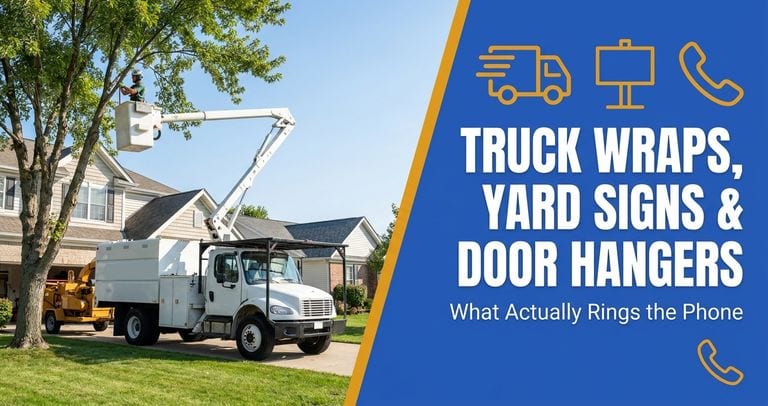
Your Trucks Already Advertise Every Single Day. The Only Question Is Whether Anyone Calls.
You already run a real tree service. Your bucket truck, chip truck and crew pickup are on the road before most of your customers are awake, and they sit in driveways for hours while your guys work.
Every one of those hours, somebody is looking at your equipment. The neighbor walking the dog. The homeowner two doors down who has been staring at a cracked limb over the garage since the last windstorm.
Most tree companies waste that attention. A plain white truck with a magnet sign. A yard sign that never went in the ground. No door hangers, because "nobody reads those."
Then the same owner spends $3,000 a month on online ads trying to reach the exact people who just watched his crew take down a 70-foot oak on their street.
This guide is written for the owner who already has crews, trucks and a phone that rings, and wants the trucks, the job sites and the street itself to book more work. Owner to owner, 2026 numbers.
We will cover what a truck wrap is really worth, how to use yard signs so they book the neighbor, the job-site door hanger play that turns one removal into three or four more estimates on the same block, how to track which one made the phone ring, and the mistakes that quietly waste the money.
Why Trucks, Signs and Door Hangers Still Book Tree Jobs in 2026
Tree work is the most visible service a homeowner ever buys. Nobody notices a plumber. Everybody on the street notices a crane, a bucket truck and a chipper running for six hours.
That visibility is your advantage. A gutter guy or a flooring installer works mostly out of sight. You put on a show every single day, right in front of the people most likely to need you next.
Trees on the same street are usually the same age, the same species and planted by the same developer. They took the same storms. When one homeowner finally calls about the big silver maple, three of the neighbors have the same problem and have been putting it off.
That is why offline signage still works for tree companies when it does nothing for a lot of other trades. It reaches the right person at the exact moment they are thinking about their own trees.
It also does something online ads cannot. It proves you are real and local. A homeowner who has seen your truck on their street three times trusts your number more than the one they found in a search result five minutes ago.
Key takeaway: Your equipment and job sites are already the best-placed advertising you own. Signage does not replace getting found on Google. It makes the people who see your crew in person far more likely to call you instead of the first name they find online.
Truck Wraps: The Billboard That Parks in Your Customer's Driveway
A wrap is the one piece of signage that works every hour your truck is moving or parked. It is also the one most owners get wrong, because they design it like a business card instead of a sign that has to be read from across the street.
What a Wrap Costs in 2026
Prices vary by region, vehicle size and the shop, but most wrap shops quote in these ranges:
- Cut vinyl lettering (name, phone, website on the doors and tailgate): roughly $300 to $900 per truck.
- Partial wrap (doors, rear quarter and tailgate with a printed graphic): roughly $1,200 to $2,800.
- Full wrap on a pickup: roughly $2,800 to $5,000. On a box truck, chip truck or bucket truck, $4,000 to $8,000 or more depending on the square footage and how much of the boom you cover.
A quality cast vinyl wrap installed by a good shop usually lasts five to seven years. Cheaper calendered vinyl can start to crack and peel in two or three, especially on trucks that sit in full sun.
Is a Wrap Worth It? Run the Math on Your Own Numbers
Here is a simple way to think about it. Say a full wrap costs you $4,000 and lasts five years. That is $800 a year, or about $67 a month.
If your average tree job is $1,800, the wrap has to bring in one booked job every couple of years to pay for itself. If it brings in one job a month, it is the cheapest advertising you own by a mile.
You will never know the exact number unless you track it, which we cover below. But the math is forgiving. Unlike an ad that stops the second you stop paying, a wrap keeps working every day for years.
Design Rules That Make a Wrap Actually Ring the Phone
- The phone number is the hero. It should be readable from 50 feet away, on both sides and the back. If you only fix one thing, fix this.
- Say what you do in four words or less. "Tree Removal and Trimming" beats a list of eleven services nobody can read at 40 miles an hour.
- Show your town. "Serving Overland Park and Olathe" tells a neighbor you are local, which is half the reason they trust you.
- Licensed and insured, in plain words. For tree work this matters more than almost any other trade. Homeowners know a tree on the roof is a disaster.
- One clean photo or none. A crisp shot of a bucket truck at work beats a collage of leaves. Busy wraps read as noise.
- Put the website and a review line on the back. "4.9 stars on Google" (only if it is true) gives the driver behind you a reason to look you up at the next light.
Do not forget the equipment you leave on job sites. A stump grinder or chipper sitting at the curb for a day is a billboard too. A simple decal with your name and number on every machine costs almost nothing.
Yard Signs: The Sign That Books the Neighbor While Your Crew Is Still There
A yard sign is the cheapest piece of signage you will ever buy and the one with the most direct line to a booked job. Corrugated plastic signs with wire stakes usually run a few dollars each in bulk.
The trick is how and when you use them.
Ask Every Customer, Every Time
Make it part of the estimate, not an afterthought. "We put a sign out front while we work and leave it for a week afterward. Is that okay?" Most homeowners say yes, especially happy ones.
Some HOAs and some towns limit how long signs can stay up. Follow the rules. A sign that gets a customer a letter from the HOA costs you the review.
Timing Is Everything
The sign has to be in the ground the morning the crew shows up, not the day after. The day of the job is when the street is paying attention: the crane is up, the chipper is loud, people come out to watch.
That is the moment a neighbor wants your number. If the sign is there, they take a picture of it. If it is not, they ask your groundman, who is busy, or they forget.
What the Sign Should Say
- Your name and a big phone number. Same rule as the truck.
- One line that sells the neighbor: "Your neighbors chose us" or "Ask about our neighbor discount this week."
- A tracking number or a short web address that only appears on yard signs, so you know which calls came from them.
Storm season is when yard signs earn their keep. After a big wind event, every street has three or four damaged trees. A sign at the first job on the block often books the next two before you have finished cleanup.
Door Hangers: Turn One Tree Job Into Three or Four More on the Same Street
Most owners think of door hangers as a cold canvassing tool, and cold canvassing is a grind. That is not how the best tree companies use them.
They use them as a job-site tool. Every time a crew is on a street, they hang 20 to 40 doors on the same block before they leave.
The Job-Site Door Hanger Play
The hanger says something like: "We are working at 1418 Maple this week. Sorry about the noise. While our crew and equipment are on your street, we can look at your trees too. Neighbors on this street get a discount on trimming booked in the next 14 days."
It works for three reasons.
- It is not cold. The homeowner just watched your crew work. You are the tree company on their street, not a stranger.
- The discount is real money for you to give. When the crane and crew are already on the block, the second and third job skip the drive time and the mobilization. You can give 10 percent and still make more per hour than on a job across town.
- It has a deadline. "In the next 14 days" turns "someday" into "this week."
The Math on One Street
Here is a worked example with round numbers. Use your own.
A crew hangs 40 doors around a removal. Printing and the 20 minutes it takes come to maybe $40 to $60. If two homeowners call and one books a $1,200 trim, that job cost you roughly $50 to win.
Compare that with what you pay online for a single lead, before it even books. If you want to see how that looks for your own company, our guide on what a tree lead is really worth walks through the cost per booked job math.
Door Hangers vs. Mailers
Mailers have their place. USPS Every Door Direct Mail lets you hit every house on a carrier route without a mailing list, and it is a solid way to cover neighborhoods you want to break into.
But a door hanger placed by your own crew on the day of a job beats a mailer that shows up two weeks later with no connection to anything the homeowner saw. Use mail to reach new areas. Use hangers to harvest the street you are already working on.
How to Know Which One Actually Made the Phone Ring
This is where most tree companies fall down. They spend real money on wraps, signs and hangers, then have no idea which one brought in the work. So the next time money gets tight, they cut the thing that was actually working.
Three simple habits fix it.
1. Give Each One Its Own Phone Number
Call tracking numbers cost a few dollars a month each. Put one number on the trucks, a different one on yard signs and a third on door hangers. Every call tells you exactly where it came from. We explain how we set this up for owners on our call tracking and recording page.
2. Ask on Every Call
"How did you hear about us?" Then write it down in the same place every time, whether that is your CRM, your estimating software or a notebook in the office. "Saw your truck" and "neighbor had you out" are answers worth counting.
3. Count Booked Jobs, Not Calls
A channel that brings 20 calls and 2 jobs is worse than one that brings 8 calls and 5 jobs. At the end of each month, add up what you spent on each one and divide by the jobs it booked. That is your cost per booked job, and it is the only number that tells you where to put more money.
Truck Wraps vs. Yard Signs vs. Door Hangers: Side by Side
| Option | Typical cost | How long it works | Best for | How to track it |
|---|---|---|---|---|
| Full truck wrap | $2,800 to $8,000+ per vehicle | 5 to 7 years (cast vinyl) | Name recognition across your whole service area, every day | Dedicated tracking number on the wrap |
| Vinyl lettering | $300 to $900 per truck | Several years | Tight budgets, fleet trucks, trailers and equipment | Same number as the wraps |
| Yard signs | A few dollars each | The job day plus about a week | Booking neighbors during and right after a job | Yard-sign-only number or short web address |
| Door hangers | Under a dollar each, plus crew time | About two weeks (with a deadline offer) | Turning one job into several on the same street | Hanger-only number or offer code |
| EDDM mailers | Postage plus printing per piece | One drop | Breaking into a new neighborhood or town | Mail-only number |
The Mistakes That Quietly Waste Your Sign and Wrap Money
A Phone Number Nobody Can Read
The single most common wrap mistake. Logo huge, phone number tiny. If a driver cannot read it from the lane next to you, the wrap is decoration.
A Dirty Truck
Your truck is your storefront. A wrap covered in mud and sap says the same thing about your work. Wash the trucks that carry your name.
Signs That Never Go Out
A box of yard signs in the shop does nothing. Make "sign in the ground" part of the crew leader's checklist, right next to cones and the chipper safety check.
Door Hangers With No Reason to Call Now
A hanger with just your logo and services gets thrown away. Tie it to the job on the street and give it a short deadline, or skip it.
Bad Driving in a Branded Truck
Every person your driver cuts off now knows your company name and number. A wrapped truck is advertising in both directions. Make sure your guys know it.
No Online Presence Behind the Sign
Here is the part most owners miss. Very few people call straight off a truck. They see the truck, then they search your name. If what they find is three reviews and a website that has not been touched since 2019, you lose the job you already paid to win.
How Home Service Direct Fits In: Owning the Search That Happens After They See Your Truck
We work with more than 100 tree service companies on the part that happens after the yard sign, the wrap and the door hanger: the moment the homeowner picks up their phone and looks you up.
That search is where the job is won or lost. When they type your name, or "tree removal near me," you want your Google Business Profile, your reviews and your ads to be right there, and you want them to see the same company they just saw on their street.
We run the online side for tree companies: Google Local Service Ads, Google Ads, Facebook ads and the website that turns those visits into booked estimates. You can see how we approach it on our marketing for tree companies page, and how our Local Service Ads management for tree services puts you at the very top of Google with the Google Verified badge.
The trucks and signs build the trust. We make sure that trust turns into a booked job instead of a call to the next company on the list. If you want a steady flow of calls on top of what your street signage already brings in, look at our exclusive leads for tree companies, where you are the only company that gets each call.
Frequently Asked Questions
How much does it cost to wrap a tree service truck?
Most shops quote roughly $2,800 to $5,000 for a full wrap on a pickup and $4,000 to $8,000 or more for a box truck, chip truck or bucket truck, depending on size and how much of the vehicle you cover. Partial wraps run roughly $1,200 to $2,800, and simple vinyl lettering roughly $300 to $900 per truck. Prices vary by region and shop, so get two or three quotes and ask what grade of vinyl they use.
Do truck wraps actually bring in tree jobs?
They do when the phone number is easy to read and the design says what you do in a few words. The bigger effect is trust: homeowners who have seen your truck around town are more likely to call you when they search. The only way to know what your wraps bring in is to put a dedicated tracking number on them and count the booked jobs.
Is it legal to put a yard sign at a customer's house?
With the homeowner's permission, it usually is, but many HOAs and some towns limit sign size or how long a sign can stay up. Ask the customer at the estimate, and check local rules if you work in HOA-heavy neighborhoods. Pull the sign on time so the customer never gets a complaint letter.
How many door hangers should my crew hang around a job?
Twenty to forty on the same block is a good rule of thumb. Focus on the houses that can see your crew working and the ones with similar trees. The goal is not volume. It is reaching the neighbors who just watched you work, with an offer tied to this week.
Should I spend money on signage or on online ads?
Both do different jobs. Signage reaches people who see your crew in person and builds trust in your name. Online ads and your Google profile catch the people searching right now, including the ones who saw your truck and looked you up. The best-run tree companies use signage to make every job site sell the next one, and use online to make sure they win the search that follows.